
Nebuchadnezzar's dream: the statue of Daniel 2 explained
The story behind Daniel 2, the description of the statue, the two ways the four kingdoms are identified, the meaning of the stone cut without hands, and where the English phrase *feet of clay* comes from.
In this article
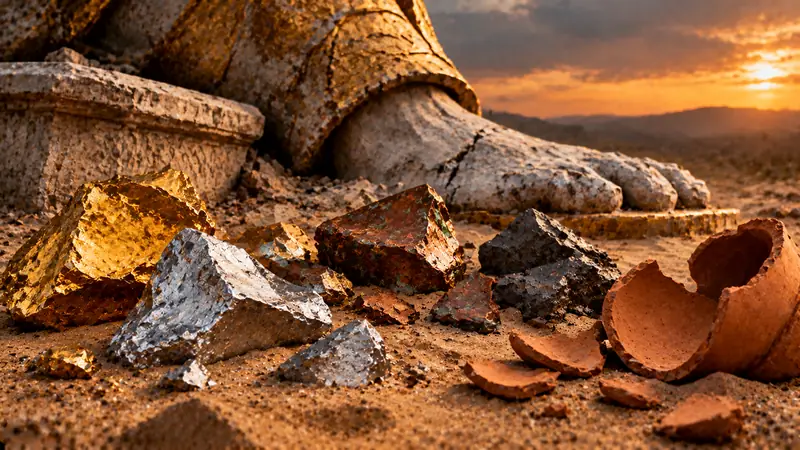
This chapter gave English one of its most useful phrases. When we say a person has feet of clay, we mean an admired figure has a hidden weakness that will bring them down — and the image comes from here, from the bottom of a statue in a Babylonian king's dream.
The phrase has outlived most of the empires the chapter is about, which is roughly the point it was making.
Our main source throughout is the Bible. Scripture here is quoted from the King James Version.
The story
Nebuchadnezzar has a dream that disturbs him badly, and he does something unreasonable: he summons his wise men and demands that they tell him both the dream and its meaning, without his telling them what he saw.
They protest that no one on earth can do that. He orders all of them executed, which includes Daniel and his three friends, who were part of the same corps of trained advisers.
Daniel asks for time, gathers his friends, and they pray. The secret is revealed to him at night, and his first response is not to go to the king:
Daniel answered and said, Blessed be the name of God for ever and ever: for wisdom and might are his: And he changeth the times and the seasons: he removeth kings, and setteth up kings: he giveth wisdom unto the wise, and knowledge to them that know understanding.
Daniel 2:20-21
He worships before he reports. And notice the content of the prayer: God changes times and seasons, removes kings and sets up kings. That sentence is the interpretation of the dream, prayed before the dream is explained.
Then, standing in front of the most powerful man alive, Daniel is careful about credit:
Daniel answered in the presence of the king, and said, The secret which the king hath demanded cannot the wise men, the astrologers, the magicians, the soothsayers, shew unto the king; But there is a God in heaven that revealeth secrets, and maketh known to the king Nebuchadnezzar what shall be in the latter days. Thy dream, and the visions of thy head upon thy bed, are these.
Daniel 2:27-28
Cannot the wise men… but there is a God in heaven. He first says plainly that no human expertise can do this, including his own.
The dream: the statue
A great image, immense and terrifying, made of five materials from top to bottom:
- Head — fine gold
- Breast and arms — silver
- Belly and thighs — brass
- Legs — iron
- Feet — part iron, part clay
Then a stone, cut out without hands, strikes the feet. The whole statue breaks and the pieces are blown away like chaff. And the stone becomes a great mountain filling the earth.
Two patterns in the materials matter.
They decrease in value going down: gold, silver, brass, iron, then iron mixed with fired clay.
They increase in hardness until the end: gold is soft, iron is hard — but the feet are iron mixed with a material that does not bind to it. The strongest-looking part of the statue is the part that cannot hold together.
Advertisement
Daniel's interpretation
Daniel tells the king directly that he is the head of gold (Daniel 2:38), and that after him will come a lesser kingdom, then a third of brass that will rule the whole earth, then a fourth as strong as iron, which will be divided and partly brittle.
And then:
And in the days of these kings shall the God of heaven set up a kingdom, which shall never be destroyed: and the kingdom shall not be left to other people, but it shall break in pieces and consume all these kingdoms, and it shall stand for ever.
Daniel 2:44
In the days of these kings — while the divided state is in place — God sets up a kingdom that is never destroyed and never handed to anyone else.
Which four kingdoms?
Christian and Jewish interpreters have offered two main schemes, and both are held by serious readers.
The traditional Christian reading: Babylon, Medo-Persia, Greece, Rome. The grounds are that Daniel 5 shows Babylon falling to the Medes and Persians, Daniel 8 explicitly names Greece, and the fourth is left unnamed but matches Rome's description — and the eternal kingdom arriving in the days of the fourth fits the birth of Christ under Roman rule.
The alternative reading: Babylon, Media, Persia, Greece, with the divided feet as the successor kingdoms after Alexander. The grounds are that Daniel elsewhere seems to distinguish Media from Persia, and that the detailed material in Daniel 11 corresponds closely to the Greek period.
What the text itself fixes: only the first. Daniel names Babylon and leaves the rest unnamed. Any scheme beyond that is inference, and the honest position is to say which parts are stated and which are reconstructed.
And note what the chapter is doing either way. It is telling a king at the height of his power that his empire is a segment of a sequence and that the sequence ends. The identification of the middle kingdoms is less important than the shape: empires come in order, they decline in value, and they end.
Advertisement
The stone cut without hands
The detail is in the phrase: without hands. Not quarried, not carved, not built. Whatever this kingdom is, it is not manufactured.
Three features of the stone are worth holding:
It arrives from outside. It is not the next material in the sequence, and it is not made of the statue.
It strikes the feet. The point of contact is the weakest part — the divided, brittle base, not the golden head.
It grows. It becomes a great mountain and fills the whole earth, which means this kingdom is not merely final but expanding.
Christian readers have consistently identified the stone with the kingdom of God established in Christ, and the New Testament uses stone imagery for him repeatedly — the stone the builders rejected (Matthew 21:42), and a stone of stumbling (1 Peter 2:8). Whether the growth is the present spread of the kingdom or its final establishment, or both, is where readings diverge.
The king's reaction
He falls on his face before Daniel, acknowledges Daniel's God as a revealer of secrets, and promotes him to rule over the province of Babylon.
And then, in the very next chapter, he builds an enormous golden image and commands everyone to worship it.
That sequence is not an accident of editing. A man is told that he is the head of gold and that his kingdom will end — and he responds by building a statue entirely of gold. He accepted the compliment and ignored the warning, which is a recognisable way of hearing a hard truth.
Daniel 2 and Daniel 7
The same material, from two points of view.
Daniel 2 is a pagan king's dream, and the empires appear as a statue: valuable, impressive, monumental.
Daniel 7 is Daniel's own vision of the same sequence, and the empires appear as wild beasts coming out of a churning sea: predatory and frightening.
The difference is the vantage point. From the throne, empire looks like gold. From underneath, it looks like a beast. Both chapters end the same way — with a kingdom given by God that does not pass.
Lord, the powers around me look permanent. Remind me which kingdom is actually not going to end.
Prayer
What the dream teaches
God tells a hostile king the truth, through a captive. Daniel is a deported teenager turned civil servant, and the channel of revelation runs through him rather than through the empire's own experts.
Credit is given away immediately. Cannot the wise men… but there is a God in heaven. Daniel had every incentive to take the win and did not.
Empires are a sequence, not a destination. The materials decline, and the strongest-looking part is the one that will not hold.
The decisive kingdom is not built. Cut without hands, arriving from outside, and growing rather than finished.
Being told the truth is not the same as receiving it. Chapter 3 follows chapter 2.
Father, you change times and seasons, you remove kings and set up kings. Keep me from putting my weight on anything with feet of clay. Let me belong to the kingdom that will never be destroyed. In Jesus' name, amen.
Prayer
Questions for reflection or small group
- What in your own life looks like iron and is actually mixed with clay?
- Daniel worships before he reports. What does that order suggest?
- The king accepted the compliment and ignored the warning. Where do you do that?
- Why does the same sequence look like a statue to a king and like beasts to a prophet?
What does the statue in Nebuchadnezzar's dream mean?
A sequence of kingdoms, from the head of gold down to feet of iron mixed with clay, declining in value and ending in division. A stone cut without hands strikes the feet, destroys the statue and becomes a mountain filling the earth — the kingdom God sets up, which is never destroyed (Daniel 2:44).
What are the four kingdoms of Daniel 2?
Daniel names only the first: Nebuchadnezzar himself, as the head of gold. The traditional Christian reading takes the rest as Medo-Persia, Greece and Rome; an alternative reading takes them as Media, Persia and Greece. The rest is inference, not statement.
What is the stone cut without hands?
A kingdom that is not manufactured — it arrives from outside the sequence, strikes the statue at its weakest point, and grows into a mountain filling the earth. Christian readers identify it with the kingdom of God established in Christ.
What do the feet of iron and clay mean?
A divided and brittle final stage: the strongest material mixed with one that will not bind to it. The English phrase feet of clay, meaning a hidden weakness in an admired figure, comes from this passage.
How are Daniel 2 and Daniel 7 related?
They cover the same sequence from two viewpoints. In Daniel 2 a pagan king sees empires as a magnificent statue; in Daniel 7 Daniel sees them as wild beasts rising from the sea. Both end with an everlasting kingdom given by God.
If you want to go deeper into the prophetic books with a guide, the ebook Vida de Oración (in Spanish) goes deeper into this subject.
Sources
- The Holy Bible, King James Version. Primary source for this article: every biblical quotation comes from it, and the other sources serve only to show where each Christian tradition put its reading of the text in writing.
- eBible.org. The Holy Bible, King James Version.
Consulted on November 15, 2026.
Free
Read the whole Bible in one year
Download the plan as a PDF: 365 days, Old and New Testament side by side, so you can start today — not on January 1st.
One study a week, nothing else. One click to leave. Privacy policy
Done. Your plan is here: Download the PDF
I couldn’t register that right now. Please try again in a moment.

Vagner Soares is a presbyter with pastoral ordination, a mentor and a digital entrepreneur with more than 10 years of experience in technology, digital marketing and education.
Keep reading
 ProphecyDaniel 7: the four beasts and the Son of manDaniel 7 explained: the lion, bear, leopard and fourth beast, the little horn, the court of the Ancient of days, and the kingdom given to the Son of man.Read the article
 Bible studyDaniel in the lions' den: the story and its lessons of faithDaniel in the lions' den (Daniel 6) step by step: the context, who Darius was, how the trap was set and what the story teaches about faith today.Read the article
 ProphecyRevelation: a summary of the book block by blockA summary of Revelation in seven blocks: the letters, the throne, the seals, the trumpets, the dragon and the beasts, Babylon's fall and the new creation.Read the article