
The armour of God: the six pieces of Ephesians 6 explained
The context of Ephesians 6:10-18, who the enemy is and who it is not, what each of the six pieces meant to a first-century reader, the place of prayer, and how to put it on in an ordinary week.
In this article
Two things are usually missed about this passage, and both change how it reads.
The first: it is the end of a letter about unity. Five and a half chapters on Jews and Gentiles made one people, on bearing with one another, on households — and then the armour. Whatever the battle is, Paul has just spent the whole letter describing what is under attack.
The second: Paul was chained to a Roman soldier while writing it. The illustration was not chosen from a book. It was sitting next to him.
Our main source throughout is the Bible. Scripture here is quoted from the King James Version.
The command before the kit
Finally, my brethren, be strong in the Lord, and in the power of his might. Put on the whole armour of God, that ye may be able to stand against the wiles of the devil.
Ephesians 6:10-11
Note the order. Be strong in the Lord comes before put on. The strength is borrowed, not generated; the armour is God's, not the believer's own.
And note the purpose given: that ye may be able to stand. Not to advance, conquer or clear territory. The verb stand appears four times in the passage. This is defensive language about holding ground already given.
*On wiles:* the KJV word translates a Greek term meaning scheming or method. Paul assumes the opposition works by strategy rather than by force — which is why the response is not strength but armour.
Who the enemy is, and who it is not
For we wrestle not against flesh and blood, but against principalities, against powers, against the rulers of the darkness of this world, against spiritual wickedness in high places.
Ephesians 6:12
The first half of that verse is the part that gets skipped. We wrestle not against flesh and blood.
Written to a congregation where Jewish and Gentile believers had reason to resent each other, with household instructions immediately preceding, this is pointed. The person across the aisle is not the enemy. Neither is the family member, the colleague, or the other wing of the church.
This single clause, taken seriously, would defuse a great deal of what Christians currently treat as spiritual warfare.
On the four terms. Principalities, powers, rulers of the darkness of this world, spiritual wickedness in high places. Paul does not define them and no attempt here will improve on his reticence. What the list does is establish scale — the opposition is organised and above the level of individual malice.
And the limits are worth stating. The passage gives no technique, no formula, no words of power. Paul's instruction is to be clothed and to stand, which is a notably modest set of expectations compared with much that gets built on this text.
Advertisement
The six pieces
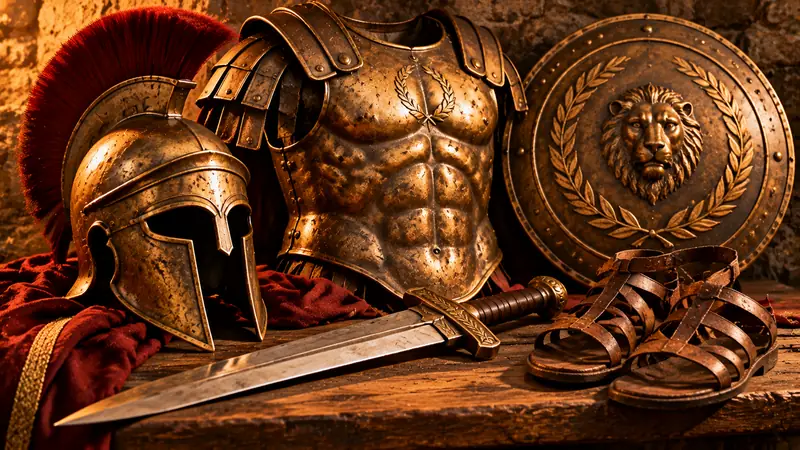
Stand therefore, having your loins girt about with truth, and having on the breastplate of righteousness; And your feet shod with the preparation of the gospel of peace; Above all, taking the shield of faith, wherewith ye shall be able to quench all the fiery darts of the wicked. And take the helmet of salvation, and the sword of the Spirit, which is the word of God.
Ephesians 6:14-17
1. The belt of truth
The KJV says having your loins girt about with truth, which is archaic but precise. A Roman soldier's belt was the foundation of the kit: it held the tunic up so he could move, and the sword hung from it. Without the belt, nothing else worked.
Truth is placed first for that reason. Truth about God — his character as the letter has described it. Truth about yourself — honesty rather than performance. Truth in speech, which Paul has already commanded in 4:25.
In practice: where you are not being straight — with God, with yourself, with the people closest to you — nothing else holds.
2. The breastplate of righteousness
Covering the chest and vital organs. In Paul's thought, righteousness is primarily a status given in Christ (as in Philippians 3:9) and secondarily a way of living.
Both senses protect. Accusation is one of the enemy's standard methods, and a settled standing before God is what blunts it. Ephesians has already said it: by grace through faith, not of works (Ephesians 2:8-9).
In practice: when the accusation is you are not really a Christian, the answer is not a better week. It is the verdict already given.
3. The footwear of the gospel of peace
Roman military sandals were studded on the sole for grip. The point is not mobility but traction — the ability to hold position without slipping.
Note the content: the gospel of peace, in a passage about war. Paul has already called Christ our peace, who broke down the wall (Ephesians 2:14).
In practice: having something firm under you. A person who knows they are at peace with God does not have to be braced in every conversation.
4. The shield of faith
The KJV says above all, and the Greek more precisely means in addition to all — alongside the rest. The shield Paul describes is the large rectangular body shield, not a small round one, and it was designed to be locked together with the shields of the men beside you. A line of them formed a wall.
That is not an incidental detail in a letter about unity. Faith held individually still works; faith held alongside others works better, and Paul's whole letter has been about the one body.
In practice: the quenching of fiery darts — burning projectiles — is specific. Sudden doubt, sudden fear, the thought that arrives from nowhere. Faith is what absorbs it. And often what absorbs it is another Christian standing next to you.
5. The helmet of salvation
Protecting the head, which is where most attacks in the Christian life actually land: despair, cynicism, the slow conviction that none of it is true.
Paul uses the same image elsewhere as "the hope of salvation" (1 Thessalonians 5:8), which is useful — the helmet is forward-looking. It protects the mind by fixing it on an outcome already secured.
In practice: knowing how the story ends is what keeps the present from becoming the whole picture.
6. The sword of the Spirit
The only offensive item, and Paul defines it immediately: the word of God.
On the Greek: the word for sword here is the machaira, the short stabbing blade used in close combat, not the long cavalry sword. And the term Paul uses for word is not the broad logos but rhēma — a spoken utterance, a specific saying.
Put together, the image is precise: not the whole Bible swung about in general, but a particular word applied at close quarters. Which is exactly what Jesus does in the wilderness, answering each temptation with one specific text (Matthew 4:1-11).
In practice: this is the argument for memorising Scripture. A passage you have to look up is not in your hand when you need it.
Prayer: the atmosphere of the whole thing
Praying always with all prayer and supplication in the Spirit, and watching thereunto with all perseverance and supplication for all saints.
Ephesians 6:18
Is prayer the seventh piece? Grammatically, no — it is not described as armour. It is the activity in which all of it is done. Which makes it less like a piece of equipment and more like the air.
Note the four alls: all prayer, all perseverance, all saints, praying always. And note who it is for — all saints, other people. Paul then asks them to pray for him, specifically for boldness (Ephesians 6:19-20).
He is in prison awaiting trial and the thing he asks for is not release.
Lord, I am not strong, and the armour is yours. Clothe me, and let me stand today.
Prayer
Advertisement
Putting it on in an ordinary week
Not a ritual, and not a formula. A short morning review that takes two minutes:
- Belt: where am I not being straight today?
- Breastplate: what am I being accused of, and what is already settled about me?
- Shoes: am I at peace with God, or braced?
- Shield: what sudden fear needs catching — and who can stand next to me in it?
- Helmet: what am I thinking about that forgets the ending?
- Sword: which one verse do I need in my hand today, and do I know it by heart?
- Prayer: who am I praying for besides myself?
And one discipline that matters more than any of the above: when you are in conflict, ask whether you have forgotten verse 12. Most of what feels like a battle is a person. Paul says the person is not it.
Father, you have given me everything I need to stand, and I do not have to win ground you have already taken. Keep me from treating people as the enemy. Put a word in my mouth today and remind me to pray for someone other than myself. In Jesus' name, amen.
Prayer
Questions for reflection or small group
- The armour passage ends a letter about unity. What does that context change?
- Paul says stand, not advance. Why might that be the instruction?
- The shield was designed to lock together with others. Who stands next to you?
- Which single verse would you want in your hand this week, by memory?
What are the pieces of the armour of God?
Six: the belt of truth, the breastplate of righteousness, the footwear of the gospel of peace, the shield of faith, the helmet of salvation and the sword of the Spirit, which is the word of God (Ephesians 6:14-17).
What does it mean to put on the armour of God?
To be clothed in what God provides rather than relying on your own strength — Paul says be strong in the Lord before he says put on (Ephesians 6:10-11). The stated purpose is to be able to stand, which appears four times in the passage.
Which piece is the only offensive weapon?
The sword of the Spirit, which Paul defines as the word of God. The Greek term is the short close-combat blade, and the word for word means a specific utterance — a particular text applied at close range, as Jesus does in the wilderness.
Who is the fight in Ephesians 6 against?
Not people. Paul states it directly: we wrestle not against flesh and blood (Ephesians 6:12). In a letter about Jewish and Gentile believers becoming one body, that clause is the most practically important in the passage.
Is prayer part of the armour of God?
It is not listed as a piece, but it is the activity in which the whole passage happens — praying always, with all perseverance, for all saints (Ephesians 6:18). Paul then asks for prayer for himself, and asks for boldness rather than release.
If you want to go deeper into prayer as the ground of all of this, the ebook Las 13 Cartas de Pablo Explicadas Versículo por Versículo (in Spanish) goes deeper into this subject.
Sources
- The Holy Bible, King James Version. Primary source for this article: every biblical quotation comes from it, and the other sources serve only to show where each Christian tradition put its reading of the text in writing.
- eBible.org. The Holy Bible, King James Version.
Consulted on November 15, 2026.
Free
Read the whole Bible in one year
Download the plan as a PDF: 365 days, Old and New Testament side by side, so you can start today — not on January 1st.
One study a week, nothing else. One click to leave. Privacy policy
Done. Your plan is here: Download the PDF
I couldn’t register that right now. Please try again in a moment.
Vagner Soares is a presbyter with pastoral ordination, a mentor and a digital entrepreneur with more than 10 years of experience in technology, digital marketing and education.
Keep reading
 Bible studyEphesians: a study guide, summary and applicationA study of Ephesians: what we are in Christ and how to live it. The two-part structure, the key verses, and a ready plan for six group sessions.Read the article
 PrayerHow to pray: a simple guide to starting today, without formulasHow to pray step by step, with the pattern Jesus taught, what to say when no words come, how long to pray and what to do when your mind wanders.Read the article
 Bible studyWho is the Holy Spirit: what the Bible teaches about himWho the Holy Spirit is: a divine person, not a force. What he does in the Old and New Testaments, in conversion, and in everyday Christian life.Read the article