
The life of Moses: from the Nile to Mount Nebo, in order
The story of Moses told in order and split into three blocks of forty years, with the burning bush, the exodus, Sinai, the mistake that cost him the promised land, and what his life teaches now.
In this article
- The setting: a king who knew not Joseph
- First forty years: the prince
- Second forty years: the shepherd
- The bush
- The plagues and the Passover
- The sea
- Forty years in the wilderness
- Who Moses was on the inside
- The mistake that cost him the land
- Mount Nebo
- Moses and Jesus
- Lessons for today
- A prayer
- Questions for reflection or small group
- Sources
The life of Moses divides itself into three blocks of forty years: forty in Egypt as a prince, forty in Midian as a shepherd, forty in the wilderness as a leader. Stephen tells it exactly that way in Acts 7.
The detail that surprises most is the middle one. The man God used to bring a whole nation out of Egypt spent forty years minding somebody else's sheep, with nothing happening.
Our main source is the Bible itself. The wording here is the King James Version, as it stands.
The setting: a king who knew not Joseph
Now there arose up a new king over Egypt, which knew not Joseph.
Exodus 1:8
Centuries pass between the end of Genesis and the start of Exodus. Jacob's descendants multiplied, the new power saw them as a threat and enslaved them. Then came the order:
And Pharaoh charged all his people, saying, Every son that is born ye shall cast into the river, and every daughter ye shall save alive.
Exodus 1:22
That is when Moses is born.
First forty years: the prince
His mother hid him three months, and when she could no longer:
And when she could not longer hide him, she took for him an ark of bulrushes, and daubed it with slime and with pitch, and put the child therein; and she laid it in the flags by the river's brink.
Exodus 2:3
The word the KJV uses for the basket is ark — the same word used for Noah's. Both are pitched vessels that carry a life safely over water.
Pharaoh's daughter rescues and raises him:
And the child grew, and she brought him unto Pharaoh's daughter, and he became her son. And she called his name Moses: and she said, Because I drew him out of the water.
Exodus 2:10
He grew up in the court: "Moses was learned in all the wisdom of the Egyptians, and was mighty in words and in deeds" (Acts 7:22). And at forty he made a choice:
By faith Moses, when he was come to years, refused to be called the son of Pharaoh's daughter; Choosing rather to suffer affliction with the people of God, than to enjoy the pleasures of sin for a season; Esteeming the reproach of Christ greater riches than the treasures in Egypt: for he had respect unto the recompence of the reward.
Hebrews 11:24-26
He went out to his brethren, saw an Egyptian beating a Hebrew, killed him and buried him in the sand. The next day it was known, and he fled.
Advertisement
Second forty years: the shepherd
In Midian he defended some women at a well, and their father took him in:
And Moses was content to dwell with the man: and he gave Moses Zipporah his daughter.
Exodus 2:21
Forty years of silence. The text records almost nothing of that stretch. It is the long, signless section that hardly ever makes the summaries of his life.
Lord, teach me to trust you in the years when nothing visible happens.
Prayer
The bush
And the angel of the Lord appeared unto him in a flame of fire out of the midst of a bush: and he looked, and, behold, the bush burned with fire, and the bush was not consumed.
Exodus 3:2
What catches Moses' attention is not the fire but that the bush is not consumed. He turns aside to look, and then God speaks:
And he said, Draw not nigh hither: put off thy shoes from off thy feet, for the place whereon thou standest is holy ground.
Exodus 3:5
And the commission comes:
Come now therefore, and I will send thee unto Pharaoh, that thou mayest bring forth my people the children of Israel out of Egypt.
Exodus 3:10
Moses answers with five objections in a row, and they are worth seeing because they are anyone's: who am I, what do I tell them, they will not believe me, I cannot speak, and finally just send somebody else.
On the fourth:
And Moses said unto the Lord, O my Lord, I am not eloquent, neither heretofore, nor since thou hast spoken unto thy servant: but I am slow of speech, and of a slow tongue.
Exodus 4:10
Slow of speech, and of a slow tongue. The great spokesman of the Old Testament started by saying he could not talk. God's answer was not to make him eloquent: "go, and I will be with thy mouth, and teach thee what thou shalt say" (Exodus 4:12).
And in the middle of that conversation comes the name:
And God said unto Moses, I Am That I Am: and he said, Thus shalt thou say unto the children of Israel, I Am hath sent me unto you.
Exodus 3:14
Advertisement
The plagues and the Passover
Moses and Aaron stand before Pharaoh with a short message: "Thus saith the Lord God of Israel, Let my people go" (Exodus 5:1). The answer is heavier work for the slaves.
The ten plagues follow, and each strikes at an Egyptian god: the Nile, the sun, the livestock. They are not random punishments: they are a demonstration of who is in charge.
The last one brings the Passover:
And the blood shall be to you for a token upon the houses where ye are: and when I see the blood, I will pass over you, and the plague shall not be upon you to destroy you, when I smite the land of Egypt.
Exodus 12:13
The blood on the door is the sign. Paul picks the image up in one line: "Christ our passover is sacrificed for us" (1 Corinthians 5:7).
The sea
Pursued and cornered, the people panic. Moses answers:
And Moses said unto the people, Fear ye not, stand still, and see the salvation of the Lord, which he will shew to you to day: for the Egyptians whom ye have seen to day, ye shall see them again no more for ever. The Lord shall fight for you, and ye shall hold your peace.
Exodus 14:13-14
Stand still. It is the only thing he asks them to do.
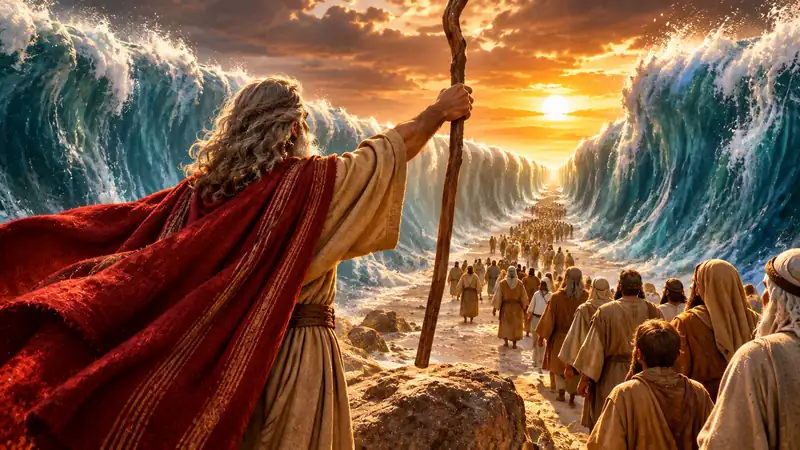
And Moses stretched out his hand over the sea; and the Lord caused the sea to go back by a strong east wind all that night, and made the sea dry land, and the waters were divided.
Exodus 14:21
The text names the means: a strong east wind all that night. A miracle is no less a miracle for having a how.
Forty years in the wilderness
Along the way come the manna — "I will rain bread from heaven for you; and the people shall go out and gather a certain rate every day, that I may prove them" (Exodus 16:4) — and the water from the rock (Exodus 17:6).
And so does the best management advice in the Bible, given by a father-in-law:
And Moses' father in law said unto him, The thing that thou doest is not good. Thou wilt surely wear away, both thou, and this people that is with thee: for this thing is too heavy for thee; thou art not able to perform it thyself alone.
Exodus 18:17-18
Jethro tells him flatly: the thing that thou doest is not good. Moses was judging the entire nation alone, morning to night. The fix was delegating to "able men, such as fear God, men of truth, hating covetousness" (Exodus 18:21).
At Sinai the law arrives, and it opens with rescue rather than demand:
I am the Lord thy God, which have brought thee out of the land of Egypt, out of the house of bondage. Thou shalt have no other gods before me.
Exodus 20:2-3
First I brought thee out, then thou shalt have no. The order is theology, not grammar.
Who Moses was on the inside
Two verses say more than any summary.
The first, after the golden calf, when God offers to destroy the nation and start again with him:
Yet now, if thou wilt forgive their sin--; and if not, blot me, I pray thee, out of thy book which thou hast written.
Exodus 32:32
He would rather be blotted out than saved alone.
The second:
(Now the man Moses was very meek, above all the men which were upon the face of the earth.)
Numbers 12:3
Very meek, above all the men which were upon the face of the earth. The same man who killed an Egyptian and smashed the stone tablets.
And the relationship he had: "the Lord spake unto Moses face to face, as a man speaketh unto his friend" (Exodus 33:11). In one of those conversations, God describes himself: "The Lord, The Lord God, merciful and gracious, longsuffering, and abundant in goodness and truth" (Exodus 34:6).
The mistake that cost him the land
At Kadesh the people demand water again. The instruction is precise:
Take the rod, and gather thou the assembly together, thou, and Aaron thy brother, and speak ye unto the rock before their eyes; and it shall give forth his water, and thou shalt bring forth to them water out of the rock: so thou shalt give the congregation and their beasts drink.
Numbers 20:8
Speak ye unto the rock. Moses, furious, strikes it twice with the rod. The water comes anyway, but:
And the Lord spake unto Moses and Aaron, Because ye believed me not, to sanctify me in the eyes of the children of Israel, therefore ye shall not bring this congregation into the land which I have given them.
Numbers 20:12
It is one of the hardest pages in the Old Testament. Forty years of service, and the promised land stays on the other side.
Context note: the text does not present this as a petty God punishing a technicality. It states the reason: because ye believed me not, to sanctify me in the eyes of the children of Israel. The issue was misrepresenting God in front of the people, in the role of the man who spoke for him.
Mount Nebo
And Moses went up from the plains of Moab unto the mountain of Nebo, to the top of Pisgah, that is over against Jericho. And the Lord shewed him all the land of Gilead, unto Dan.
Deuteronomy 34:1
God shows him the whole land from the summit. And then:
So Moses the servant of the Lord died there in the land of Moab, according to the word of the Lord. And he buried him in a valley in the land of Moab, over against Bethpeor: but no man knoweth of his sepulchre unto this day.
Deuteronomy 34:5-6
Nobody knows where his grave is. And the epitaph the text gives him:
And there arose not a prophet since in Israel like unto Moses, whom the Lord knew face to face.
Deuteronomy 34:10
At a hundred and twenty, "his eye was not dim, nor his natural force abated" (Deuteronomy 34:7).
Moses and Jesus
Moses himself announced someone else:
The Lord thy God will raise up unto thee a Prophet from the midst of thee, of thy brethren, like unto me; unto him ye shall hearken.
Deuteronomy 18:15
Peter quotes that verse and applies it to Jesus (Acts 3:22). And there are more direct connections:
- The bronze serpent lifted up in the wilderness (Numbers 21:8-9) is the image Jesus uses of himself: "as Moses lifted up the serpent in the wilderness, even so must the Son of man be lifted up" (John 3:14).
- The greatest commandment Jesus quotes is from Moses: "Hear, O Israel: The Lord our God is one Lord" (Deuteronomy 6:4-5, quoted in Mark 12:29-30).
- John sums up the difference: "the law was given by Moses, but grace and truth came by Jesus Christ" (John 1:17).
- Hebrews sharpens it: Moses was faithful "as a servant," and Christ "as a son over his own house" (Hebrews 3:5-6).
And in the end, the man who did not enter the land is standing in it, on the mount of transfiguration:
And, behold, there appeared unto them Moses and Elias talking with him.
Matthew 17:3
Luke adds what they were talking about: "spake of his decease which he should accomplish at Jerusalem" (Luke 9:31). The Greek word behind decease is exodus.
Lessons for today
1. The years with no signs count. Forty of them, minding sheep.
2. God does not wait for you to be capable. I will be with thy mouth.
3. Leading alone destroys the leader and the people. Jethro was right.
4. Obedience includes the how. Speaking to the rock was not the same as striking it.
5. You can finish well without seeing the result. Moses saw the land from a distance, and the New Testament shows him standing inside it.
A prayer
Lord, give me faithfulness in the years when nothing happens and humility to accept help when the weight is too much. Teach me to obey in the manner and not only in the outcome. And if I do not get to see what I hoped for, give me Moses' peace on Nebo. In Jesus' name, amen.
Prayer
Questions for reflection or small group
- Which part of your life is your Midian?
- What excuse of yours sounds like one of Moses' five?
- Is there something you are carrying alone, as Moses was before Jethro?
- What would it mean for you to finish well without seeing the result?
How long did Moses live?
A hundred and twenty years, in three blocks of forty: Egypt, Midian and the wilderness. He died with his sight and strength intact (Deuteronomy 34:7).
Why did Moses not enter the promised land?
Because he struck the rock instead of speaking to it, as God had commanded. The reason the text gives is that he did not sanctify God before the people (Numbers 20:8-12).
What does I AM THAT I AM mean?
It is God's answer when Moses asks his name at the bush (Exodus 3:14). It points to self-existence and permanence: God is not defined by anything outside himself.
Where is Moses buried?
Nobody knows. The text says God buried him in a valley in Moab, "but no man knoweth of his sepulchre unto this day" (Deuteronomy 34:6).
Does Moses appear in the New Testament?
Yes. On the mount of transfiguration alongside Elijah (Matthew 17:3), speaking with Jesus about his decease at Jerusalem (Luke 9:31). And his prophecy in Deuteronomy 18:15 is applied to Jesus in Acts 3:22.
If you want a full overview of the Old Testament, the ebook Las 13 Cartas de Pablo Explicadas Versículo por Versículo (in Spanish) goes deeper into this subject.
Sources
- The Holy Bible, King James Version. Primary source for this article: every biblical quotation comes from it, and the other sources serve only to show where each Christian tradition put its reading of the text in writing.
- eBible.org. The Holy Bible, King James Version.
- BibleProject. Hebrews (video).
Consulted on November 15, 2026.
Free
Read the whole Bible in one year
Download the plan as a PDF: 365 days, Old and New Testament side by side, so you can start today — not on January 1st.
One study a week, nothing else. One click to leave. Privacy policy
Done. Your plan is here: Download the PDF
I couldn’t register that right now. Please try again in a moment.

Vagner Soares is a presbyter with pastoral ordination, a mentor and a digital entrepreneur with more than 10 years of experience in technology, digital marketing and education.
Keep reading
 Bible studyJoseph in Egypt: the full story and what it teachesThe story of Joseph in order: the coat, the pit, Potiphar's house, prison, Pharaoh's dreams, the reunion with his brothers and the forgiveness at the end.Read the article
 Bible studyThe prophet Elijah: his life, his miracles and what he teaches nowThe life of Elijah in order: the brook Cherith, the widow of Zarephath, Mount Carmel, the still small voice, Elisha and the chariot of fire.Read the article
 Bible studyDaniel in the lions' den: the story and its lessons of faithDaniel in the lions' den (Daniel 6) step by step: the context, who Darius was, how the trap was set and what the story teaches about faith today.Read the article