
The seven seals of Revelation: what they are and what they mean
The setting of Revelation 5 to 8, why only the Lamb can open the scroll, what each of the seven seals contains, the pause in chapter 7 and what this vision says to Christians under pressure.
In this article
One word in the King James Version sends English readers down the wrong track from the start.
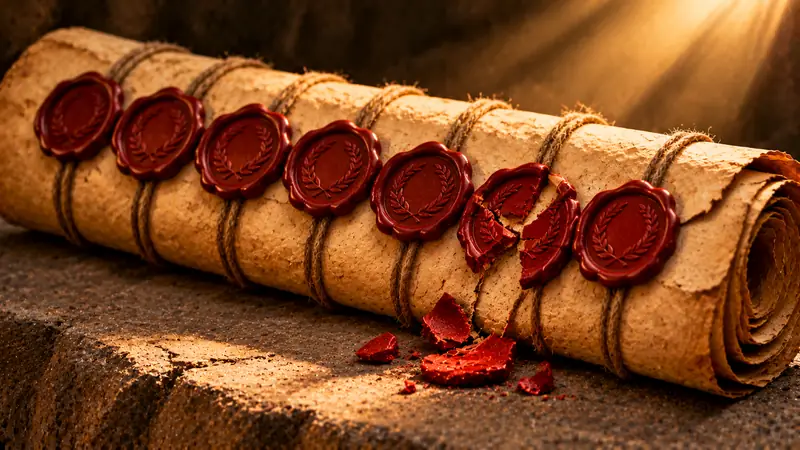
The KJV calls the sealed object a book. Picture a bound volume with seven seals on the cover and the image makes very little sense. The Greek word is biblion, and in the first century that meant a scroll — a rolled document, sealed along the outer edge, which has to be unrolled progressively as each seal is broken.
That single correction makes the whole sequence coherent. Seven seals are not seven locks on one lid. They are seven stages of unrolling, and the contents are revealed as the scroll opens.
Our main source throughout is the Bible. Scripture here is quoted from the King James Version.
The scroll nobody could open
In Revelation 4 John sees a throne. In chapter 5 he sees a scroll in the right hand of the one seated on it, sealed with seven seals, and a challenge goes out for someone worthy to open it. Nobody responds — not in heaven, not on earth, not under the earth. John weeps.
And one of the elders saith unto me, Weep not: behold, the Lion of the tribe of Judah, the Root of David, hath prevailed to open the book, and to loose the seven seals thereof.
Revelation 5:5
Then comes the turn that governs the rest of the book. He is told to look for a Lion. What he actually sees, in the next verse, is a Lamb standing as though it had been slain.
The elder announces strength and John is shown slaughter. Whatever Revelation means by power, it is defined here, and the definition is given before a single seal is broken.
And they sung a new song, saying, Thou art worthy to take the book, and to open the seals thereof: for thou wast slain, and hast redeemed us to God by thy blood out of every kindred, and tongue, and people, and nation.
Revelation 5:9
The reason he is worthy is stated plainly: thou wast slain, and hast redeemed us. Not that he is strongest. That he was killed, and bought people out of every tribe and language.
The first four seals: the horsemen
The first four seals form a set, each introduced by one of the four living creatures saying come.
- First seal — a white horse, a rider with a bow and a crown, going out to conquer.
- Second seal — a red horse, and power given to take peace from the earth.
- Third seal — a black horse, a rider with scales, and prices called out for wheat and barley: the language of rationing.
- Fourth seal — a pale horse, whose rider is named Death, with authority over a fourth part of the earth.
Conquest, war, famine, death — in that order, which is the order these things actually arrive in history. The detail worth holding is the limit: a fourth part. The scale is restricted from the outset.
A note on the first rider: Christian readers have long divided over whether he represents Christ or a counterfeit of him, since a white horse and a crown appear later in the book for very different figures. The text does not settle it, and a confident answer here is going beyond what is written.
Advertisement
The fifth seal: the cry of the martyrs
And they cried with a loud voice, saying, How long, O Lord, holy and true, dost thou not judge and avenge our blood on them that dwell on the earth?
Revelation 6:10
This is the most human moment in the book. Those already killed for the word of God ask a question that is not patient, not polite and not resolved: how long?
Two things follow, and both matter.
They are not rebuked. The complaint stands in the text as a legitimate thing to say to God, in the same tradition as the psalms that ask the same question.
And they are not answered either. They are given white robes and told to rest a little longer, until the number is complete. That is not an explanation. It is an acknowledgement with no timetable attached.
For anyone praying how long about something now, the fifth seal is the part of Revelation that belongs to them.
The sixth seal: the world comes apart
An earthquake, the sun darkened, the moon like blood, stars falling, the sky rolled back. Then kings, commanders, the rich, the powerful and the enslaved alike hiding in caves — the list deliberately includes every social rank.
For the great day of his wrath is come; and who shall be able to stand?
Revelation 6:17
The chapter ends on a question, not a statement: who shall be able to stand? And then the narrative stops.
Advertisement
The pause in chapter 7: the answer
Chapter 7 is an interruption between the sixth seal and the seventh, and it exists to answer the question chapter 6 just asked.
First, the sealing of 144,000 from the tribes of Israel — a mark of protection placed on God's servants before the next stage.
On the 144,000: the number is 12,000 from each of twelve tribes, and the tribal list in Revelation 7 is irregular — Dan is missing, and Manasseh appears alongside Joseph. Readers divide over whether the figure is literal or symbolic, and over whether it refers to Jewish believers or to the whole church under a symbolic census. What the text does say is why they are sealed: they are marked as belonging to God before the trouble proceeds.
Then John sees something he is not able to count:
After this I beheld, and, lo, a great multitude, which no man could number, of all nations, and kindreds, and people, and tongues, stood before the throne, and before the Lamb, clothed with white robes, and palms in their hands; And cried with a loud voice, saying, Salvation to our God which sitteth upon the throne, and unto the Lamb.
Revelation 7:9-10
Note the contrast. The 144,000 are numbered precisely. The multitude that follows is explicitly innumerable, drawn from all nations, kindreds, people and tongues. Whatever the first group means, the second answers who shall be able to stand with a crowd too large to count.
And the chapter closes with the gentlest verse in the book:
For the Lamb which is in the midst of the throne shall feed them, and shall lead them unto living fountains of waters: and God shall wipe away all tears from their eyes.
Revelation 7:17
The Lamb who was slain becomes the shepherd, and the hand that wipes away tears is God's own.
The seventh seal: silence
And when he had opened the seventh seal, there was silence in heaven about the space of half an hour.
Revelation 8:1
After six seals of upheaval, the seventh brings nothing. Silence in heaven, for about half an hour — in a book that has been continuously loud with worship since chapter 4.
What the silence means is not stated. The most common readings are that it is the pause before judgment, or that it is heaven waiting while the prayers of the saints are brought forward, since that is what happens in the next verses. Either way, the loudest thing in this chapter is the absence of sound.
Lord, when I cannot see what you are doing, remind me who is holding the scroll.
Prayer
When do the seals happen?
This is where interpretive frameworks do the work, and it is worth naming them rather than presenting one as obvious.
Preterist — the seals describe the first century: Roman conquest, war, the famines recorded in that period, and the persecution the churches were under as John wrote.
Historicist — they unfold across church history in sequence.
Futurist — they describe a period of tribulation still to come, which is the most common reading in popular English-language teaching.
Idealist — they describe the recurring pattern of history in every age: conquest, war, scarcity, death, the suffering of God's people, and upheaval.
What is not in dispute from the text itself: the seals are opened by the Lamb, their scale is limited, the martyrs' question is unanswered rather than dismissed, and the sequence ends with a crowd nobody can number. Any reading that keeps those four features is working with the text; any reading that needs you to ignore one of them is not.
What the seals teach
History is being unrolled, not spilled. The scroll is opened by someone, in order, with limits stated. That is the structural claim of the whole passage.
The one who opens it was killed. The qualification for authority over history, in this book, is having been slain.
*Asking how long is allowed.* The martyrs do it from under the altar and are not corrected.
God does not always answer the timing question. They are told to wait a little longer. That is the answer given, and it is thin on purpose.
The end of the sequence is a crowd, not a remnant. Innumerable, from every nation. Chapter 6 asks who can stand; chapter 7 shows more than can be counted.
Father, you hold the scroll and the Lamb opens it. When I ask how long and hear nothing, let me keep asking rather than stop trusting. Thank you that the end of this is a crowd too large to count, and your own hand wiping the tears. In Jesus' name, amen.
Prayer
Questions for reflection or small group
- Does reading scroll instead of book change the picture for you?
- John is told to look for a Lion and shown a Lamb. What does that do to how you read the rest?
- The martyrs ask how long and get no date. What are you asking that about?
- Why do you think the seventh seal is silence?
What are the seven seals of Revelation?
Seven stages in the opening of a sealed scroll in Revelation 5 to 8. The first four release the horsemen — conquest, war, famine and death. The fifth shows the martyrs crying how long. The sixth brings cosmic upheaval. The seventh brings silence in heaven.
Who opens the seven seals?
The Lamb. Nobody in heaven or on earth was found worthy, and John wept until he was told that the Lion of the tribe of Judah had prevailed — and then shown a Lamb standing as though slain. The stated reason he is worthy is that he was killed and redeemed people out of every nation (Revelation 5:9).
What happens at the seventh seal?
Silence in heaven for about the space of half an hour (Revelation 8:1), after six seals of upheaval. The text does not explain it; the common readings are a pause before judgment, or heaven waiting as the prayers of the saints are brought forward.
Who are the 144,000?
Twelve thousand from each of twelve tribes, sealed as God's servants before the next stage of judgment (Revelation 7:4-8). The tribal list is irregular, and readers differ over whether the number is literal or symbolic and whether it refers to Jewish believers or the whole church. The text states only why they are sealed.
Have the seven seals already been opened?
Christians differ, and the answer depends on the interpretive framework — preterist, historicist, futurist or idealist. What the text itself establishes is that the Lamb opens them, their scale is limited, and the sequence ends with a multitude no one can number.
If you want to go deeper into the prophetic books with a guide, the ebook Vida de Oración (in Spanish) goes deeper into this subject.
Sources
- The Holy Bible, King James Version. Primary source for this article: every biblical quotation comes from it, and the other sources serve only to show where each Christian tradition put its reading of the text in writing.
- eBible.org. The Holy Bible, King James Version.
Consulted on November 15, 2026.
Free
Read the whole Bible in one year
Download the plan as a PDF: 365 days, Old and New Testament side by side, so you can start today — not on January 1st.
One study a week, nothing else. One click to leave. Privacy policy
Done. Your plan is here: Download the PDF
I couldn’t register that right now. Please try again in a moment.

Vagner Soares is a presbyter with pastoral ordination, a mentor and a digital entrepreneur with more than 10 years of experience in technology, digital marketing and education.
Keep reading
 ProphecyRevelation: a summary of the book block by blockA summary of Revelation in seven blocks: the letters, the throne, the seals, the trumpets, the dragon and the beasts, Babylon's fall and the new creation.Read the article
 ProphecyThe four horsemen of the Apocalypse: who they are and what they meanThe four horsemen of the Apocalypse explained: the white, red, black and pale horses, what each represents, where the image comes from and the debate over the first.Read the article
 ProphecyThe seven trumpets of Revelation: what each one meansThe seven trumpets of Revelation explained: the partial judgments of chapters 8 to 11, the link with the plagues of Egypt, and the kingdom announced at the seventh.Read the article