
Bible stories for children: which ones to tell and how to tell them
Twelve Bible stories to tell children, with the passage for each one, the central idea in a sentence, how to adapt by age, what to do with the hard parts and the mistakes most often made.
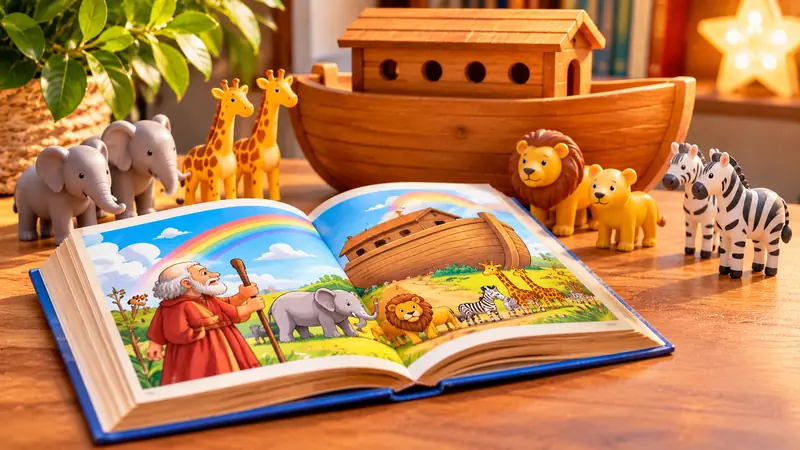
In this article
Telling the Bible to a child looks easy and is not. The temptation runs two ways: soften it until the story loses its point, or turn it into a moral lesson where the aim is behaving well.
This article gives twelve stories, the passage for each, the central idea in one sentence, and how to adapt them by age without inventing anything.
Our main source is the Bible itself. The wording here is the King James Version, as it stands.
The command is to repeat, not to entertain
And thou shalt teach them diligently unto thy children, and shalt talk of them when thou sittest in thine house, and when thou walkest by the way, and when thou liest down, and when thou risest up.
Deuteronomy 6:7
Notice the four moments: at home, walking by the way, lying down and rising up. The teaching the text describes is not a weekly class: it is conversation inside ordinary life.
And on the place Jesus gave children:
But when Jesus saw it, he was much displeased, and said unto them, Suffer the little children to come unto me, and forbid them not: for of such is the kingdom of God.
Mark 10:14
Paul reminds Timothy where his faith came from: "from a child thou hast known the holy scriptures, which are able to make thee wise unto salvation" (2 Timothy 3:15).
Twelve stories and the central idea of each
1. Creation
Text: Genesis 1. Idea in a sentence: everything that exists God made, and he made it good.
Close with the verse that sums up the chapter: "God saw every thing that he had made, and, behold, it was very good" (Genesis 1:31). For the youngest, "In the beginning God created the heaven and the earth" (Genesis 1:1) is enough.
2. Noah and the ark
Text: Genesis 6-9. Idea in a sentence: God judges evil and keeps a promise.
The starting point is "Noah found grace in the eyes of the Lord" (Genesis 6:8), and the end is the sign: "I do set my bow in the cloud, and it shall be for a token of a covenant" (Genesis 9:13).
Careful: this is a story about a flood in which people died. With small children, stay with Noah, the animals and the rainbow. With over-eights you can talk about why the flood came, without detail.
3. Joseph and his brothers
Text: Genesis 37-50. Idea in a sentence: God can bring good even out of what others wrecked.
The closing verse is the one that sums it all up: "ye thought evil against me; but God meant it unto good" (Genesis 50:20).
4. The baby in the river
Text: Exodus 2:1-10. Idea in a sentence: God looked after Moses when he was a helpless baby.
There is a detail children love: Pharaoh's daughter opens the basket and "behold, the babe wept. And she had compassion on him" (Exodus 2:6). And the sister watching from a distance.
5. David and Goliath
Text: 1 Samuel 17. Idea in a sentence: David's confidence was in God, not in his own size.
The key to keeping this from becoming a self-improvement tale is in what David says before the fight:
Then said David to the Philistine, Thou comest to me with a sword, and with a spear, and with a shield: but I come to thee in the name of the Lord of hosts, the God of the armies of Israel, whom thou hast defied.
1 Samuel 17:45
The contrast in the verse is exact: you with a sword, I in the name of the Lord.
6. Daniel and the lions
Text: Daniel 6. Idea in a sentence: Daniel kept praying even when it was dangerous, and God looked after him.
What he himself says on coming out: "My God hath sent his angel, and hath shut the lions' mouths" (Daniel 6:22).
7. Jonah and the great fish
Text: Jonah 1-4. Idea in a sentence: God has compassion even on the people we do not like.
And do not cut the story when Jonah comes out of the fish. The book ends with a question from God about the enemy city: "should not I spare Nineveh, that great city?" (Jonah 4:11). That question is the point of the book.
8. The birth of Jesus
Text: Luke 2:1-20. Idea in a sentence: God became a baby, and the news went first to some shepherds.
"She brought forth her firstborn son, and wrapped him in swaddling clothes, and laid him in a manger" (Luke 2:7), and the announcement: "unto you is born this day in the city of David a Saviour, which is Christ the Lord" (Luke 2:11).
9. Jesus calms the storm
Text: Mark 4:35-41. Idea in a sentence: the wind and the sea obey Jesus.
And he arose, and rebuked the wind, and said unto the sea, Peace, be still. And the wind ceased, and there was a great calm.
Mark 4:39
Children keep the whole scene with three words: Peace, be still.
10. The lost sheep
Text: Luke 15:3-7. Idea in a sentence: God goes looking for the one who is lost and is glad when he finds him.
"Rejoice with me; for I have found my sheep which was lost" (Luke 15:6). It is probably the best story for a child who feels they have done wrong.
11. Zacchaeus
Text: Luke 19:1-10. Idea in a sentence: Jesus went looking for someone everybody despised, and it changed him.
"Zacchaeus, make haste, and come down; for to day I must abide at thy house" (Luke 19:5). And the change shows in what he does: "the half of my goods I give to the poor" (Luke 19:8).
12. The resurrection
Text: Matthew 28:1-10. Idea in a sentence: Jesus died and came back to life, and that changes everything.
"He is not here: for he is risen, as he said" (Matthew 28:6).
Lord, teach me to tell your stories without inventing and without hiding, in a way that lets children see you.
Prayer
Advertisement
How to adapt by age
Ages 2 to 4. One scene, not the whole story. Three or four sentences. Plenty of repetition: the same story many times beats many different stories. Gestures and sounds help.
Ages 5 to 7. The whole story, in about five minutes. They can follow sequence now: first this, then this. Let them tell it back to you — that is when it sticks.
Ages 8 to 11. They can take the whole story, hard parts included, and they start asking the good questions: why did God allow it, what happened to the others. Do not invent answers for them.
Preteens. Here the risk is boredom through repetition. Read them the text straight from the Bible, not a children's version, and work on the context: who wrote it, when, to whom.
What to do with the hard parts
The Bible has violence, death and injustice. Hiding it entirely creates a problem later, when the child finds out alone and feels they were lied to.
Three simple rules:
- Do not invent. If you do not know, say you do not know. It is a perfectly good answer and it teaches honesty.
- Ration, do not falsify. A four-year-old does not need the killing of the children of Bethlehem. But do not say it did not happen either.
- When they ask, answer what they asked. No more. Children usually ask less than adults fear.
Advertisement
Five common mistakes
1. Turning every story into a moral. If David and Goliath ends with you can beat your giants too, the story has become about the child and not about God.
2. Making the characters flawless heroes. Noah got drunk, David committed adultery, Peter denied Jesus. Biblical figures are not spotless models: they are real people God used.
3. Mixing tradition with text. Three kings with names, the ox and the donkey. Make clear what is Bible and what is custom.
4. Telling only the pleasant stories. The Bible is not a collection of nice tales: it is one story with a thread.
5. Forgetting where it all points. Jesus read the whole of Scripture as something speaking about him: "beginning at Moses and all the prophets, he expounded unto them in all the scriptures the things concerning himself" (Luke 24:27). He himself connected Jonah with his own death and resurrection (Matthew 12:40).
A simple routine at home
- A fixed moment, however short: before bed works well.
- One story a week, repeated over several nights, rather than a different one each evening.
- Let the child tell it back. That shows you what they understood.
- Finish by praying one sentence each.
- If one night it does not happen, nothing is lost. "Train up a child in the way he should go" (Proverbs 22:6) describes a long road, not a perfect streak.
A prayer
Lord, I want these children to know you, and not only the stories. Give me simple, honest words, patience to repeat myself and humility to say *I do not know* when I do not. Let what they hear at home stay with them for life. In Jesus' name, amen.
Prayer
Questions for parents and teachers
- Which of these stories do you tell most? Which have you never told?
- Do your stories end up being about God or about the child's behaviour?
- What would you do if a child asked you something you could not answer?
- When exactly, in your week, does this moment fit?
Which Bible stories should I tell a small child first?
Creation, Noah, baby Moses in the river, the birth of Jesus and the lost sheep. They are short, visual scenes with no violence needing explanation.
How do I tell the violent parts of the Bible?
Ration by age, but do not falsify. With small children you can stay with the central part of the story; with over-eights you can cover the rest without graphic detail.
Is it wrong to use illustrated children's Bibles?
No, they are useful for the youngest. From about eight or nine it helps to move toward the biblical text itself, so they get used to the Bible they will use as adults.
How long should a devotional moment with children be?
Short and frequent. Three minutes a day goes further than half an hour on Sunday. For the youngest, repeating the same story beats variety.
How do I keep the stories from becoming only morals?
End each story with what God did, not with what the child should do. David won because he came "in the name of the Lord of hosts" (1 Samuel 17:45), not by believing in himself.
If you want a fuller overview of Scripture to teach from, the ebook Panorama Teológico del Antiguo y Nuevo Testamento (in Spanish) goes deeper into this subject.
Sources
- The Holy Bible, King James Version. Primary source for this article: every biblical quotation comes from it, and the other sources serve only to show where each Christian tradition put its reading of the text in writing.
- eBible.org. The Holy Bible, King James Version.
- BibleProject. Hebrews (video).
Consulted on November 15, 2026.
Free
Read the whole Bible in one year
Download the plan as a PDF: 365 days, Old and New Testament side by side, so you can start today — not on January 1st.
One study a week, nothing else. One click to leave. Privacy policy
Done. Your plan is here: Download the PDF
I couldn’t register that right now. Please try again in a moment.

Vagner Soares is a presbyter with pastoral ordination, a mentor and a digital entrepreneur with more than 10 years of experience in technology, digital marketing and education.
Keep reading
 Bible studyThe life of Moses: from the Nile to Mount Nebo, in orderThe life of Moses in order: the ark of bulrushes, forty years in Midian, the burning bush, the plagues, the Red Sea, Sinai, the wilderness and Mount Nebo.Read the article
 Bible studyJoseph in Egypt: the full story and what it teachesThe story of Joseph in order: the coat, the pit, Potiphar's house, prison, Pharaoh's dreams, the reunion with his brothers and the forgiveness at the end.Read the article
 Bible studyDaniel in the lions' den: the story and its lessons of faithDaniel in the lions' den (Daniel 6) step by step: the context, who Darius was, how the trap was set and what the story teaches about faith today.Read the article