
Ministry evaluation without feeling corporate: conversations that help people grow
Learn how to evaluate church volunteers and leaders with 3 simple questions, a coffee every six months and respectful notes, with no scorecards or HR vibe.

In this article
- Talk about the ministry without scorecards or an HR vibe
- Why evaluate: what you lose when nobody asks
- What Scripture teaches about examining service
- Simple questions: the script that fits on an index card
- Light frequency: the right rhythm for each size of church
- Focus on growth: what to do with each answer
- Respectful record-keeping: notes, not a personnel file
- An example: the children's ministry that lost two volunteers in one month
- Mistakes that make the conversation feel like a corporate review
- Signs the conversations are working
- Frequently asked questions
Free mind map
This whole guide on one page
The five steps in this article as an infographic you can print, pin on the notice board or send to your team.
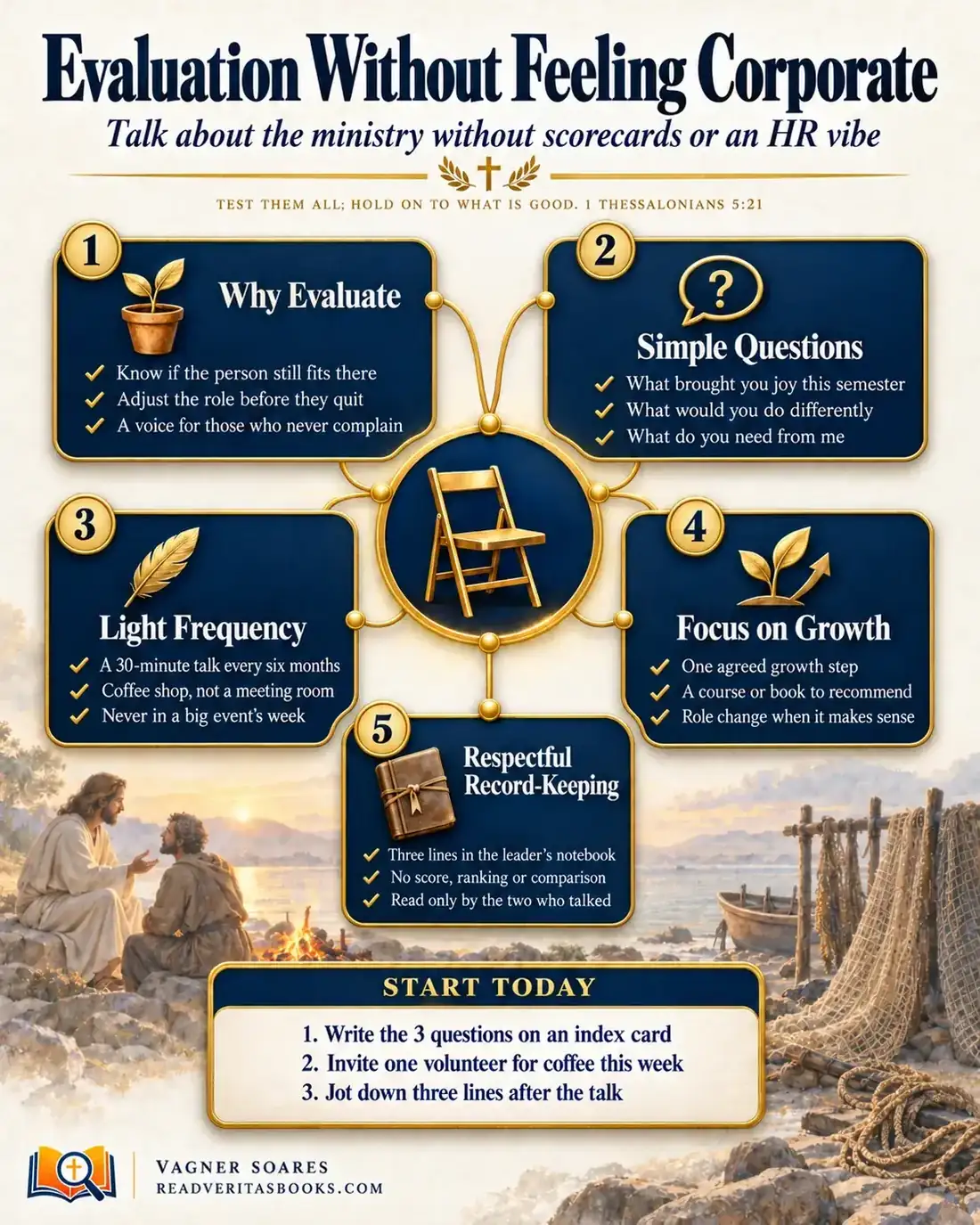
Just say the word evaluation and some volunteers tense up. They picture a form, a score from one to ten and a cold conversation behind a closed office door. That is why many churches never evaluate anything, and problems only surface when someone is already burned out or asking to step down.
There is a middle path: talking about ministry regularly, in a light and pastoral way, without scorecards and without turning the church into a company. Here is how to do it without breaking trust.
Test them all; hold on to what is good.
1 Thessalonians 5:21
Talk about the ministry without scorecards or an HR vibe
A corporate review exists to measure performance and support decisions about roles and pay. In a church, almost no one is on the payroll. Copying the business format, with rating scales and individual targets, brings all the weight of HR and none of the reasons behind it.
A ministry conversation has another goal: caring for those who serve and adjusting the service. The content looks similar, but the tone changes everything: open questions, an informal setting, a focus on the next step and respect for what is shared. If the volunteer leaves feeling inspected, something went wrong. If they leave feeling seen, you got it right.
Advertisement
Why evaluate: what you lose when nobody asks
Without conversation, leaders only find out something is wrong when the person disappears. And there were almost always signs: the volunteer who used to arrive early and now comes in at the last minute or the teacher who stopped suggesting ideas. Nobody asked.
Many people stay in a role that no longer fits because they are embarrassed to ask for a change. Others are overloaded and keep quiet, because they do not want to seem unspiritual. And then there are the quiet ones, who never complain in meetings and so are never heard. Start with them.
A scheduled, predictable and short conversation creates a space where these things can be said without drama. It protects the person, the ministry and the leaders themselves, who can now decide based on real information instead of hallway impressions.
What Scripture teaches about examining service
The verse that opens this article has a specific context. In 1 Thessalonians 5:20-21, Paul asks the church not to despise prophecy but to test it: "Prove all things; hold fast that which is good." The text is about discerning what was said in the gatherings, not about reviewing volunteers. But the principle serves church administration: the church neither accepts everything without thinking nor rejects everything out of fear.
In Exodus 18:13-24, Jethro watches Moses judging the people from morning until evening. First he observes, then he asks, and only then does he speak plainly: "The thing that thou doest is not good." The reason is the exhaustion of Moses and the people (Exodus 18:18), and the proposal is to share the load with other capable men. Moses listened and did what his father-in-law said (Exodus 18:24). The passage does not create a method; it shows a trusted person who observes, asks and proposes an adjustment to protect the one who serves.
In Acts 15:36, Paul suggests to Barnabas that they revisit the cities where they had preached "and see how they do": follow-up, not inspection. And Galatians 6:4 adds: "But let every man prove his own work, and then shall he have rejoicing in himself alone, and not in another." Paul is speaking of each believer examining their own conduct without measuring themselves against others. For the church, this supports two practices in this article: letting people assess their own service, and never comparing volunteers with each other.
Simple questions: the script that fits on an index card
Complicated questions produce defensive answers. Simple, open ones invite honesty. Ask the same three every time, in the same order and with the same words: the person knows what to expect, and you can see their progress from one season to the next without any scores.
To open the conversation:
- "Thank you for making time for this. It is not a test, it is a conversation about care. I want to hear how serving is going for you and how I can help."
The three questions:
- "What brought you joy in your ministry this season?" Start with what went well, so the person relaxes.
- "What would you do differently?" Let them name what could improve. Do not suggest answers or finish their sentences. If there is silence, wait.
- "What do you need from me?" Leave with one concrete request you can meet in the coming weeks, even a small one.
To close:
- "So here is what we agreed: [the growth step] on your side and [the request] on mine. I will write down these three things, and only I will read them. Next time, we will start right here."
If a criticism of the leadership comes up, thank them and take note without defending yourself in the moment. An instant defense teaches people that honesty is not worth it.
Advertisement
Light frequency: the right rhythm for each size of church
Conversations that are too rare lose their meaning; conversations that are too frequent start to feel like surveillance. For most volunteers, about 30 minutes every six months is enough. Schedule ahead, respect the time and avoid the weeks of big events. Choose a coffee in a quiet café or a cozy corner of the church: a meeting room with a table in the middle feels like a job interview.
Small church (up to about 100 people)
The pastor or one trusted leader can meet with everyone. Spread one or two conversations a week across the six months. Because everyone knows everyone, confidentiality needs even more care.
Medium-sized church
Each coordinator meets with their own team, and the pastor meets with the coordinators. Block out a fixed window on the calendar so the conversations do not keep sliding.
Large church
The conversation flows down the structure: team leaders with volunteers, coordinators with team leaders, pastors with coordinators. The risk is that standardization turns into bureaucracy. Keep the same card, train the people who will lead the conversations and do not ask for individual reports to be passed up, only general themes.
Focus on growth: what to do with each answer
A good conversation ends with one concrete step, one agreed form of support and a date to come back to it. The kind of step depends on what you heard.
If the person is doing well and wants to stay where they are, agree on a single thing to develop before the next conversation, such as leading a short team meeting or training someone new, and suggest a course, a book or a leader to talk it over with.
If they show signs of fatigue, lighten the load before you talk about growth: fewer Sundays on the rota, one task less, a partner to share the work. Watch for the warning signs of volunteer burnout.
If they say they no longer feel they are in the right place, treat it as good news. Offer two or three options in other areas, agree on a transition date and make sure the current team is not left short. No one needs to stay stuck in a role just because they have always been in it.
If they want more responsibility, do not promise a position over coffee. Agree on a trial step and follow it up. A leadership development plan helps give that desire some direction.
If a conduct or relationship problem comes up, set up a separate conversation for it and follow the process your church already uses.
Respectful record-keeping: notes, not a personnel file
Notes keep you from forgetting what you agreed. But no one opens up if they think their words will circulate among the leadership. Your notes are a reminder for the next meeting, not a file on the person.
- Write them the same day, not during the conversation. An open notebook on the table turns coffee into an interview.
- Write only three lines: what brought them joy, the agreed growth step and the request you will follow up on.
- Do not record scores, rankings or comparisons with other volunteers.
- Keep them somewhere only you can access, such as a personal notebook or a password-protected folder. In a church management system, do not use fields other leaders can see.
- Tell the person the notes stay between the two of you, and show them what you wrote if they wish.
- Before the next conversation, reread the three lines and start with the agreed step.
There is a real trade-off here: the more you write, the easier it is to remember and to hand the ministry over to a successor, and the greater the risk to trust. When in doubt, write less. If you take something to the pastor, take themes without names ("three people asked for fewer Sundays") unless the person agrees otherwise. For personal data, follow the guide on how to store member data responsibly and check with a local lawyer or accountant what applies where you are.
An example: the children's ministry that lost two volunteers in one month
Imagine a church of 115 members whose children's ministry has 14 volunteers. In March, two of them stop showing up without explanation. The coordinator realizes she has never had a one-to-one conversation with any of them, except to ask them to cover an absence.
She writes the three questions on a card and lists the 14 names, starting with the quietest. She schedules two conversations a week for seven weeks, skipping the week of the children's celebration. Each one takes place at the bakery next to the church, with 30 minutes on the clock.
In the second week, a volunteer who has served in the nursery for six years says she would like to teach the older children. The coordinator does not decide on the spot: the following week she offers two possible classes and sets the move for the next month, after preparing someone to take over the nursery. In the fourth week, a young man says he is on the rota every Sunday and cannot keep going. His step will be to serve every other Sunday; his request is a revised rota. For each person, she writes three lines in a notebook she keeps with her, never in the team's messaging group.
At the end, she takes the pastor only a summary without names: three people are asking for fewer Sundays, materials need organizing and the team needs two new volunteers. The church starts with recruitment and with training new volunteers. Six months later, she rereads the notebook and opens each conversation by asking about the agreed step.
Mistakes that make the conversation feel like a corporate review
Opening with criticism. Even with a hard subject, start with what went well and let the person speak before you share your view.
Canceling again and again. To the volunteer, it says they are not a priority. Treat the time as a pastoral commitment.
Forgetting what you agreed. If you promised new materials and never delivered, the next conversation starts with no credibility.
Using the conversation for another purpose, such as choosing next year's leaders, without the person knowing. Once they find out, the honesty of every future round is gone.
Signs the conversations are working
After one or two rounds, volunteers ask for a role change before they disappear, not after. Quiet people start offering ideas in meetings. And leaders begin to talk about concrete issues ("we are short of materials", "the rota is too heavy") instead of complaining about people. When volunteers arrive with their answers already thought through, the evaluation has become part of the care.
Frequently asked questions
How do you evaluate church volunteers without making them feel judged?
Use the same three open questions every time, start with what brought joy and choose an informal place. The feeling of being judged fades when volunteers see that you keep your promises.
Do I have to evaluate every volunteer at the same time?
No. Spread the conversations across the six months, for example two a week.
How do you evaluate church leaders, not just volunteers?
The format is the same, with one extra question about the team the person leads: who is overloaded and who is ready for more. Someone above them in the structure should lead it, and it should also care for the leader's own well-being.
Does this replace everyday feedback?
No. The twice-a-year conversation complements the quick feedback you give along the way. It is the moment to look at the bigger picture.
Evaluating with grace is a concrete way to care for the people who serve: testing everything and holding on to what is good, including the good in those who serve beside you. To round this out, see how to give feedback to volunteers without discouraging them, how to spot the warning signs of volunteer burnout and how to motivate volunteers without spiritual guilt.

Vagner Soares is a presbyter with pastoral ordination, a mentor and a digital entrepreneur with more than 10 years of experience in technology, digital marketing and education.
Keep reading
 People management · Reference guideThe Complete Guide to People Management in the Church: From Recruiting to Ongoing CareRecruit, develop, evaluate, care for, and retain volunteers and leaders with a five-part path and practical steps you can start using in your church today.Read the article
 People managementIntegrating Gen Z volunteers: a voice, short tasks and someone alongsideLearn how to integrate Gen Z volunteers in your church with direct invitations, 8-week projects, guided autonomy and a clear path toward leadership.Read the article
 People managementWomen's leadership in church administration: real room to make decisionsLearn how to give women real decision-making power in church administration: board seats, budget votes, mentoring among women and visible pastoral support.Read the article