
Noah's ark for children: the story, lessons and activities
The story in simple language to read aloud, what the biblical text actually says, five lessons for children, questions for each age group, easy activities, and how to answer the hard questions.
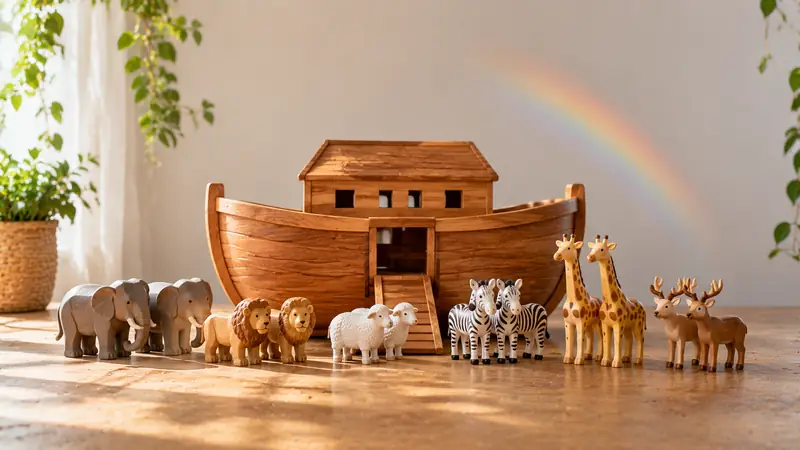
In this article
In English, a Noah's ark has come to mean a crowded, chaotic, slightly comic scene — all those animals, two by two, on a boat.
The Bible's version is not comic. It is a story in which almost everyone dies, and children work that out faster than adults expect. This article gives a version to read aloud, the details the storybooks usually drop, and a straight answer for the question a six-year-old will eventually ask.
Our main source throughout is the Bible. Scripture here is quoted from the King James Version.
The story, to read aloud
For children roughly three to eight. Five minutes.
A long time ago, the world had gone very wrong. People were cruel to each other, and it made God sad — the Bible says it grieved him.
But there was one man called Noah who still loved God and tried to do what was right.
God told Noah something surprising. I am going to send a great flood. Build a boat — a very big boat — and I will keep you safe.
So Noah began to build. Not a little boat. An enormous one, as long as a street, made of wood and covered with pitch to keep the water out. It took him a very long time, and the people around him thought he was being silly, because there was no water anywhere near.
Noah kept building anyway.
When the boat was finished, God told Noah to bring his family — his wife, his three sons and their wives — and animals of every kind, so that none of them would be lost. Birds, and creeping things, and great heavy animals, all going up the ramp into the ark.
Then God shut the door.
And the rain came. It rained and rained, for forty days and forty nights, until the water covered everything. Inside the ark it was dark and noisy and it smelled of animals, and it went on for a very long time — not just days, but months.
Then one day the rain had stopped, and the water began to go down. Noah sent out a raven, and then a dove, to see if there was dry land. The first time, the dove came back with nothing. The second time, it came back with a fresh green olive leaf in its beak — the first new leaf anyone had seen. The third time, the dove did not come back at all, because it had found somewhere to live.
At last God said, Come out. And they all came out onto dry ground — Noah, his family, and every animal.
Noah said thank you to God. And God made a promise, and he put something in the sky so that everyone would remember it.
I do set my bow in the cloud, and it shall be for a token of a covenant between me and the earth.
Genesis 9:13
A rainbow. God's promise never to flood the whole earth again.
What the Bible actually says
Several details get lost in retellings, and the older children will notice.
The ark was huge. Three hundred cubits long — somewhere around 140 metres, or roughly 450 feet. It had three decks and one door.
It was not two of everything. Genesis 6:19 says two of every kind, and Genesis 7:2 adds that clean animals and birds came by sevens. Both are in the text.
And it was not forty days altogether. It rained for forty days (Genesis 7:12), but the waters prevailed for a hundred and fifty days (Genesis 7:24), and the total time from entering the ark to leaving it was over a year (compare Genesis 7:11 with Genesis 8:13-14).
Noah's obedience is stated twice, in almost identical words:
Thus did Noah; according to all that God commanded him, so did he.
Genesis 6:22
Thus did Noah; according to all that God commanded him, so did he. The narrator says it again at Genesis 7:5.
*And the word in Genesis 9:13 is bow, not rainbow.* The Hebrew word is the ordinary word for a war bow — the weapon. The image is of a weapon hung up in the clouds, pointed away. That is a detail worth saving for older children, and it is more striking than the decorative version.
Advertisement
Five lessons for children
1. God notices when things are wrong. He is not indifferent to cruelty. For a child who has been treated badly, that is the most important sentence in the story.
2. One person can do the right thing when nobody else is. Noah built for years while being laughed at.
3. Obeying sometimes looks strange before it makes sense. A boat, on dry land, with no rain.
4. God keeps his people safe through the trouble, not away from it. Noah went through the flood, in the dark, for a year. The ark did not prevent the flood.
5. God keeps his promises. And he gave a sign in the sky so that nobody would have to take it on trust alone.
Questions by age
Three to five
- Can you name some of the animals that went in?
- Who shut the door of the ark?
- What colours are in a rainbow?
- Noah had to wait a long time. What is something you have to wait for?
Six to eight
- Why do you think the people laughed at Noah?
- What do you think it was like inside the ark for a whole year?
- Why did Noah send the dove out three times?
- What does God promise with the rainbow?
Nine to twelve
- The story says God was grieved. What does that tell us about him?
- Noah was not perfect — later in the chapter he gets drunk. Why do you think the Bible includes that?
- Jesus talked about Noah (Matthew 24:37-39). What was he comparing?
- What is the difference between being rescued from trouble and being kept through it?
Advertisement
Simple activities
- Two by two. Line up toy animals in pairs and name them. Works for the youngest.
- Build an ark. A cardboard box, a shoebox, blocks. Try to make three decks.
- Paint a rainbow and write the promise on it.
- Measure it out. With older children, pace out 140 metres outside. The scale genuinely surprises them.
- The dove's three trips. Act them out: nothing, a leaf, and not coming back.
- A promise jar. Write down promises God makes in the Bible, one a week, and keep them in a jar.
- Olive leaf hunt. Hide a green paper leaf and let them find it.
How to answer the hard questions
They will ask. Three principles first: answer the question actually asked, do not pretend the story is cheerful, and it is fine to say you do not know.
Did all the other people die?
Yes. Do not dodge this. Yes — it is a very sad part of the story. The people were hurting each other badly and God stopped it. And God was so sad about it that he promised never to do it that way again. For a younger child, that is enough. An older one may want to stay with it, and staying with it is better than brushing it off.
Was God being mean?
God was not angry for no reason. The Bible says people were being cruel and violent, and it grieved him. And then the honest part: I find this story hard too. A child who is told that an adult also finds it difficult learns that faith and questions can coexist.
Did it really happen?
Christians answer that in different ways. Many believe it happened as described; others think the story is told in the way ancient stories were told, to teach something true. What all of them agree on is what it teaches: that God sees wrong, that he rescues, and that he keeps promises. With an older child you can add that flood stories appear in several ancient cultures, which some take as evidence and others as context. Either way, you are modelling honesty.
How did all the animals fit?
Nobody knows exactly. It was a very big boat, and the Bible does not explain how. Resist inventing an answer; the invented ones are what a teenager later discovers were invented.
What about the animals that drowned?
That is sad too. Do not add anything.
Tips for whoever is telling it
- Five minutes with the youngest. Stop while they still want more.
- Read one verse from the Bible itself, even to a three-year-old. Hearing that it comes from a book matters.
- Use the dark bit sparingly with small children and more honestly with older ones.
- Repeat it. They will ask for it ten times, and each time they take in a little more.
- Do not finish with a moral. The story works; and so we must always obey switches it off.
- If they are frightened, do not minimise. It is a scary part. And God kept them safe all the way through, and he made a promise.
- And keep the rainbow for the end. It is the point the story is moving toward.
Father, thank you for keeping Noah safe through the flood and for the promise in the sky. Help the children listening to know that you see when things go wrong, and that you keep your promises. In Jesus' name, amen.
Prayer
Where is the story of Noah's ark in the Bible?
Genesis chapters 6 to 9. Jesus also refers to Noah and the flood in Matthew 24:37-39, and the letters mention him in Hebrews 11:7 and 1 Peter 3:20.
What is the lesson of Noah's ark for children?
Five things: God notices when things are wrong; one person can do right when nobody else is; obedience sometimes looks strange before it makes sense; God keeps his people safe through trouble rather than away from it; and God keeps his promises, with the rainbow as the sign.
How many animals went into the ark?
Genesis 6:19 says two of every kind, and Genesis 7:2 adds that clean animals and birds came by sevens. Both details are in the text, so the familiar two-by-two picture is incomplete.
How long was Noah in the ark?
Over a year. It rained for forty days (Genesis 7:12), the waters prevailed for a hundred and fifty days (Genesis 7:24), and comparing the dates in Genesis 7:11 with Genesis 8:13-14 gives a total of more than twelve months.
What does the rainbow mean in the story of Noah?
It is the sign of God's promise never again to destroy the earth by flood (Genesis 9:13). The Hebrew word is the ordinary word for a war bow, so the image is of a weapon hung up in the clouds and pointed away.
If you want more help teaching the Bible at home, the ebook Vida de Oración (in Spanish) goes deeper into this subject.
Sources
- The Holy Bible, King James Version. Primary source for this article: every biblical quotation comes from it, and the other sources serve only to show where each Christian tradition put its reading of the text in writing.
- eBible.org. The Holy Bible, King James Version.
Consulted on November 15, 2026.
Free
Read the whole Bible in one year
Download the plan as a PDF: 365 days, Old and New Testament side by side, so you can start today — not on January 1st.
One study a week, nothing else. One click to leave. Privacy policy
Done. Your plan is here: Download the PDF
I couldn’t register that right now. Please try again in a moment.

Vagner Soares is a presbyter with pastoral ordination, a mentor and a digital entrepreneur with more than 10 years of experience in technology, digital marketing and education.
Keep reading
 Bible studyBible stories for children: which ones to tell and how to tell themTwelve Bible stories for children with the text for each, how to tell them without inventing, what to do with the hard parts and the mistakes to avoid.Read the article
 Bible studyFamily worship: how to do it in 15 minutesFamily worship step by step: what it is, the biblical basis, a 15-minute outline, ideas by age, common mistakes, and how to keep the habit going.Read the article
 Bible studyHow to raise children according to the Bible: principles for parents todayHow to raise children according to the Bible: teaching day to day, disciplining without provoking, and what Proverbs 22:6 does and does not promise.Read the article