
The Dead Sea Scrolls: what they are and why they matter for the Bible
The discovery in the caves at Qumran, what is in the scrolls, who may have kept them, the two Isaiah scrolls, what comparison with the traditional text showed, and what the scrolls do not prove.
In this article
Before 1947, the oldest complete Hebrew manuscripts of the Old Testament dated from around the tenth century AD. The obvious question — what might have drifted across a thousand years of hand copying — had no way of being answered.
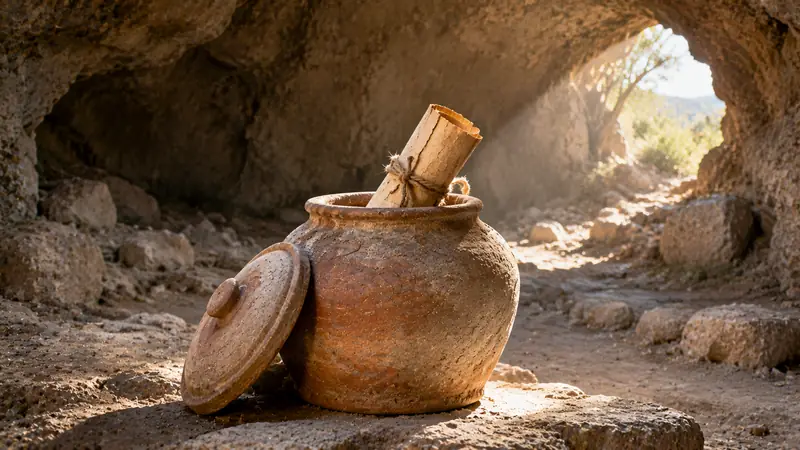
Then a shepherd threw a stone into a cave.
Our main source throughout is the Bible. Scripture here is quoted from the King James Version.
The discovery
In 1947, Bedouin shepherds came across jars containing scrolls in a cave near Khirbet Qumran, on the northwestern shore of the Dead Sea. The first finds were sold through antiquities dealers before scholars understood what they were.
What followed was roughly a decade of searching by Bedouin and archaeologists, often in competition. By 1956, eleven caves near Qumran had yielded manuscripts, and related finds turned up at other sites in the Judean Desert.
What they are
The term refers most specifically to the manuscripts from those eleven caves at Qumran, with later finds from neighbouring areas usually discussed alongside them.
The scale. Around fifteen thousand fragments, most of them small, representing the remains of roughly eight hundred to nine hundred original manuscripts. A handful survived nearly intact; the great majority did not.
The dating. Nearly all of the Qumran scrolls date from the third to the first century BC, with the collection as a whole running into the first century AD.
The languages. Mostly Hebrew, with substantial Aramaic and some Greek, written mainly on parchment and some on papyrus.
The best-preserved material came from Cave 1, including an Isaiah scroll, the Rule of the Community — also called the Manual of Discipline — and the War Scroll, properly The War of the Sons of Light Against the Sons of Darkness.
Cave 4 was the largest find by volume: around six hundred manuscripts, in some fifteen thousand fragments, which is where most of the painstaking reconstruction work has gone.
Advertisement
What they contain
Three broad categories.
Biblical texts
Copies of books of the Hebrew Bible — covering nearly the whole of it. Every book is represented except Esther.
An important caveat: this is not a complete Bible set. It is a collection of separate copies of individual books, in varying states, some in multiple copies and some in a single fragment. Psalms, Deuteronomy, Isaiah and Genesis are among the most frequently represented.
Other religious writings
A larger category than the biblical one, and in some ways more historically valuable.
Commentaries on biblical books — the Habakkuk commentary is the best known — which show how one Jewish group in that period read Scripture.
Community documents, including the Rule of the Community, which sets out the regulations of the group's common life.
Hymns and prayers, including the collection known as the Thanksgiving Hymns.
Apocalyptic and visionary works, including the War Scroll, which describes a final conflict between light and darkness.
And books that are not in the Hebrew Bible but were evidently read, including material connected to Enoch and Jubilees.
The Copper Scroll
Found in Cave 3, and unlike everything else: engraved on copper sheets rather than written on parchment, and containing a list of locations where treasures were supposedly hidden.
No consensus exists on what it is. Whether it records real temple treasure, a legend, or something else entirely remains unsettled, and nothing listed in it has been found.
Who kept the scrolls
The traditional and still most common view associates the Qumran site and its library with the Essenes, a Jewish group described by ancient writers as living a communal, strictly observant and separatist life.
But this is not settled, and it is worth stating the alternatives rather than presenting one as established fact.
Some scholars link the material to other Jewish groups, or to a collection of libraries brought out of Jerusalem and hidden during the war with Rome. The site itself has been interpreted variously as a religious settlement, a fortified estate and a pottery works.
What the scrolls do show, whoever kept them, is that Judaism in the late Second Temple period was considerably more varied than later sources suggest.
Advertisement
The Isaiah scrolls
Two copies of Isaiah came from Cave 1, and one of them is the most famous manuscript of the twentieth century.
The Great Isaiah Scroll contains essentially the entire book, on a parchment roll around seven metres long, dated to roughly 125 BC. It is the only nearly complete biblical book preserved from before the destruction of the temple.
The second, fragmentary Isaiah scroll came from the same cave.
Why Isaiah matters particularly: it is the book most quoted in the New Testament, it contains the passages Christians read as describing the suffering servant, and it had the most at stake in the question of textual reliability.
But he was wounded for our transgressions, he was bruised for our iniquities: the chastisement of our peace was upon him; and with his stripes we are healed.
Isaiah 53:5
That verse, and the chapter around it, was being copied in that form more than a century before Jesus was born. Whatever anyone concludes about its meaning, the question of whether Christians altered it later is settled by a physical object.
What the comparison showed
The Great Isaiah Scroll was compared with the medieval Masoretic text — a gap of roughly a thousand years of copying.
The result: the differences are overwhelmingly matters of spelling, word forms and the occasional word or phrase, with no change to the sense of the book.
That is the single strongest piece of evidence available on the transmission of the Old Testament text, and it is a physical, checkable object rather than an argument.
And the honest other half. The scrolls also complicated the picture in ways worth knowing:
Some books circulated in more than one textual form. The differences between the Hebrew and the Greek Septuagint versions of Jeremiah, for instance, turn out to reflect genuinely different ancient Hebrew text-forms rather than loose translation.
Some readings at Qumran agree with the Septuagint against the Masoretic text, which has led modern translations to adopt a handful of them — occasionally visible in a footnote in your Bible.
*So the finding is not the text never varied.* It is that the text was transmitted with remarkable care, and that where variation existed it was limited and visible.
Anyone told the simpler version and later shown the complication has good reason to distrust whoever simplified it.
Why they matter
For the Old Testament text: a thousand-year jump backwards with the sense of the book intact.
For the history of the period: the scrolls are the primary source for how at least one Jewish community in the century before Christ organised itself, prayed and read Scripture.
For the background of the New Testament: they show what first-century Judaism actually looked like from inside, including the vocabulary and the expectations the Gospels assume.
And for the canon question: they show a community reading a wide range of texts, which bears on how the boundaries of Scripture were formed.
The grass withereth, the flower fadeth: but the word of our God shall stand for ever.
Isaiah 40:8
What the scrolls are not
Several claims circulate and should be addressed directly.
They are not Christian documents. No New Testament text was found at Qumran, and no reference to Jesus. The collection predates or runs alongside the earliest Christian writings.
They do not contain a suppressed gospel. Occasional claims to that effect have not been supported by the published texts, and the entire corpus has now been published.
They were not hidden by the church. The delay in publishing material from Cave 4 — which took decades and caused genuine academic acrimony — was a matter of scholarly control and slow work, not religious suppression. It has long since been resolved.
And they do not prove the Bible is true. They are strong evidence about transmission — that what we have is what was written. Whether what was written is true is a separate question that no manuscript can settle.
Where they are today
Most of the material is held in Israel, with the best-known scrolls displayed at the Shrine of the Book at the Israel Museum in Jerusalem, and the Copper Scroll in Jordan.
And they are online. In 2011 the Israel Museum worked with Google to publish five of the larger scrolls, including the Isaiah Scroll, in high resolution — so anyone can look at a two-thousand-year-old copy of Isaiah 53 from a phone.
Father, your word has come down to me through caves and jars and the hands of scribes I will never know. Thank you for keeping it. Give me the honesty to weigh evidence carefully and the faith to trust what it points to. In Jesus' name, amen.
Prayer
Questions for reflection or small group
- Does a physical object a thousand years older change anything for you?
- Why does it matter that the finding is carefully transmitted rather than never varied?
- The scrolls settle transmission and not truth. Where is that line for you?
- What would you want to look at first, if you opened the Isaiah Scroll online?
What are the Dead Sea Scrolls?
Manuscripts found from 1947 in eleven caves near Qumran on the northwestern shore of the Dead Sea — around fifteen thousand fragments representing the remains of roughly eight hundred to nine hundred original manuscripts, mostly in Hebrew, with some Aramaic and Greek.
How old are the Dead Sea Scrolls?
Nearly all of the Qumran manuscripts date from the third to the first century BC, with the wider collection running into the first century AD. The Great Isaiah Scroll is dated to around 125 BC.
Do the Dead Sea Scrolls confirm the Bible?
They provide strong evidence about transmission: the Great Isaiah Scroll, compared with medieval copies a thousand years later, differs mainly in spelling and word forms without changing the sense. They also show that some books circulated in more than one textual form. They cannot establish whether what was written is true.
Which books of the Bible were found at Qumran?
Nearly the whole Hebrew Bible is represented — every book except Esther — though as separate copies of individual books in varying states rather than as a complete Bible. Psalms, Deuteronomy, Isaiah and Genesis are among the most frequently found.
How many Dead Sea Scrolls are there?
Around fifteen thousand fragments, most of them small, representing roughly eight hundred to nine hundred original manuscripts. Fewer than a dozen survived in nearly complete form, the best known being the Great Isaiah Scroll from Cave 1.
If you want to understand how the biblical text reached us, the ebook Las 13 Cartas de Pablo Explicadas Versículo por Versículo (in Spanish) goes deeper into this subject.
Sources
- The Holy Bible, King James Version. Primary source for this article: every biblical quotation comes from it, and the other sources serve only to show where each Christian tradition put its reading of the text in writing.
- Encyclopaedia Britannica. Dead Sea Scrolls.
- Encyclopaedia Britannica. Isaiah scroll.
- Museum of the Bible. Dead Sea Scrolls resources.
Consulted on November 15, 2026.
Free
Read the whole Bible in one year
Download the plan as a PDF: 365 days, Old and New Testament side by side, so you can start today — not on January 1st.
One study a week, nothing else. One click to leave. Privacy policy
Done. Your plan is here: Download the PDF
I couldn’t register that right now. Please try again in a moment.

Vagner Soares is a presbyter with pastoral ordination, a mentor and a digital entrepreneur with more than 10 years of experience in technology, digital marketing and education.
Keep reading
 Bible studyIs the Bible reliable? What we know about the text and its historyIs the Bible reliable? How the text was copied, what the Dead Sea Scrolls showed, what textual variants actually are, and where faith enters the question.Read the article
 Bible studyWho wrote the Bible: authors, periods and how it reached usWho wrote the Bible: the named authors and the anonymous books, in what periods, how the scribes worked and what inspiration actually means.Read the article
 Bible studyThe apocryphal books: what they are and why they are not includedWhat the apocryphal or deuterocanonical books are, which ones they are, where they came from, how each tradition reached its list and whether to read them.Read the article