
How to schedule church volunteers without overloading the same people
Build a fair church volunteer schedule with a broad pool, planned rotation, advance notice, emergency backups and a regular workload review.

In this article
- Why the schedule always lands on the same people
- What the Bible shows about sharing the work
- Broad volunteer pool: at least three names per role
- Planned rotation: limits that protect your most available people
- Advance notice: a rhythm of reminder, confirmation and swap
- Emergency backup: who covers when someone can't come
- Workload review: count, talk and adjust
- Example: a church of 210 members rebuilds its schedule
- First steps for this week
- Signs your new schedule is working
- Frequently asked questions
Free mind map
This whole guide on one page
The five steps in this article as an infographic you can print, pin on the notice board or send to your team.
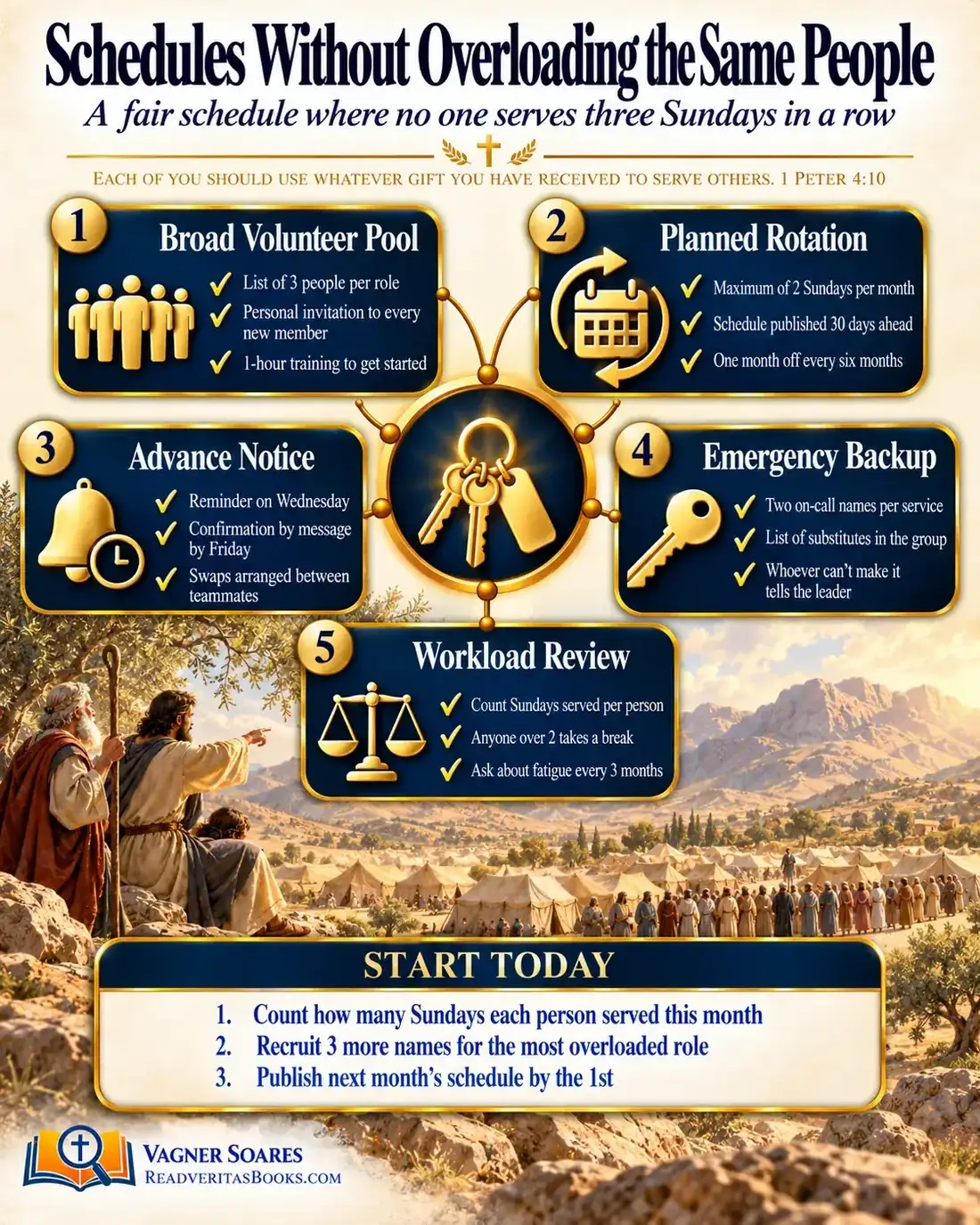
Every church has that one person who can always step in: they play on the worship team, cover the welcome desk when someone is missing and still help with the kids. Nobody meant to overload them. But without a clear system, leaders keep turning to the person who never says no, until that person burns out, gets sick or quietly disappears.
This article shows you how to build a church volunteer schedule that truly shares the work, without expensive software: just a few rules your team agrees on and keeps.
Each of you should use whatever gift you have received to serve others
1 Peter 4:10
Why the schedule always lands on the same people
Volunteer overload almost never comes from bad intentions. It comes from hurry. On Thursday night someone is missing for sound, so the leader calls whoever said yes last time. It works, so it happens again. Within a few months, three or four people carry almost all of Sunday, while dozens of members attend without ever being asked.
People who serve too much stop worshiping as part of the congregation and start serving with frustration. People who are never asked conclude they aren't needed. A good church serving schedule fixes both at once: it relieves the overloaded and makes room for gifts that were sitting unused.
Advertisement
What the Bible shows about sharing the work
In Exodus 18, Moses spends the whole day, from morning until evening, settling the people's disputes by himself. His father-in-law, Jethro, watches and speaks plainly: "The thing that thou doest is not good" (Exodus 18:17). Then he explains why: "Thou wilt surely wear away, both thou, and this people that is with thee" (Exodus 18:18). The problem wasn't ability. It was concentration.
Jethro's solution was to choose capable men and divide the work, so that "they shall bear the burden with thee" (Exodus 18:22). The passage is about judging cases, not scheduling greeters, and it doesn't hand us an org chart to copy. But the principle is clear: when one person does everything, they wear out and everyone else is left without room.
Service in the temple was organized in rotation as well. The priests were divided into courses that took turns (1 Chronicles 24:19), and centuries later Zechariah was serving "in the order of his course" when he received the announcement of John's birth (Luke 1:8-9). Taking turns did not make the service any less serious.
Finally, after an intense season of mission, Jesus told his disciples: "Come ye yourselves apart into a desert place, and rest a while" (Mark 6:31). Rest was part of how Jesus cared for those who served. For church administration, this means a break in the schedule isn't a concession to the weak. It is care for the people who serve.
Broad volunteer pool: at least three names per role
There is no fair rotation without enough people. Before you touch the schedule, look at your base. Work through these steps, ideally with each ministry leader at the same table:
- List every role in a normal service, one per line: welcome, parking, sound, slides, worship, kids' room, nursery, cleaning, coffee.
- Next to each role, write the names of people who know how to do it and are available today. Be honest: someone who "helps out sometimes" but has never been trained doesn't count yet.
- Highlight the roles with one or two names. Those are the ones that turn every absence into a crisis, and that's where recruiting starts.
- For each highlighted role, make personal invitations. A general announcement from the stage rarely works as well as a one-to-one conversation. When you welcome new members, ask about their gifts and availability.
- Offer a simple way in: a session of about an hour that shows the role in practice, followed by two or three Sundays serving alongside someone experienced. The guide on how to train new volunteers before placing them in a role walks through this process.
- Only call a role "covered" when it has three trained people. With three, one can be away and another can rest without the service grinding to a halt.
To decide who to ask, read about how to recruit the right volunteers for the right role.
Planned rotation: limits that protect your most available people
With a bigger pool, a volunteer rotation schedule becomes possible. The schedule stops being pieced together midweek with whoever answers the phone and is planned for the whole month, published about 30 days ahead, always on the same date.
The core rule is a cap: each person serves at most two Sundays a month, counting every role. That cap protects exactly the people most likely to say yes to everything. Add one month off every six months for each volunteer, staggered across the team, so no one goes a whole year without simply sitting down to worship.
Small church (up to about 100 people)
One schedule, made by one person and reviewed by the pastor, is usually enough. Here the two-Sunday cap may be hard at first, and it's fine to start with three, as long as there's a plan to bring it down.
Medium church
Each ministry builds its own schedule, but someone has to look at the whole picture, because overload hides in the totals. A shared spreadsheet with every team's schedule keeps the same person from showing up in three ministries on the same Sunday.
Large church
With several services and dozens of roles, a church management system or a scheduling tool helps you cross-check data and send reminders. Even so, the tool doesn't replace the rule. Put the monthly cap and the six-monthly break in writing, and appoint an overall volunteer coordinator who tracks the numbers and talks with team leaders.
Advertisement
Advance notice: a rhythm of reminder, confirmation and swap
Many no-shows aren't about commitment. They come from forgetting or from conflicts that surface too late. The answer is a fixed rhythm, agreed once and repeated every week. Here are sample messages you can adapt and send in the team group chat or one-to-one.
Wednesday reminder, always sent on the same day:
"Hi Sam! Just a reminder that you're on the schedule this Sunday, on the welcome team for the 10 a.m. service. Please arrive at 9:30 at the main entrance. Can you confirm by Friday? If you can't make it, arrange a swap with someone on the welcome team and let me know. Thanks for serving!"
Swap request, sent by the person who can't serve:
"Welcome team, I can't serve on Sunday the 12th. Could anyone swap with me? I'll take the 26th from whoever says yes."
The key is predictability. Everyone knows the reminder comes on Wednesday, confirmation is due by Friday, and the person who can't serve arranges the swap and tells the leader.
Emergency backup: who covers when someone can't come
Even with a solid plan, things come up. Without a defined backup, the gap always gets filled by the same reliable person, and overload sneaks back in through the side door.
So every service has two on-call names, told in advance that they may be needed that day, and those names rotate too. The list of substitutes for each role stays visible in the team group. From there, use this decision rule:
If the absence is known by Friday, the person who can't come finds a swap within their own team. The leader steps in only if nobody has agreed by Saturday noon.
If the absence comes up on Saturday night or Sunday, the leader calls that day's on-call volunteers first, not the person who always helps.
If the on-call volunteers can't come either, the leader checks the substitute list for that role, starting with whoever has served least that month.
If the role is essential and no one is available, simplify the service rather than calling someone who is already overloaded.
Workload review: count, talk and adjust
Perception can fool you. A leader may think the schedule is balanced while some volunteers already feel exhausted. So at the end of each month, add up how many Sundays each person served, across every role. Anyone over two sits out the next schedule, even if they offer to keep going. Every three months, talk privately with each volunteer, without pressure: How are you doing? What feels heavy right now? Would you like to change roles or take a break?
The review has its costs. If no one owns the number, it stops being counted by the second month. Keeping the cap sometimes means a slightly less polished Sunday while new people learn. And taking someone off the schedule can feel like rejection if it isn't explained with care.
Watch for what the numbers don't show: someone who has started arriving late or answers messages with a single word. These may be signs of volunteer burnout, and they deserve a conversation before any change to the schedule.
Example: a church of 210 members rebuilds its schedule
Picture a church of 210 members with one service each Sunday. The pastor notices that the sound operator looks tired and asks the volunteer coordinator to look at the numbers. She opens a spreadsheet and marks who served in September. The result: the sound operator served all four Sundays and also helped at the welcome desk on two of them; one kids' room teacher also served all four; 40 other people who had served at some point went the whole month without being scheduled.
That same week, she lists the roles and finds that sound and the kids' room each have a single person. Together with the pastor, she makes six personal invitations: three for sound and three for the kids' room. Four people say yes. The sound operator runs a one-hour session on a Saturday, and for the next two Sundays the new volunteers serve beside him.
The October schedule goes out on the 1st, with the two-Sunday cap per person and two on-call names per service. Every Wednesday the coordinator sends the reminder in the group, and those scheduled confirm by Friday. The night before the third Sunday, one of the new kids' room volunteers falls ill, and the coordinator calls the on-call volunteers, not the long-serving teacher.
At the end of October she counts again. No one served more than two Sundays, and the sound operator served just two. She schedules the quarterly conversation for December and notes that the kids' room teacher will take her month off in November.
First steps for this week
- Count how many times each person served last month, across every role. That number shows where the overload is, without guesswork.
- Find the role with the fewest names and make three personal invitations for it this week.
- Choose a fixed publication date for the schedule and a fixed reminder day, and tell your team both.
- Pick next Sunday's two on-call names and let them know today.
Signs your new schedule is working
- No one appears more than twice a month in the count, even across different ministries.
- Last-minute absences are covered by the on-call volunteers, not by the usual few.
- People who used to only attend now show up on the schedule regularly.
- Your longest-serving volunteers are back to attending some services simply as worshipers.
Frequently asked questions
How do you schedule church volunteers when you only have a few?
Start with the pool, not the schedule. List the roles, see which have only one or two people and focus your invitations there. Meanwhile, simplify the service where you can and accept a slightly higher temporary cap, with a date to bring it back down.
What if only one person has the skill we need?
That's a sign that training others for that role is a priority. Ask the person who already knows the job to teach others, serving side by side for a few Sundays until they feel confident.
Doesn't rotation hurt the quality of the ministry?
It doesn't have to. Good onboarding and a few experienced people as anchors keep quality high. The goal isn't to change everything every week, but to avoid depending on a handful of people.
What about someone who wants to serve every Sunday?
Thank them for their willingness and explain that the limit protects them and makes room for others. If they want to do more, invite them to help train new volunteers or to coordinate the on-call list.
Scheduling fairly is a practical way to care for the people who serve, and a reminder that the body needs every member: "the eye cannot say unto the hand, I have no need of thee" (1 Corinthians 12:21). To fit the schedule into your church year, build an annual ministry calendar without conflicts, and learn how to motivate volunteers without spiritual guilt, so serving keeps flowing from love.

Vagner Soares is a presbyter with pastoral ordination, a mentor and a digital entrepreneur with more than 10 years of experience in technology, digital marketing and education.
Keep reading
 Ministry organization · Reference guideComplete ministry organization guide: your church's whole ministry structure on one pageOrganize your church ministries with this complete guide: structure and leaders, small groups, schedules and teams, safety and care, and orderly growth.Read the article
 Ministry organizationChildren's ministry safety: a practical guide to protocols for your churchPractical children's ministry safety protocols: volunteer screening, wristband check-out, a safe classroom, emergency plans and ongoing team training.Read the article
 Ministry organizationHow to Launch a New Ministry Without Disrupting the Ones You Already HaveA step-by-step plan to launch a new church ministry: validate the need, choose a leader, fit it in with others, plan resources, and evaluate it at 90 days.Read the article