
How to Build an Annual Ministry Calendar Without Scheduling Conflicts
Build an annual ministry calendar with no date clashes: fixed dates first, room booking rules, a shared calendar, quarterly reviews, and one person in charge.

In this article
- Why separate ministry schedules always end in clashes
- Order, plans, and a willingness to give way: what Scripture teaches
- Fixed dates first: the year's skeleton in one meeting
- Space booking: a rule that decides before the argument
- Visibility for everyone: the right format for your church's size
- Quarterly adjustments: a ready-made agenda for the calendar meeting
- Calendar owner: who it should be and what to watch
- Example: a 180-member church that stopped double-booking its hall
- Mistakes that make leaders stop trusting the calendar
- Signs your calendar is working
- Frequently asked questions
Free mind map
This whole guide on one page
The five steps in this article as an infographic you can print, pin on the notice board or send to your team.
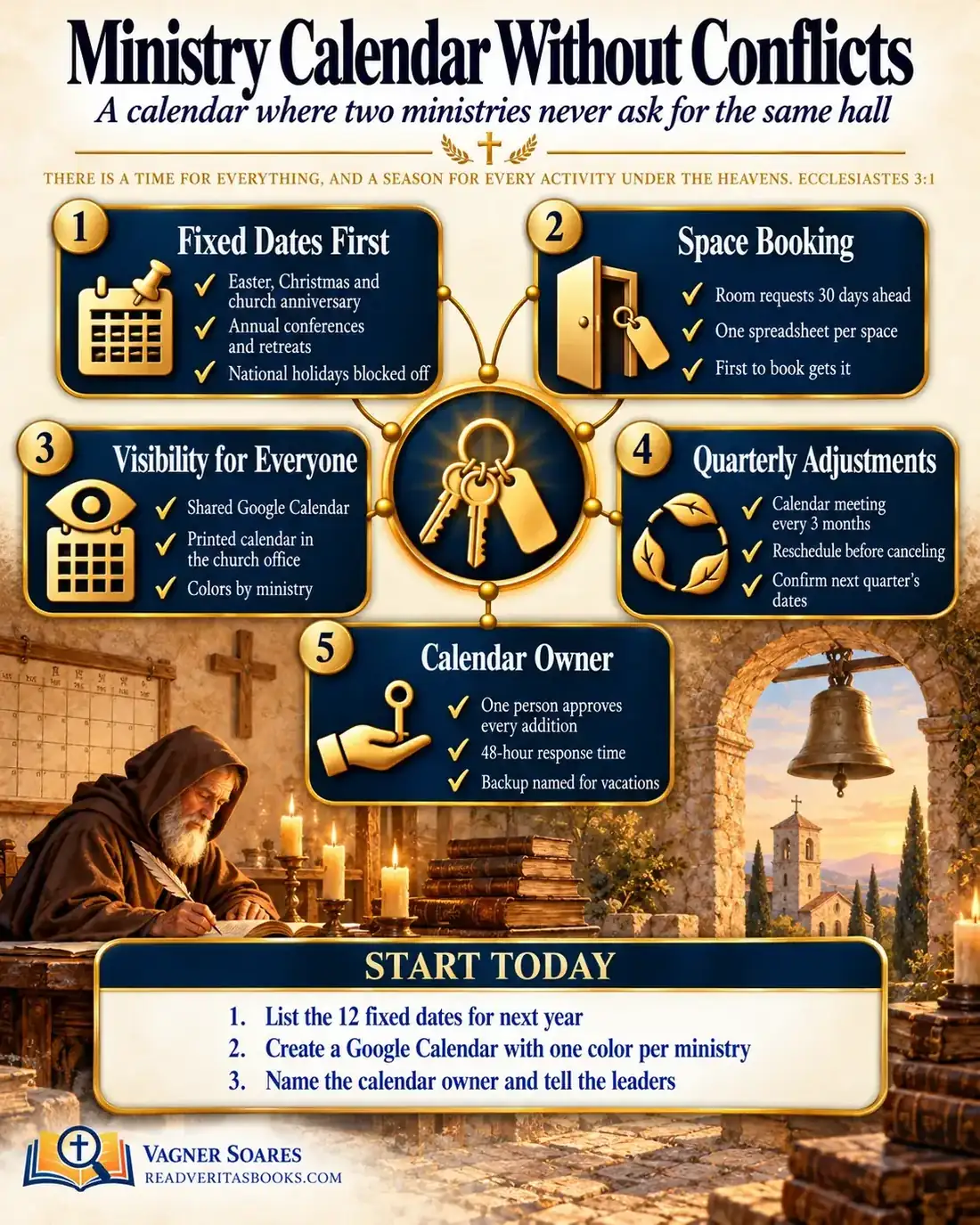
You know the scene: the youth ministry plans an event for Saturday, the married couples group schedules a dinner the same night, and both discover the clash after the invitations are printed. The same volunteers get two requests, the fellowship hall is promised twice, and someone walks away hurt. It is not a lack of goodwill; it is the lack of a single calendar.
This guide shows you how to build an annual ministry calendar that your whole leadership team respects: fixed dates first, room booking with a clear rule, a shared church calendar everyone can see, a review every quarter, and one named person looking after it all.
There is a time for everything, and a season for every activity under the heavens.
Ecclesiastes 3:1
Why separate ministry schedules always end in clashes
When each ministry keeps its plans in a notebook, a group chat, or the leader's head, no one sees the whole year. Clashes do not show up during planning. They show up the night before, when they cannot be solved without someone losing out, and the person who pays is usually the volunteer who serves in two or three ministries.
There is a quieter cost too: every conflict settled in the hallway leaves the impression that whoever speaks loudest wins.
An annual church calendar, single and with known rules, does not take autonomy away from any ministry. It simply ensures everyone plans while knowing what the others have already booked, and that conflicts are resolved on paper, months ahead.
Advertisement
Order, plans, and a willingness to give way: what Scripture teaches
The opening verse comes from a poem in which the Preacher observes that life has seasons: planting and harvesting, weeping and laughing, keeping silent and speaking. Ecclesiastes 3:1 is not a scheduling manual. But it reminds leaders of something easy to forget: not everything fits into the same moment, and recognizing that is wisdom.
The passage closest to our problem is 1 Corinthians 14:29-33. Paul is writing to a church whose gatherings were disorderly, with many speaking at once. He tells the prophets to speak "one by one, that all may learn, and all may be comforted," and gives the reason: "For God is not the author of confusion, but of peace" (1 Corinthians 14:33). The setting is the worship gathering, not the calendar. The principle still applies honestly: legitimate gifts get in each other's way when they compete for the same space, and Paul's answer is not to silence anyone but to give each one a turn.
James 4:13-15 sets the right tone. James rebukes merchants who announced a full year of business as if tomorrow were guaranteed. He does not condemn planning; he condemns presumption, and teaches believers to say, "If the Lord will, we shall live, and do this, or that." For a church, that means planning the year seriously and setting times to revisit the plan without drama.
And Philippians 2:4 speaks to the attitude of anyone who will have to give up a date: "Look not every man on his own things, but every man also on the things of others." A calendar only works when leaders accept that another ministry is God's work too.
Fixed dates first: the year's skeleton in one meeting
Before adding anything new, mark what repeats every year. These dates keep a new event from landing on the very weekend of a commitment no one can move. Do it in a single meeting with your pastor and ministry leaders, in the last quarter of the previous year:
- Project or print the calendar of the year that is ending and walk through it month by month, asking what repeated and what should repeat.
- Enter the whole-church celebrations first, such as Easter, Christmas, and the church anniversary, with the prep week, rehearsals, and setup already blocked out.
- Add each ministry's major events, such as conferences, retreats, and camps, even if the program is still open.
- Block off public holidays and long weekends, when many families travel. Only events that do not depend on attendance go there.
- Check volunteers: if two events close together rely on the same sound, worship, or children's team, space them out or arrange extra help now.
- Read the final list aloud and ask each leader to confirm their own dates. Whatever is confirmed goes on the calendar marked "fixed."
A good target is to leave with about 12 protected fixed dates. A simple annual plan the leadership actually uses says what the church wants to do; the calendar says when.
Space booking: a rule that decides before the argument
Many conflicts are not about dates but about rooms. Two events can share a day if they use different spaces; trouble starts when both are counting on the main hall or the kitchen. That is why church room booking needs a spreadsheet with one tab per space and a rule everyone knows before they need it.
Every request states the ministry, the contact person, date and time (including setup and cleanup), the space, the expected number of people, and any volunteers needed from other teams. With that in hand, the decision follows this rule:
- If the space is free and the request came in at least 30 days ahead, the calendar owner confirms within 48 hours.
- If it came in with less than 30 days' notice, but the space and volunteers are free, the owner confirms and notes "exception."
- If two requests compete for the same space, the first one in wins, and the second immediately gets two alternatives.
- If one of them is a fixed date, the fixed date takes priority.
- If a pastoral emergency comes up, such as a funeral, it goes first, and the affected ministry is told the same day.
- If there is still no agreement, the pastor decides and explains the reason to both leaders.
First come, first served can sound cold, but it protects relationships: decisions no longer depend on who pushes hardest. For day-to-day room use, see how to organize the use of church spaces without scheduling conflicts.
Advertisement
Visibility for everyone: the right format for your church's size
A calendar only one person can see prevents nothing. Every leader needs to check it before promising a date, and people who do not use smartphones should be able to see the plan without asking for favors.
Small church (up to about 100 people)
A free shared calendar, such as Google Calendar, with editing rights only for the person in charge, is enough. Add a printed monthly sheet on the noticeboard by the entrance and an announcement on the first Sunday of the month.
Medium church (100 to 400 people)
Give each ministry its own color, so anyone can see at a glance who is using each weekend. Leaders get the view-only link, and the church office posts the quarterly view on the wall. Your internal communication should always point to this calendar, never to parallel lists.
Large church (over 400 people)
It usually pays to separate an internal calendar, with every booking and setup, from a public one that shows only what members need to know. A church management system or a request form linked to the spreadsheet keeps bookings from arriving through scattered messages.
Quarterly adjustments: a ready-made agenda for the calendar meeting
No annual calendar survives untouched until December. As Proverbs 16:9 puts it, "A man’s heart deviseth his way: but the LORD directeth his steps." Instead of patching things on the fly, set a one-hour meeting in the first week of each quarter and use this agenda:
- Welcome and prayer (5 minutes).
- Thanks to anyone who gave up a date or a room last quarter (5 minutes).
- Review of the quarter just ended: which clashes appeared and where the rule failed (10 minutes).
- Read-through of the next three months, date by date, with each leader confirming or adjusting (20 minutes).
- New requests and clashes: another date or another room first, canceling only as a last resort (15 minutes).
- Action items: who tells which team what, by when, and the date of the next meeting (5 minutes).
Record the outcome in one-page minutes, listing the confirmed dates and the changes agreed.
Calendar owner: who it should be and what to watch
Every shared calendar needs someone who approves additions, updates the schedule the same day decisions are made, answers requests within 48 hours, and mediates clashes by the agreed rules. The hard question is who.
The options and their costs
If the pastor is the owner, decisions carry authority, but the pastor becomes a bottleneck and spends pastoral time on room bookings. If the role sits with the church office, there is availability, but there may not be enough authority to say no to a long-serving leader. An organized, respected volunteer is often the best balance, as long as the pastor publicly recognizes the role.
What to watch
The calendar owner applies rules, not preferences. If leaders sense favoritism, there is almost always a rule that was never written down. Watch for delays too: late answers send leaders back to booking on their own. And name a backup with access to the same spreadsheets, so vacations do not freeze the calendar.
Example: a 180-member church that stopped double-booking its hall
Imagine a church of 180 members with six ministries: children, youth, women, couples, worship, and outreach. The year before, the hall was promised twice on three occasions, and the couples' dinner was canceled in the final week.
In October, the pastor gathers the six leaders. The volunteer who already runs the church office brings a printout of the year's calendar. Month by month, the group records 12 fixed dates. While checking volunteers, a clash appears: the youth retreat and the women's conference both want the same long weekend in May, and both rely on the sound team. Since both are fixed events, the pastor decides on the spot: the retreat keeps its date, because the campsite has already been booked with a deposit, and the conference moves to the following week. Everyone thanks the women's ministry leader.
At the same meeting, the office volunteer is announced as calendar owner, with the treasurer as backup. She sets up the calendar with one color per ministry and a spreadsheet with four tabs: hall, two classrooms, and kitchen.
In March, the couples group asks for the hall with 20 days' notice. The space and kitchen are free, so she confirms the next day and notes "exception." At the April meeting, someone notices that the outreach work day falls on the cantata rehearsal; the rehearsal moves to another room. In July, the minutes record something new: no space was promised twice all semester.
Mistakes that make leaders stop trusting the calendar
Building the calendar alone in the office. Ministry leaders know dates and limits the pastor cannot see, and they only respect what they helped build.
Letting the schedule go stale. One change agreed in the hallway and never recorded is enough for someone to book right on top of it. Decided today, updated today.
Looking only at rooms and forgetting people. Events in different spaces still clash if they rely on the same volunteers; caring for serving schedules that don't overload the same people is part of the calendar.
Signs your calendar is working
- Leaders check the calendar before announcing any date to their teams.
- Clashes surface at the quarterly meetings, with months to spare, not the night before.
- No one has to ask the pastor whether the hall is free.
- Anyone who gives up a date is thanked publicly.
Frequently asked questions
Do we need special software for a church ministry calendar?
Not necessarily. A free shared calendar and one spreadsheet per space solve most of the problem for many churches. What makes the difference is clear rules and one responsible person.
Who decides when two ministries want the same date?
The calendar owner, applying the agreed rules: fixed dates take priority and, among ordinary requests, the first one in wins. When a case is sensitive or involves two fixed events, the owner brings it to the pastor.
How far ahead should we build the annual church calendar?
A good rule of thumb is to start in the last quarter of the previous year, in October or November. That way the fixed dates are already protected when January arrives.
What about events that come up at the last minute?
They go in as a recorded exception, as long as the space and volunteers are free. Pastoral emergencies take priority, but the ministry that loses the room is told the same day and offered another date.
A single, visible ministry calendar prevents most last-minute conflicts and frees leaders to care for people instead of competing for rooms. Before making room for something new, read how to launch a new ministry without disrupting the others, bring the same care to serving schedules that don't overload the same people, and see the complete guide to ministry organization.

Vagner Soares is a presbyter with pastoral ordination, a mentor and a digital entrepreneur with more than 10 years of experience in technology, digital marketing and education.
Keep reading
 Ministry organizationHow to Launch a New Ministry Without Disrupting the Ones You Already HaveA step-by-step plan to launch a new church ministry: validate the need, choose a leader, fit it in with others, plan resources, and evaluate it at 90 days.Read the article
 Ministry organizationMusic ministry beyond worship: choir, instrumental and special events without overloading peopleOrganize your music ministry beyond worship: a map of the groups, one rehearsal calendar, rotating teams, one-off events and healthy limits on schedules.Read the article
 Ministry organization · Reference guideComplete ministry organization guide: your church's whole ministry structure on one pageOrganize your church ministries with this complete guide: structure and leaders, small groups, schedules and teams, safety and care, and orderly growth.Read the article