
How to make a simple annual plan that your leaders actually use
Build a one-page annual plan for your church: clear priorities, quarterly check-ins, adjustments without guilt and a year-end review with your leaders.

In this article
- Why the long plan never makes it to March
- Planning and trusting: what the Bible says about making plans
- Just one page: a ready-to-copy template
- This year's priorities: choosing a few and saying no to the rest
- Quarterly check-in: the meeting that keeps the page alive
- Mid-course adjustments: when to change and when to persist
- Year-end review: closing the cycle honestly
- Example: a church of 145 members, from paper to practice
- Mistakes that send the plan back to the drawer
- Signs your leaders are using the plan
- Frequently asked questions
Free mind map
This whole guide on one page
The five steps in this article as an infographic you can print, pin on the notice board or send to your team.
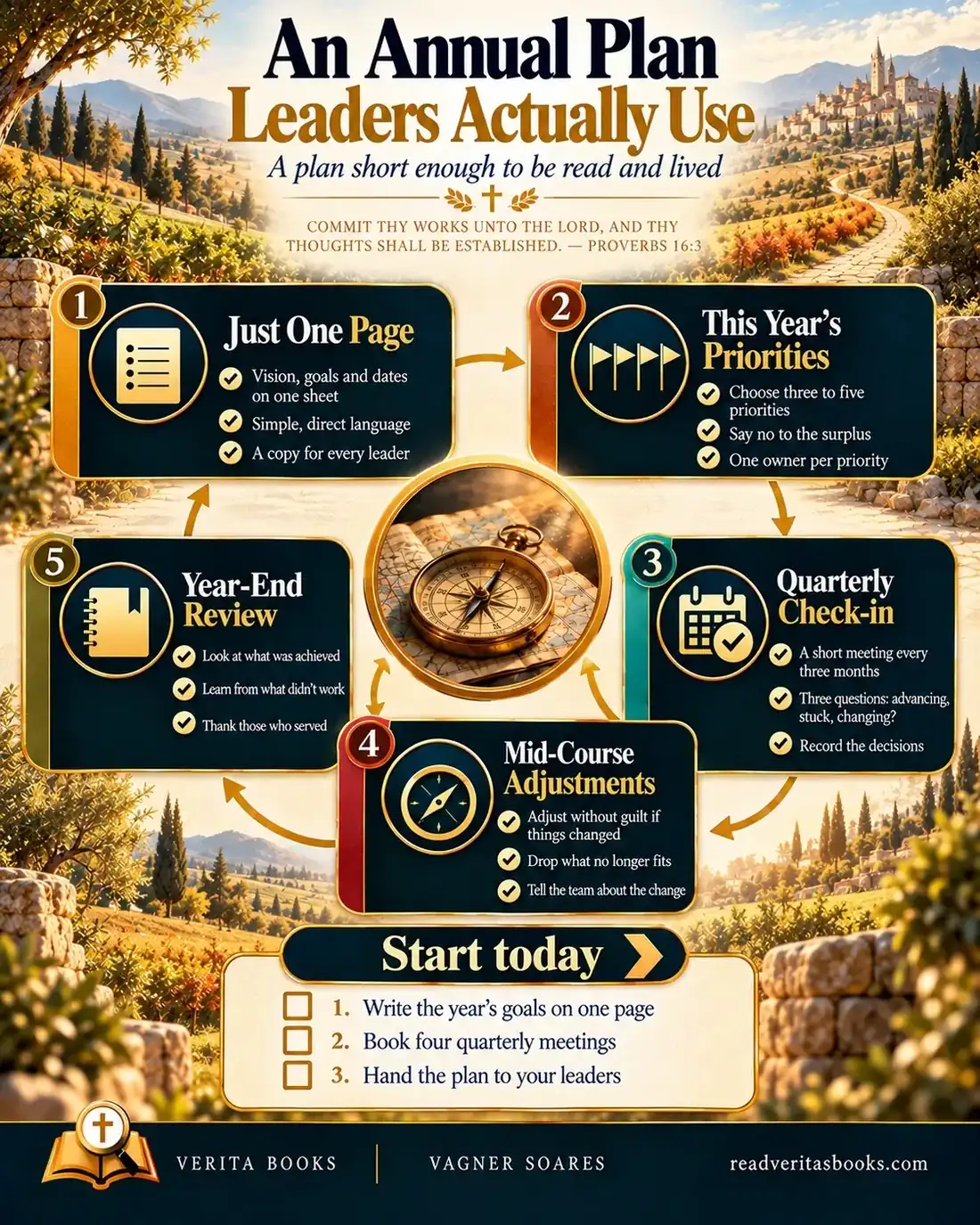
Many churches begin the year with a beautiful multi-page plan that nobody rereads after February. The problem is rarely a lack of vision. It is a document too long to remember and too complicated to use in leadership meetings.
This guide takes the opposite route: a church annual plan that fits on one sheet, with a few priorities, four check-in meetings and an honest review at the end. An annual plan your leaders read, understand and actually consult.
Commit thy works unto the LORD, and thy thoughts shall be established.
Proverbs 16:3
Why the long plan never makes it to March
The long plan usually comes from a good desire: not to forget anything. Every ministry adds its dreams, the pastor adds the vision, someone attaches the events calendar, and in the end there are thirty goals all carrying the same weight. In January, everyone applauds. By March, nobody can name the three things that mattered most.
A plan only guides when people remember it without opening the file. A few priorities, in short sentences, can be repeated at the service, in the leaders' meeting and in the car park. The short plan also protects your leaders from saying yes to everything: turning down a good idea that doesn't fit now stops being personal, because the answer becomes "that isn't one of our priorities this year".
Advertisement
Planning and trusting: what the Bible says about making plans
Some believers are wary of planning, as if writing goals were a lack of faith. Scripture does not support that idea, but neither does it approve the arrogance of thinking we control the future.
In Luke 14:28-30, Jesus speaks to the crowds about the cost of following him and uses an everyday picture: who, "intending to build a tower, sitteth not down first, and counteth the cost"? The subject of the passage is discipleship, not church administration. But the illustration only works because Jesus treats it as obvious that a sensible person does the sums before starting.
Proverbs 16 completes the opening verse: "A man's heart deviseth his way: but the LORD directeth his steps" (Proverbs 16:9). The text assumes that people plan, and it affirms that the final direction belongs to God. Proverbs 15:22 adds that "in the multitude of counsellors they are established", a good reason to plan together rather than alone.
James 4:13-15, finally, rebukes those who talk of spending "a year" in a certain city as if tomorrow were guaranteed. James does not forbid plans; he corrects the attitude: "If the Lord will, we shall live, and do this, or that." The principle for the church: plan carefully, with counsel, and hold the plan with open hands.
Just one page: a ready-to-copy template
The single page has to be readable in a few minutes by any leader, including a volunteer who arrived six months ago. If someone needs an explanation to understand a line, that line is still too complicated. Copy this template into a document or spreadsheet and fill it in with your leaders:
- Vision for the year: one sentence. Example: "This year we want every visitor to be followed up and every member to be connected to a small group."
- Priorities: five at most, each with an owner and a sign that it worked.
- Not this year: the good ideas the leadership decided not to pursue now.
- Fixed dates: the four quarterly check-ins, the year-end review and the major events already confirmed.
- Resources: the approximate amount set aside for each priority, in line with the approved budget.
Each priority fits on one line: "Organize the welcome of visitors. Owner, the welcome team coordinator. We will know it worked when every visitor is contacted within a week."
Once the page is ready, print a copy for every ministry leader and send the digital version to the leaders' group. A plan that only the pastor has guides no one.
This year's priorities: choosing a few and saying no to the rest
When everything is a priority, nothing gets enough time, money or attention to move. This process fits into one meeting of two to three hours:
- Before the meeting, ask each leader for two written answers: what worries them most about their ministry, and what the whole church needs to do better next year.
- In the meeting, read the answers aloud and group the similar ones.
- For each theme, ask whether there are people, money and time to move it forward this year. Look at reality, not only at wishes.
- Narrow it down to three to five priorities. If there is no agreement, each person votes for three themes and the most voted go into the final discussion.
- Write the "not this year" list with what was left over. It shows the ideas were heard, just not chosen for now.
- Put a name on each priority. Without an owner, the task belongs to everyone and ends up belonging to no one. The owner doesn't do everything alone; they make sure the priority moves and report on progress.
- Close by praying over the chosen priorities and committing the plan to the Lord.
Advertisement
Quarterly check-in: the meeting that keeps the page alive
The quarterly check-in shows in time what is moving and what has stalled. The structure never changes: for each priority, the owner answers three questions. What moved forward? What got stuck? What needs to change? Decisions are written down with the name of whoever takes each step, so the next meeting doesn't start from zero.
Book all four dates at the start of the year. If they depend on goodwill every quarter, the calendar will swallow them. The format changes with the size of the church.
Small church, up to about 100 people
The pastor and three or four leaders meet for an hour, often after the service. Someone records the decisions on the back of the plan or in a shared note.
Medium church, between 100 and 400 people
Each owner sends a short paragraph with the three answers a few days before. The meeting lasts about ninety minutes and starts with the stalled priorities. A secretary records the decisions in simple minutes.
Large church, with several teams
Ministries hold their own check-ins first and bring a summary. The central meeting deals only with what needs a decision from the senior leadership. A simple dashboard helps, in a spreadsheet or your church management system, with one colour per priority (on track, watch, stalled), alongside a few simple church indicators.
Mid-course adjustments: when to change and when to persist
In Acts 16:6-10, Paul and his companions try to preach in Asia and then to go into Bithynia, and the Spirit does not allow it. They don't abandon the mission; they change route and head for Macedonia. Adjusting the plan is maturity, not failure. The challenge is telling an adjustment apart from giving up out of tiredness.
If a priority stalled because its owner left or fell ill, don't change the priority: replace or share the responsibility at the same check-in.
If it stalled for lack of money, check with the treasurer whether the funds can come from another budget line. If they can't, scale the goal down rather than cancelling it.
If reality has truly changed (the church lost its meeting place, for example), the leadership may replace the priority, always in a meeting, and move the old one to "not this year".
If a priority has barely moved for two quarters in a row with no clear reason, ask whether it still makes sense. Items that stay just because they are listed clutter the page.
If a new opportunity appears, it doesn't go in automatically. Ask what comes out so it can come in; if nothing can, it waits for the review.
In every case, tell the team about the change and explain why, without looking for someone to blame.
Year-end review: closing the cycle honestly
"So teach us to number our days, that we may apply our hearts unto wisdom" (Psalm 90:12). Looking back with honesty is one way of seeking wisdom for the year ahead.
Start with what was achieved, priority by priority, with simple numbers and concrete stories. Numbers alone make the conversation cold; stories alone hide what didn't move. Together they give a faithful picture.
Then talk frankly about what didn't work. The biggest risk here is turning the review into a judgement of people. Talk about processes ("nobody was looking after registrations") before talking about individuals, and deal with personal issues in private.
Finally, thank in person those who served, including those who worked quietly. The review ends with three questions that already feed the next plan: what continues, what ends and what begins.
Example: a church of 145 members, from paper to practice
Picture a church of 145 members that drew up a twelve-page plan every year. In November, the pastor notices that nobody remembers the goals and decides to try the single page.
In December, he asks each of the six ministry leaders for the two written answers. At the Saturday meeting, the themes that come up most are following up visitors, training leaders, renovating the hall toilets and a shortage of children's ministry teachers. The treasurer reminds everyone that the budget only covers one building project. The leadership chooses three priorities: visitors, children's teachers and the renovation. Leader training goes on the "not this year" list.
The welcome team coordinator takes the visitors, a married couple who teach take the children's ministry and a deacon oversees the renovation. The church secretary types up the page, prints seven copies and books four check-ins, always on the second Sunday of the quarter, after the evening service.
At the April check-in, the children's ministry has stalled: only one new teacher has come forward. The decision written down is to invite five people personally and offer a two-evening training. In July, the deacon overseeing the renovation moves away; another member takes over and the name is changed on the page.
In December, the review shows the renovation finished, four new teachers and most visitors contacted within the first week. The pastor reads two accounts of families who stayed after a phone call. Leader training becomes the first priority of the next plan.
Mistakes that send the plan back to the drawer
The most common mistake is accepting too many priorities so as not to disappoint anyone. If the list runs past five, it isn't a priority list yet.
Another is treating the plan as the pastor's document. When leaders don't take part in choosing, they carry out tasks but don't commit to the direction.
It is also common to book only the first check-in. Without the dates fixed in January, follow-up vanishes in the second half of the year.
And beware of a plan cut off from money and the calendar. A priority with no budget and no space in the annual ministry calendar is just a well-written wish.
Signs your leaders are using the plan
The plan has left the paper when leaders quote the priorities without looking at the sheet, and when someone proposes a new event and another leader naturally asks which priority it fits under.
Another sign is a check-in that ends with decisions and names, not just reports. And the clearest one comes in December: the review has plenty to work with, because decisions were written down, and your leaders arrive with suggestions for the next year.
Frequently asked questions
What is the best month to do annual planning for a church?
The one your church can actually keep. Many churches plan between the end of one year and the start of the next, but you can adopt a ministry year that starts in another month. What matters is setting the dates for planning, check-ins and review well in advance.
Who should take part in building the annual plan?
The pastor, the ministry leaders and a few trusted people who know the church's reality, including whoever handles the finances. The more people you listen to first, the more people commit later.
Does a small church need an annual plan?
Yes, in a small format. One sheet with three priorities, owners and dates already helps the church use its time better and rely less on improvising.
What is the difference between strategic planning and an annual plan?
Strategic planning looks several years ahead and sets direction and major goals. The annual plan chooses which part of that path will be walked in the next twelve months. If your church has no long-term direction yet, the annual plan can start on its own and feed that reflection later.
A good annual plan is short, known and revisited. To go deeper, see the complete guide to strategic planning, learn to keep vision and values in a living document, set clear ministry goals for each area and track progress with 5 simple church indicators.

Vagner Soares is a presbyter with pastoral ordination, a mentor and a digital entrepreneur with more than 10 years of experience in technology, digital marketing and education.
Keep reading
 Strategic planningMinistry goals: how to set clear objectives for every area of the churchSet clear goals for every church ministry: measurable objectives, one owner per goal, a realistic deadline, simple tracking and time to celebrate what God did.Read the article
 Strategic planningHard Decisions in Church: How to Decide Without Paralyzing Your LeadershipLearn when to seek consensus and when someone must decide, how to hear everyone with a clear process, set a deadline, and announce the final decision.Read the article
 Strategic planning · Reference guideComplete guide to church strategic planning: from diagnosis to reviewA complete guide to church strategic planning: diagnosis, vision and values, action plan, indicators and ongoing review to take your plan off the page.Read the article