
Church Vision and Values as a Living Document That Guides Real Decisions
Write your church vision and values in 25 words or fewer, build the text with your leaders, and actually use it in monthly meetings and decisions.

In this article
- Mission, vision and values: what each one answers
- What Habakkuk and Acts teach about writing the direction down
- Why write it down: the direction leaves the pastor's head
- Involving leadership: a script for a two-hour meeting
- Plain language: before and after
- Everyday use: one rule for every proposal
- Periodic review: small, medium and large churches
- Example: the 180-member church whose vision lived in the bylaws
- Signs the document is alive
- Mistakes that send the vision back to the drawer
- Frequently asked questions
Free mind map
This whole guide on one page
The five steps in this article as an infographic you can print, pin on the notice board or send to your team.
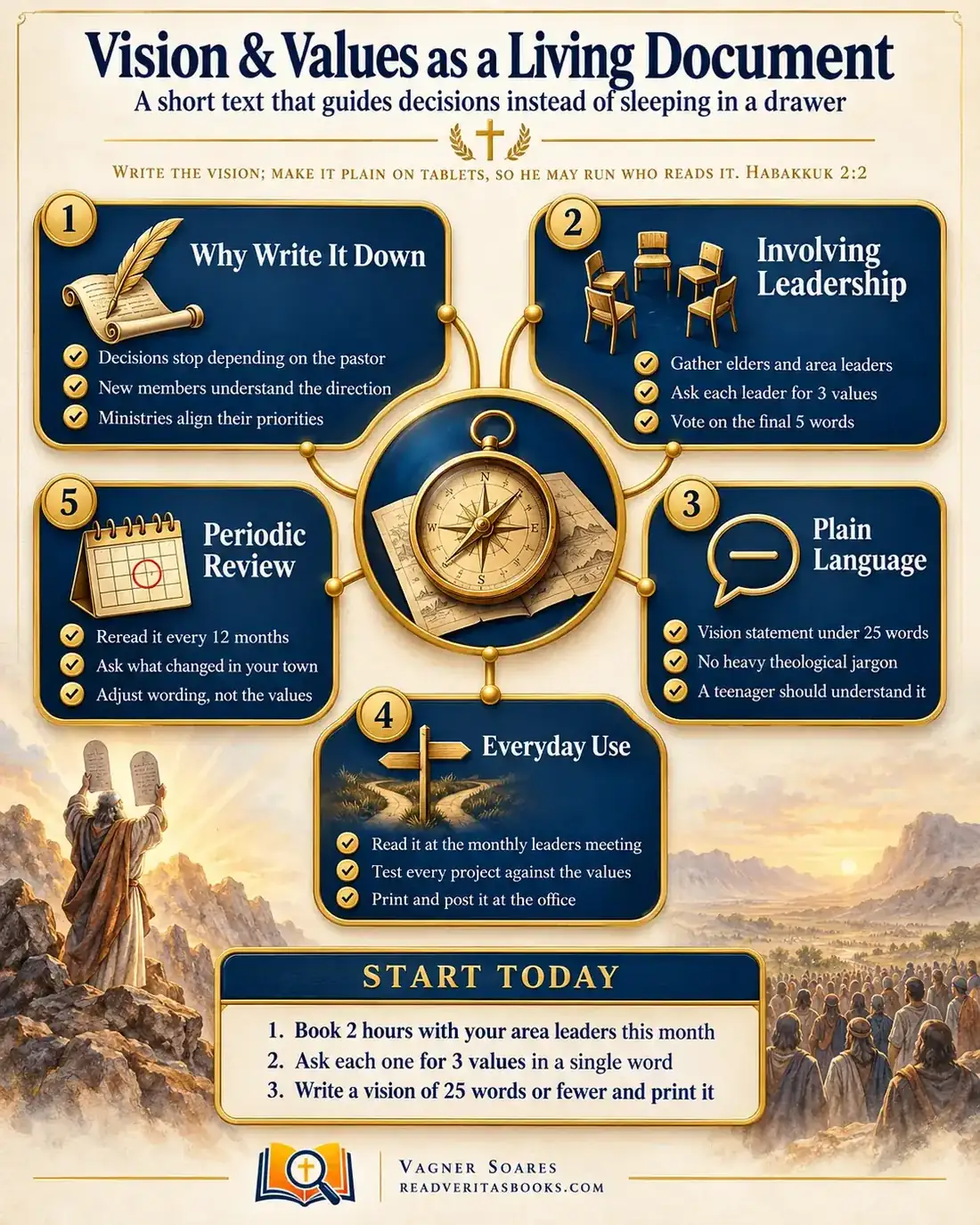
Most churches have a vision statement somewhere: on an old slide, in an office folder, in the bylaws. Hardly anyone remembers what it says, and decisions keep following whoever speaks loudest. When a new project comes up, the question "does this fit who we are?" goes unanswered.
This article shows how to write your church vision and values as a short text built with your leaders, and how to use it in every monthly meeting until it becomes a living document rather than a plaque on the wall.
Write the vision; make it plain on tablets, so he may run who reads it
Habakkuk 2:2
Mission, vision and values: what each one answers
The three words always travel together and are easily confused. The mission answers why the church exists, and much of it is already given in the gospel. The vision answers where this church, in this neighborhood and in this season, wants to go over the next few years. The values answer how it will get there: the attitudes it will not trade away, even when that would be easier.
A church vision statement that works can be said in one breath, in 25 words or fewer. The values number three to five, each with a sentence that shows the behavior you expect.
Advertisement
What Habakkuk and Acts teach about writing the direction down
The opening verse comes out of a hard conversation. Habakkuk asks God why injustice continues in Judah and hears that the Chaldeans will come as an instrument of judgment. In chapter 2 the Lord tells him to record the revelation on tablets, legibly, "that he may run that readeth it" (Habakkuk 2:2), and adds that "the vision is yet for an appointed time" (Habakkuk 2:3).
We need to be honest with the text. Habakkuk's vision is prophetic revelation, not a church plan drafted in a meeting. The same goes for Proverbs 29:18, "Where there is no vision, the people perish": the word refers to God's revelation guiding his people, not to the lack of a strategic plan. What we can fairly draw from these texts is a principle of communication: what matters to the community should be written down clearly, so that others can read it and carry it forward.
Acts shows leaders doing exactly that. In Acts 6:2-4, faced with a complaint about widows being neglected, the apostles gather the disciples, set a priority ("we will give ourselves continually to prayer, and to the ministry of the word") and involve the community in choosing who would serve tables. In Acts 15 the apostles and elders, "with the whole church" (Acts 15:22), put their decision in a letter that says "it seemed good to the Holy Ghost, and to us" (Acts 15:28), and when the believers in Antioch read it, "they rejoiced for the consolation" (Acts 15:31). The principle for church administration: decide together, in prayer, and write it so that people who were not in the room understand what was decided and why.
Why write it down: the direction leaves the pastor's head
As long as the vision lives only in the pastor's head, every decision has to go through the pastor. The youth camp, the new projector, the coffee time: everything depends on catching the pastor on a good day. Each ministry reads the direction its own way, and conflicts look personal when what is really missing is a shared standard.
Writing it down is not paperwork. It shares the responsibility of seeing the road ahead. With a clear text, a deacon can say "this isn't a priority right now" without seeming to block someone out of personal taste. And in hard seasons the text reminds everyone what must not change, which helps the church grow without losing its identity.
Involving leadership: a script for a two-hour meeting
A vision drafted behind closed doors is usually received politely and forgotten quickly. When leaders help build it, they defend it, because they recognize their own words in it. Invite elders and deacons, but also the people who run ministries every week.
- Open in prayer and explain that nobody is approving a finished text: the group will build the first draft together.
- Ask the central question and allow five minutes of silence: "What must this church never stop being, even if everything else changes?" Each person writes down three values, one word each, without talking first, so the first opinion does not pull the others along.
- Write every word on a whiteboard and group the ones that say the same thing, such as "welcome" and "receive well".
- For each of the most common words, ask where the group saw it happen in the past year. A value nobody can illustrate is still a wish; note it separately, because it may become a goal.
- Choose up to five words together.
- For the vision, ask each person to finish the sentence "Five years from now, we want our neighborhood to say this church..." out loud, and highlight the phrases that keep coming back.
- Name two people to draft a vision of 25 words or fewer, set the date it returns to the group, and record in the minutes who attended, the words chosen and the deadline.
If you cannot agree on a point, do not force a vote the same day. A second conversation, with time and prayer, usually settles what haste complicates.
Advertisement
Plain language: before and after
A value only guides decisions if people understand it instantly. That is why the rule is strict: no more than 25 words for the vision and sentences a teenager can follow without help.
Look at a rewrite. A version often found in bylaws: "To be a Christ-centered, missional and relevant community, committed to liturgical excellence, the integral edification of the saints and the holistic transformation of contemporary society." Nobody repeats that in the hallway. The revised version: "To be a family that welcomes, teaches the Word and serves our neighborhood, so that every person knows Jesus and grows in him." That is 23 words, and a teenager can explain every one.
Church core values examples, written as behavior
A single word is vague; add what happens when the value is present. Examples to adapt:
- Welcome: nobody goes through a first visit without being greeted by name and invited for coffee.
- Word: major decisions are made with the Bible open, and there is teaching for every age.
- Service: every member is encouraged to serve somewhere, and nobody serves alone for long.
- Transparency: the finances are presented to the church in a way people understand, on the agreed dates.
- Simplicity: we prefer a few activities done well to many empty ones.
Read the final text to a 13 or 14 year old and ask them to explain it back. If they stumble on a phrase, change it.
Everyday use: one rule for every proposal
A document stays alive only if it is used in real decisions. The most common risk is approving the vision with enthusiasm and never mentioning it again. A simple rule prevents that: before discussing cost and dates, the person proposing says in one sentence which value the idea strengthens. Then:
- If the proposal clearly strengthens a value and fits the calendar and budget, move on to the details and name someone responsible.
- If it strengthens a value but competes with another activity that strengthens the same value, choose the one that serves better and postpone or merge the other.
- If nobody can connect it to any value, do not reject it on the spot. Ask its author to rewrite it within two weeks; if there is still no connection, the answer is no, and the minutes record the reason.
- If the proposal goes against a value, decline kindly and explain which value is at stake.
Build in fixed moments too: open the monthly leaders meeting by reading the text and giving someone one minute to share where they saw a value in action, and include the vision in your newcomers class. When a choice is genuinely heavy, the article on difficult decisions in the church helps you move forward without paralyzing your leaders.
Periodic review: small, medium and large churches
Living does not mean unstable. Values usually last for many years; what changes is the setting. Reread the text every 12 months, ideally close to your annual planning. Adjusting wording that has aged is routine; changing a value is a bigger decision that needs time and broad input. At every review, ask what has changed in your neighborhood and whether the text still speaks to it.
Small church, up to about 100 people
The pastor and three or four leaders do the review in one evening. They share two recent stories where each value showed up, say what sounded odd during the year, and present any changes to the church during a service, in a few minutes.
Medium church, a few hundred people
Each ministry brings, in writing, one activity that strengthened a value and one that drifted away from it. The leadership gathers the answers before the meeting, and the new wording is presented at a members meeting or a service, following the church's usual practice.
Large church
The review needs its own calendar: a short consultation with area leaders, a small group that pulls the answers together, and a date to communicate. Watch for consistency: every team and campus uses the same text, with no homemade versions.
Example: the 180-member church whose vision lived in the bylaws
Consider a church of 180 members whose vision appears only in the bylaws, in a 60-word paragraph nobody reads. In the same month three proposals arrive: an expensive couples retreat, a homework club for neighborhood children and a new sound desk. The meeting runs late with no decision, and two leaders leave upset.
The pastor decides to start with the text. He invites six elders and deacons and five area leaders to a Saturday morning, from 9 to 11. On the whiteboard, the most repeated words are welcome, teach, serve the neighborhood and family. "Excellence" appears twice, but nobody can give an example from the past year, so the group notes it as a goal for the worship team. The secretary records in the minutes who attended, the four words and the three-week deadline.
A deaconess and the youth leader draft the vision: "To be a family that welcomes, teaches the Word and serves our neighborhood, so that every person knows Jesus and grows in him."
At the next meeting the proposals go through the rule. The homework club connects to serving the neighborhood and teaching, and is approved with a person in charge and a spending cap. The retreat strengthens family, but the price would leave half the couples out; the group asks for a simpler version on a farm lent by a member. The sound desk does not connect to any value, and the treasurer agrees to check whether the current one can be fixed with maintenance. Twelve months later, at the review already on the calendar, the group changes one word of the vision and keeps all four values.
Signs the document is alive
- Leaders quote the vision without reading it.
- The minutes include lines like "approved because it strengthens our welcome".
- The church has already said no to a good idea because of the text, without a fight.
- The next review is on the calendar.
Mistakes that send the vision back to the drawer
Writing the text alone and presenting it finished means it will be received as the pastor's opinion. A list of ten or twelve values stays in nobody's memory. Mentioning the vision only on the church anniversary turns it into decoration. And rewriting everything with each new idea teaches the church that the text is worth little.
Frequently asked questions
What is the difference between church mission, vision and values?
The mission says why the church exists, and much of it is already given in the gospel. The vision describes where this particular church wants to go in the next few years, in its place and time. The values show how it will get there and which attitudes it will not compromise.
How do you write a church vision statement in a few words?
Gather the phrases your leaders repeated most, write a first sentence and count the words. Cut adjectives, technical terms and repetition until you reach 25 words or fewer. Then read it to a teenager and rewrite whatever they cannot explain.
Does the vision need to be in the bylaws?
Not necessarily. Bylaws have a legal purpose and their own rules for amendment, while the vision is a working text whose wording changes more easily. If you want to include it in the bylaws, check first with a lawyer or accountant how future changes would be handled.
With a clear vision and values that are actually used, your planning has a compass. Next, explore the complete guide to strategic planning, start with an honest church health check, and learn to run a leadership meeting that ends in a decision.

Vagner Soares is a presbyter with pastoral ordination, a mentor and a digital entrepreneur with more than 10 years of experience in technology, digital marketing and education.
Keep reading
 Strategic planningPlanning Your Church's Physical Growth: Space, Building Projects, and PhasesLearn how to tell when your building is too small, which options to try before you build, and how to plan expansion in phases with reserves and a vote.Read the article
 Strategic planning · Reference guideComplete guide to church strategic planning: from diagnosis to reviewA complete guide to church strategic planning: diagnosis, vision and values, action plan, indicators and ongoing review to take your plan off the page.Read the article
 Strategic planningHard Decisions in Church: How to Decide Without Paralyzing Your LeadershipLearn when to seek consensus and when someone must decide, how to hear everyone with a clear process, set a deadline, and announce the final decision.Read the article