
Leadership meetings that end in decisions, not just discussion
Run leadership meetings with a 3-item agenda, a 90-minute cap, same-day minutes and one owner per decision, so you leave with a name and a date.

In this article
- Why so many leadership meetings end without a decision
- Deciding together in Scripture: the counsel of Proverbs and the council of Acts 15
- Clear agenda: three questions that need an answer
- Set time limit: a running order for a 90-minute meeting
- Decision log: minutes that fit in one message
- Named owners: who takes each decision
- Follow-up: how to fit it to the size of your church
- A worked example: the leadership that kept postponing the renovation
- Mistakes that send a topic back to square one
- Signs your meetings now end in decisions
- Frequently asked questions
Free mind map
This whole guide on one page
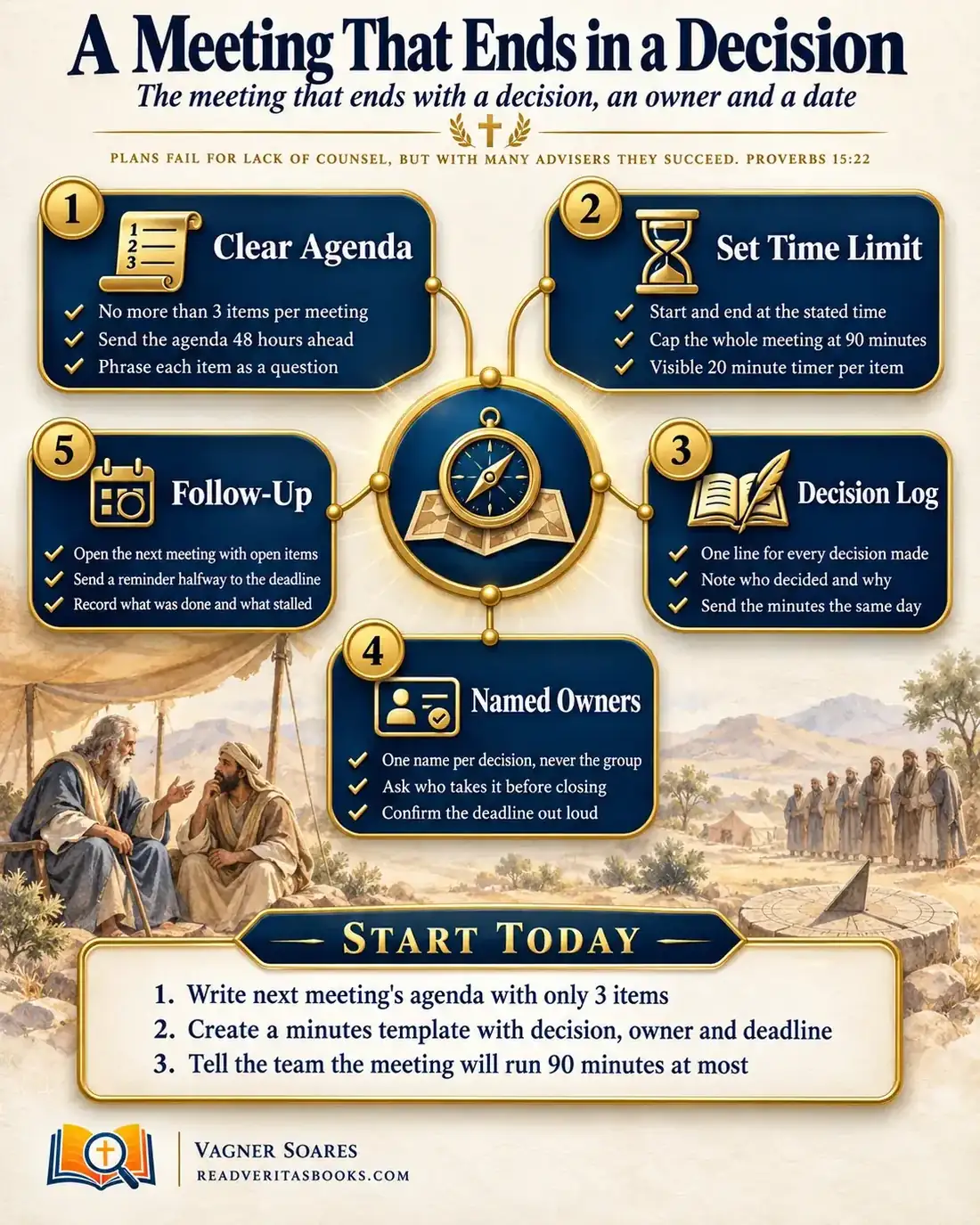
The five steps in this article as an infographic you can print, pin on the notice board or send to your team.
The meeting started late, the first topic ate up a full hour, and well into the evening someone said, "Let's think about it some more and come back to it." The next month the same topic was back on the agenda, and no one could remember exactly what had been agreed.
Usually the problem is method, not goodwill. This guide shows you how to run your church leadership meeting so it ends with a decision, an owner and a date.
Plans fail for lack of counsel, but with many advisers they succeed
Proverbs 15:22
Why so many leadership meetings end without a decision
Meetings that never decide tend to share the same causes. The first is mixing announcements with decisions: half the time goes to updates that could have arrived by message, and the topic that needed the group is left for the end, when everyone is tired.
The second is arriving without a question. "Let's talk about the sound system" opens an endless conversation; "Do we buy the new mixing desk now or wait for another quote?" asks for an answer. The third is not knowing who decides. If no one has agreed whether a topic belongs to the full leadership, the pastor or a committee, the discussion circles and no one feels free to close it.
Advertisement
Deciding together in Scripture: the counsel of Proverbs and the council of Acts 15
The opening verse is a piece of wisdom about how life usually works. Its second half completes the thought: "in the multitude of counsellors they are established" (Proverbs 15:22). The text values hearing several voices before acting. It does not say that the longer you talk the better, or that every decision needs unanimity. Counsel exists to establish plans, not to replace them.
Acts 15 shows this in a real and tense situation. There was a serious dispute over what to require of Gentile believers, and the apostles and elders came together "for to consider of this matter" (Acts 15:6). There was debate, testimony and an appeal to Scripture, but the meeting ended with a conclusion: "it seemed good to the Holy Ghost, and to us" (Acts 15:28). The decision was put into a letter, named men, Judas and Silas, were chosen to carry it (Acts 15:22), and the letter was delivered to the gathered church in Antioch (Acts 15:30-31).
The passage is not a meeting manual and gives no ideal length or voting method. It does show a sequence: consider seriously, reach a conclusion, write it down, name who carries it forward and communicate it. Something similar appears in Acts 6:3-5, where the apostles set criteria, the community chooses seven men and their names are recorded. The principle for church administration: seeking counsel is part of deciding, and a decision is only complete when someone knows what to do with it.
Clear agenda: three questions that need an answer
The agenda is the meeting's map. Without one, the most urgent topic, or the loudest voice, takes over. The rule is firm: no more than 3 decision items, each written as a question, sent 48 hours ahead.
Before you build the agenda, sort the items. Information goes into a written update. Anything one leader can settle alone, within what has already been approved, goes to that leader. Only what needs the group makes the agenda; if more than three items remain, the less urgent ones wait for next month. Here is a message you can copy and adapt:
"Grace and peace, team! Our leadership meeting is on Thursday, 7:30 to 9:00 pm, in Room 2. We will start and finish on time.
For decision:
- Will the Christmas service be on Saturday or Sunday evening?
- Do we approve buying the mixing desk up to the amount in the attached quote, or wait for a second quote?
- Who will lead the welcome team from February?
To read beforehand (not for discussion): the December calendar and the monthly finance summary, attached. If you have important information on any item, reply by tomorrow evening."
Set time limit: a running order for a 90-minute meeting
A meeting with no end time fills the whole evening. A 90-minute cap, stated in the invitation, is a commitment to each leader's family. One possible running order:
- Prayer and a brief word (10 minutes).
- Review of open items from the last minutes (10 minutes). Each owner says in one sentence whether it is done, moving or stuck.
- First decision item (20 minutes), presented in three minutes at most by whoever raised it.
- Second decision item (20 minutes).
- Third decision item (20 minutes).
- Read the decisions aloud, with owner and deadline (5 minutes).
- Buffer for the unexpected (5 minutes).
Use a visible timer, on a phone or a clock everyone can see, and give a heads-up when five minutes remain on each item. Begin on time even if someone is missing, and close on time even if there is more to say. If an item runs over, leadership decides on the spot whether to add five minutes, taken from another item, or to turn the topic into a preparation task.
Advertisement
Decision log: minutes that fit in one message
A decision that isn't written down is remembered differently by everyone. A log prevents "that's not what we agreed" and gives a memory to whoever joins leadership later. You don't need long minutes: one line per decision, with what was decided, who decided, the main reason, the owner and the deadline. For example:
"Leadership meeting, Thursday, 7:30 pm. Present: seven leaders.
- The Christmas service will be on Sunday at 7 pm. Decided by the full leadership, because the building is already booked for a wedding on Saturday. Owner: worship leader, with the rota ready by the 10th.
- The mixing desk will be bought only after a second quote, to compare warranties. Owner: treasurer, who brings the quote to the next meeting.
- The welcome team will be led by the sister who already serves on it, if she agrees. Owner of that conversation: pastor, by Sunday.
Earlier open items: children's room painting done; membership list review behind, new deadline the 20th."
Send it the same day, ideally before you go to bed, and keep a copy in a shared document, always in the same place. This is the leadership's internal record; minutes of members' meetings, or of decisions your constitution requires you to record, have their own format, so follow your governing documents and check the details with your church's accountant or lawyer. To keep that archive in order, see how to organize church minutes and official records.
Named owners: who takes each decision
"We'll look into it" is the phrase that buries more decisions than any other. When a task belongs to the group, everyone assumes someone else has it.
Moses heard from his father-in-law that "thou art not able to perform it thyself alone" (Exodus 18:18). The answer was to share the work among chosen people with clear limits, not to leave it floating among everyone. Before you close each agenda item, apply these rules:
- If the decision sits within one ministry, the owner is that ministry's leader, unless they name someone else right there.
- If it involves several ministries, choose a single name to answer for progress; the others help, but they don't share the accountability.
- If no one volunteers, the decision isn't ready yet. Ask what is missing, because sometimes it is resources and sometimes it is clarity.
- If the person already has three open tasks, find another name or take something off their list.
Once the name is set, ask: "By when can you have this done?" Let the person say the date aloud, in their own words.
Follow-up: how to fit it to the size of your church
Without follow-up, even the best decision dies quietly. The principle is the same everywhere: open the meeting with open items, send a reminder halfway to the deadline, and mark in the minutes what was done, what slipped and the new deadline. What changes is the tool.
Small church (up to about 100 people)
The leadership's messaging group is enough. Someone pins the latest minutes and, halfway to each deadline, sends a friendly note: "How is the Christmas rota coming along? Need a hand?" The risk here isn't forgetting; it is keeping everything so informal that nothing gets written down.
Medium-sized church
A simple spreadsheet with columns for decision, owner, deadline and status works well. One person, who need not be the pastor, updates it after each meeting and sends the reminders.
Large church
There are usually meetings at several levels: board, coordinators, teams. Each level keeps its own log, and decisions passed from one level to another arrive in writing.
At any size, when a task slips, talk privately, find out what got in the way and adjust the plan.
A worked example: the leadership that kept postponing the renovation
Take a church of 135 members whose leadership, the pastor and seven ministry leaders, has discussed renovating the children's restroom at four meetings in a row. Each time it ends with "let's pray about it and see."
In the fifth month, the pastor changes the method. On Monday he sorts the items: announcements go into a written update, and replacing light bulbs goes to the deacon in charge of the building, who can already approve small repairs. The first of three questions reads: "Do we renovate in January, using what is already in the building fund, or wait until we can cover the larger quote?" On Tuesday the agenda goes to the group, with the quote and the fund balance sent by the treasurer.
On Thursday the secretary keeps time. The renovation takes 25 minutes, because leadership agrees to take five from the third item. The conclusion: renovate in January, in a simpler version, within the fund balance. The deacon takes it on and says aloud, "I'll bring two labor quotes by the 15th."
At 10 pm the secretary sends the minutes, with three decisions, three names and three deadlines. On the 8th she asks the deacon whether he needs help; he asks for the number of a builder a member recommended. At the next meeting, the first open item read out is the renovation, with the quotes in hand.
Mistakes that send a topic back to square one
The most common is using the decision meeting for announcements. If an update can be read, send it ahead and protect the group's time. Another is closing without reading the decisions aloud: those five minutes are where you discover that two people understood different things.
It also hurts to decide without knowing who has the authority to do so. Agree beforehand, in line with your church's form of governance, what belongs to leadership, what goes to a members' meeting and what stays with each ministry. And avoid calling out delays in front of everyone, because it teaches people never to take anything on.
Signs your meetings now end in decisions
- The minutes reach the group that same night, and nobody asks what was decided.
- The same topics stop resurfacing month after month with nothing new.
- Your busiest leaders start coming back, because the meeting ends on time.
- Members see decisions happen: the service time changes, the room gets painted, the rota comes out on time.
Frequently asked questions
How do I write a church meeting agenda that works?
Sort the items first: updates go in writing, single-ministry tasks go to that ministry's leader, and only what needs the group makes the agenda. Write no more than three items, each as a question, and send them 48 hours ahead with any attachments.
What if a topic is too complex to decide on the spot?
That still becomes a logged decision: what you need to find out, who will gather the information and by when. The topic then returns to the next meeting ready to be decided.
Don't short, structured meetings feel cold?
Structure isn't the opposite of relationship. Open with prayer and keep other gatherings for fellowship and care for one another.
What if leadership can't reach consensus?
Agree ahead of time on how decisions will be made, in line with your church's form of governance: by consensus, by majority, or with someone having the final word. When the process is clear, a lack of consensus won't stall the meeting.
A good leadership meeting isn't the longest or the liveliest; it's the one that ends with clarity about what happens next. For the tougher topics, see how to make hard decisions without paralyzing leadership; when disagreement turns into friction, read about leadership conflict without splitting the church; before you plan, run an honest church assessment; and for the full picture, check the complete guide to strategic planning.

Vagner Soares is a presbyter with pastoral ordination, a mentor and a digital entrepreneur with more than 10 years of experience in technology, digital marketing and education.
Keep reading
 Strategic planningHow to communicate a big change to your church without creating resistanceA practical five-step guide to announcing a big change at church: the why in one sentence, who hears first, which channels, room for questions and follow-up.Read the article
 Strategic planningAn honest church assessment: 8 questions before planning anythingRun an honest church assessment with 8 questions, simple numbers and real input from members and visitors before you build next year's plan.Read the article
 Strategic planning · Reference guideComplete guide to church strategic planning: from diagnosis to reviewA complete guide to church strategic planning: diagnosis, vision and values, action plan, indicators and ongoing review to take your plan off the page.Read the article