
Strategic planning · Reference guide
Complete guide to church strategic planning: from diagnosis to review
A complete guide to church strategic planning: diagnosis, vision and values, action plan, indicators and ongoing review to take your plan off the page.

In this article
- A cycle, not an event: why so many plans die before midyear
- What Scripture shows about planning in faith
- Diagnosis: three perspectives before you decide anything
- Vision and values: the direction and the way you travel
- Action plan: few priorities, each with an owner, a deadline and money
- Indicators: a few numbers, sized to your church
- Ongoing review: the quarterly meeting that keeps the plan alive
- One example from start to finish
- First steps for this week
- Signs the plan is coming off the page
- Frequently asked questions
Free mind map
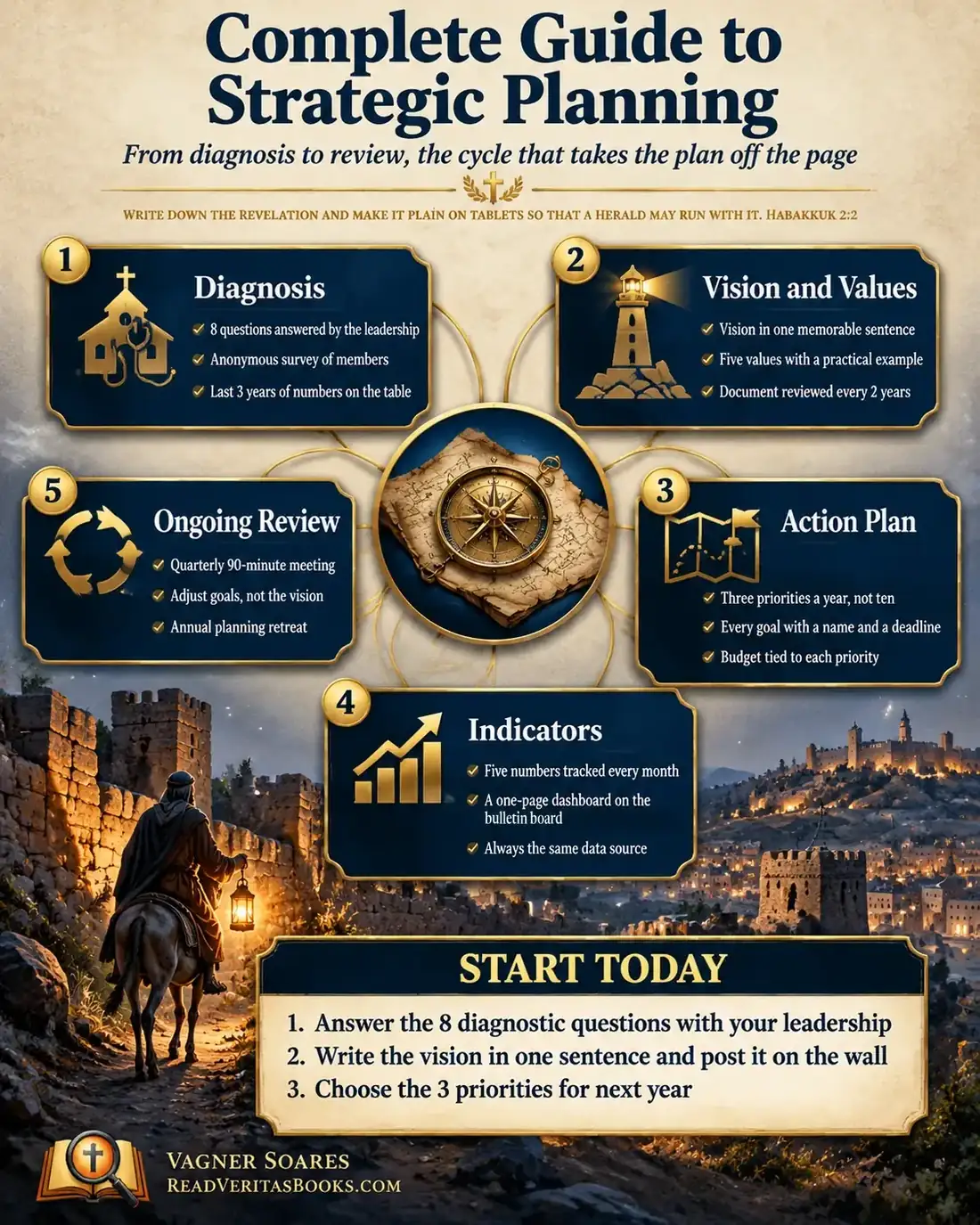
This whole guide on one page
The five steps in this article as an infographic you can print, pin on the notice board or send to your team.
Every church has plans. The trouble is that many of them are born in an energetic meeting at the start of the year, turn into a polished document and, by May, nobody remembers what was decided. The weekly rhythm of services, crises and urgent needs swallows what once looked like a priority, and leaders go back to chasing problems.
This guide presents church strategic planning as a complete cycle, from diagnosis to review, with ready-to-use models and one example followed from start to finish. It works for a congregation of forty and for one of a thousand, as long as each adjusts the size of the tools.
Write down the revelation and make it plain on tablets so that a herald may run with it.
Habakkuk 2:2
A cycle, not an event: why so many plans die before midyear
Strategic planning is not a business exercise pasted onto the church. It is stewardship: caring well for the time, people and resources God has entrusted to your community.
Plans usually die for three reasons. They were made without looking at reality, so they tackle the wrong problem. They had too many priorities, so none received enough people or money. Or nobody came back to them after January. Each flaw matches a stage that was skipped.
That is why the cycle has five parts that feed one another: diagnosis, vision and values, action plan, indicators and ongoing review. One year's review becomes the next year's diagnosis.
Advertisement
What Scripture shows about planning in faith
Nehemiah looked at the walls before calling the people
Nehemiah was cupbearer to the king of Persia when he heard that the walls of Jerusalem lay in ruins. When he arrived, he made no speech on the first day. Nehemiah 2:12-13 says he went out by night with a few men and "viewed the walls of Jerusalem, which were broken down". Only then did he gather the leaders, describe the situation plainly, "Ye see the distress that we are in", and propose the work. Their answer comes in Nehemiah 2:17-18: "Let us rise up and build."
The passage is not a management manual, and Nehemiah was rebuilding a city, not a local church. But the sequence is wise: see reality, name it honestly before the leaders and only then call everyone to work. That is the place of diagnosis.
Jesus spoke of counting the cost before the tower
In Luke 14:28-30, Jesus speaks about the cost of discipleship and uses an ordinary scene: "For which of you, intending to build a tower, sitteth not down first, and counteth the cost". Whoever skips the sums lays a foundation and cannot finish. The subject is following Christ, not a church budget. Even so, Jesus assumes sensible people calculate before they start, and launching ten projects without the people or resources to complete them is the opposite.
Planning with humility
Proverbs 16:9 holds both together: "A man's heart deviseth his way: but the LORD directeth his steps." James 4:15 corrects those who plan as if tomorrow were guaranteed and teaches them to say "If the Lord will, we shall live, and do this, or that." The principle for church administration: planning is a responsibility, and the plan stays open to God's direction. Plan with prayer, in counsel, and review without pride.
Diagnosis: three perspectives before you decide anything
No one maps a route without knowing the starting point. The diagnosis brings together three perspectives that correct one another: the leadership, the members and the numbers. Follow this order.
- Schedule a meeting for the diagnosis alone, two to three hours long. Agree at the start that no one will defend past decisions or look for someone to blame.
- Answer together: where are we growing, where are we stuck, what do visitors notice, what drains energy without bearing fruit and what does no one dare to say. The 8 questions for an honest diagnosis complete this outline.
- Run a short anonymous survey of members, with no more than six questions, half of them open. If you use an online form, do not ask for names, email addresses or ministry.
- Put the last three years of numbers on the table: average attendance, baptisms or new members, active volunteers, income and expenses. Compare year by year before interpreting.
- Cross the three perspectives and write a one-page summary: three strengths, three main problems and one sentence on what most needs to change. That page becomes the standard for every decision that follows.
Vision and values: the direction and the way you travel
The vision is the direction; the values describe how you travel there. Without them, each ministry pulls its own way and decisions become a contest of preferences.
A good vision fits in one sentence any member can repeat from memory, for example: "To be a family that welcomes whoever arrives and forms disciples who serve the neighbourhood." Draft several versions, read them aloud with your leaders and keep the simplest.
Keep values to five at most, each with an example of how it changes a decision. "Hospitality" only becomes a value when your leaders write something like: "So before we invest in a large event, we make sure there is a trained welcome team."
Watch for two opposite temptations. One is writing generic values no church would reject, which therefore help you choose nothing. The other is rewriting the vision at every change of leadership or every setback. Refresh the wording every two years if needed, and keep the essence. The article on vision and values in a living document gives the full template.
Advertisement
Action plan: few priorities, each with an owner, a deadline and money
A church action plan sets the next steps, and the biggest risk is trying to do everything at once. A list of ten priorities, in practice, has none. List every idea, group the similar ones and apply this decision rule:
- If the idea answers a problem from the diagnosis and someone on the leadership team agrees to own it, it is a candidate priority.
- If it is good but does not answer the diagnosis, it goes on the waiting list for the next retreat.
- If no one agrees to take it on, it does not go in. A priority without an owner is only a wish.
- If more than three candidates remain, the leadership votes by impact on the main problem.
- If it needs money the church does not have, it goes in with a smaller goal or waits for the following year.
Write each of the three priorities on a one-page card with five pieces of information: the expected result in one sentence, one named person responsible, the due date, the amount set aside in the budget and the first step for the next thirty days. Reserve the money for the priorities before you distribute the rest. To turn priorities into church goals and priorities for each area, see how to set clear ministry goals.
Indicators: a few numbers, sized to your church
What is not tracked tends to be forgotten. Indicators do not replace spiritual discernment, but they show early when something needs attention. The rule holds at every size: the same numbers, from the same source, collected by the same person, on the same day each month.
Small church, up to about a hundred people
Three numbers are enough, such as average attendance, returning visitors and active volunteers. A notebook or a simple spreadsheet will do, and the secretary reports them to the board in five minutes.
Medium church, from a hundred to a few hundred
Five numbers in a shared spreadsheet and a one-page dashboard with simple charts, visible to your leaders. Write down where each number comes from, so month-to-month comparisons make sense.
Large church or multiple sites
Each ministry may track its own figures, but the senior leadership looks at only five. A church management system helps record attendance and volunteering. The risk is a dashboard that grows until nobody reads it. The 5 simple church indicators are a good starting point at any of the three sizes.
Ongoing review: the quarterly meeting that keeps the plan alive
No plan survives the first quarter untouched. Ongoing review keeps the vision steady and the goals flexible: look at the numbers, celebrate what moved forward, understand what got stuck and decide on adjustments. Use this ninety-minute agenda four times a year.
- Prayer and reading the vision aloud (10 minutes).
- This quarter's indicators compared with the last, with no debate yet (10 minutes).
- Each owner presents their priority: what was done, what got stuck, what they need (45 minutes in total).
- Decisions: keep, move the deadline, reduce the goal or close, each with a name and a date (20 minutes).
- Reading the minutes and confirming the next date (5 minutes).
The minutes record each decision in one line: "Priority 2, children's ministry: goal reduced from eight to four new volunteers by 30 June; owner, the children's coordinator." This format prevents the same discussion from coming back. A leadership meeting that ends in a decision is the central tool for this stage, and to measure each project along the way, see how to tell whether a project is working. Once a year, replace the meeting with a full retreat day to redo the diagnosis.
One example from start to finish
Take a church of 110 members that approved nine goals last year and finished none. The pastor, the four board members, the treasurer and the secretary decide to do it differently.
In January they set aside a Saturday morning for the diagnosis alone. The secretary brings three years of attendance, which has slowly declined, and the visitor list: many came once and never returned. The treasurer shows steady income. The anonymous survey points to two complaints: nobody knows whom to approach after their first service, and the children's ministry depends on two tired teachers. The summary page records three problems: welcome, overload in children's ministry and no small groups.
In February the board writes the vision and four values. A hall renovation, good but outside the diagnosis, goes on the waiting list. Three priorities remain: a welcome team that follows up visitors, owned by a deacon; eight new children's volunteers by June, owned by the coordinator; three small groups by October, owned by an elder. The treasurer sets aside an amount for training and materials before distributing the rest.
The secretary records four numbers on the first Sunday of each month. In April, at the quarterly review, the welcome team is working, but children's ministry has only two new volunteers. The board reduces the goal to four and agrees that the pastor will personally invite six families, all recorded in the minutes. At the December retreat the three groups exist, children's ministry has five new volunteers and the church chooses its next priorities from numbers it now knows.
First steps for this week
- Book the diagnosis meeting and tell everyone it will have that single topic.
- Ask the secretary and the treasurer for the last three years of numbers.
- Write the questions for the anonymous survey.
- Put the four quarterly reviews and the annual retreat on the calendar.
Signs the plan is coming off the page
- Your leaders can name the year's three priorities from memory.
- When a new idea comes up, someone asks whether it answers the diagnosis.
- Quarterly reviews happen on the planned date and end with decisions in the minutes.
- At least one goal has been adjusted, a sign the plan is actually being used.
Frequently asked questions
Does a small church need strategic planning?
Yes, and it often benefits even more. With few people and resources, choosing three priorities prevents waste and burnout. The cycle can be simpler, but the stages are the same.
How do you plan in church ministry when leaders have little time?
Concentrate the effort in one day of diagnosis and priority-setting at the start of the year and four ninety-minute meetings during it. In between, each owner looks after their own priority only.
How many years should a strategic plan for a church cover?
A practical combination is a vision thought out over several years, with priorities and goals set year by year. For the year's calendar itself, see how to build a simple annual plan.
Isn't planning a lack of faith?
Planning with prayer and dependence on God is stewardship. Proverbs 16:9 sets the heart that plans beside the Lord who directs the steps, and ongoing review leaves room to change course.
This guide is the starting point for the strategic planning pillar. To go deeper into each stage, read the honest church diagnosis in 8 questions, learn how to keep your vision and values in a living document and see the 5 simple church indicators worth tracking. Start with the diagnosis: it gives meaning to everything else.

Vagner Soares is a presbyter with pastoral ordination, a mentor and a digital entrepreneur with more than 10 years of experience in technology, digital marketing and education.
Keep reading
 Strategic planningChurch Vision and Values as a Living Document That Guides Real DecisionsWrite your church vision and values in 25 words or fewer, build the text with your leaders, and actually use it in monthly meetings and decisions.Read the article
 Strategic planning5 simple metrics every church should track (without a complicated spreadsheet)Five numbers that fit on one sheet: attendance, visitor retention, volunteers, finances and small groups. Learn how to track each one without the complexity.Read the article
 Strategic planningPlanning Your Church's Physical Growth: Space, Building Projects, and PhasesLearn how to tell when your building is too small, which options to try before you build, and how to plan expansion in phases with reserves and a vote.Read the article