
Worship Team Without Competition: Scheduling, Feedback and Room for Everyone
Clear scheduling criteria, leaders who serve, feedback without comparison and room for beginners: how to end the fight for the stage on your worship team.

In this article
- Why the fight for the stage shows up even on sincere teams
- What Scripture shows about music, order and vanity
- Clear scheduling criteria: the text you can send today
- Leadership that serves by example: stepping out of the center
- Feedback without comparison: a script for the one-on-one
- Room for every skill level: steps by church size
- Focus on the purpose: decision rules for songs and solos
- An example: the worship team of a 185-member church
- Mistakes that rekindle the competition
- Signs your team is serving together
- Frequently asked questions
Free mind map
This whole guide on one page
The five steps in this article as an infographic you can print, pin on the notice board or send to your team.
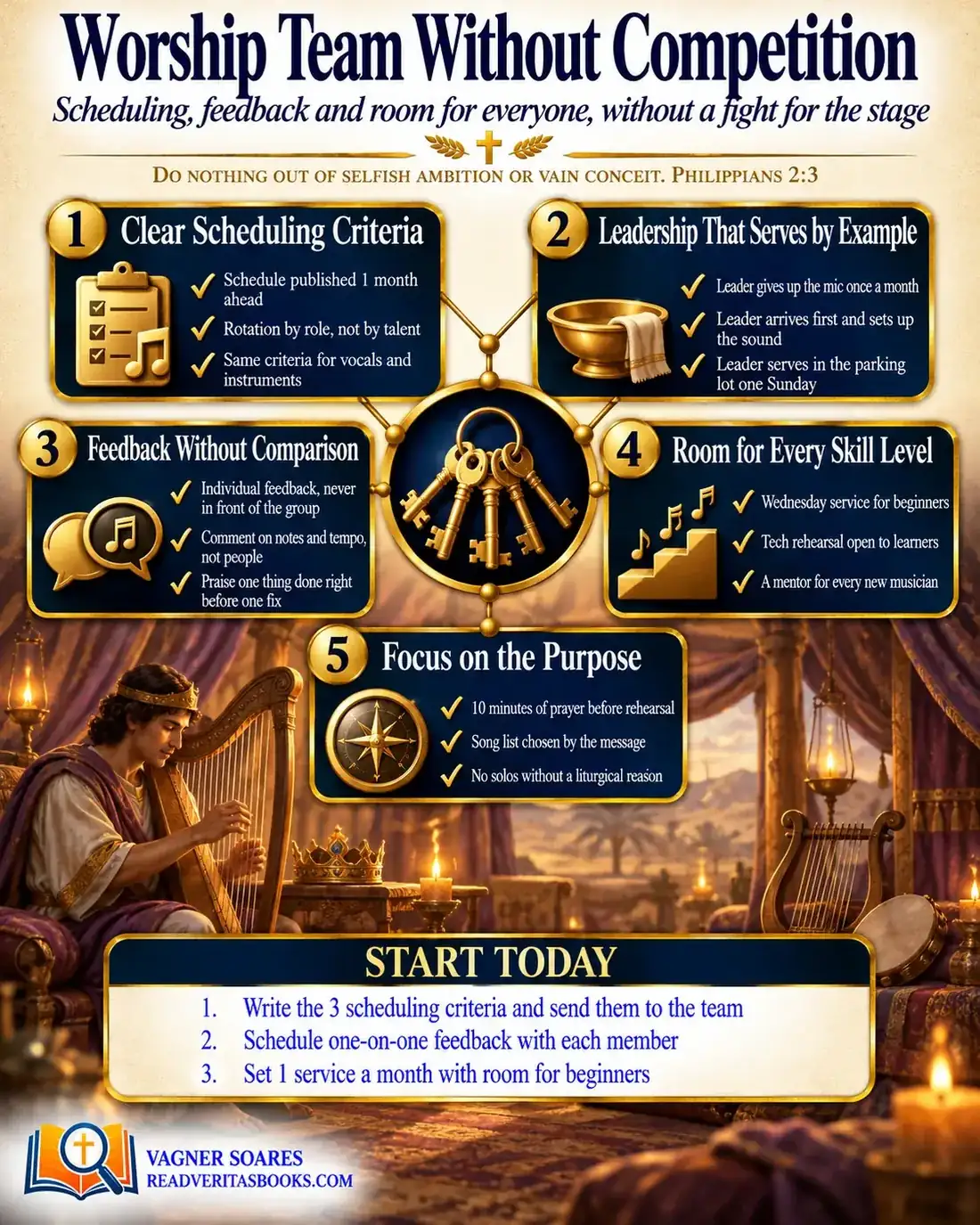
You know the scene: the same lead vocalist every Sunday, a guitarist who only lights up when there's a solo, tense looks when the schedule comes out, and a beginner who quit because they never got a chance. Nobody calls it competition, but everyone feels it, and the mood at rehearsal ends up on the platform.
This guide shows how to organize your worship team so it serves together, without a fight for the stage and without losing the quality your church expects. You'll find a ready-to-send set of criteria and one example followed from start to finish.
Do nothing out of selfish ambition or vain conceit
Philippians 2:3
Why the fight for the stage shows up even on sincere teams
In worship, serving happens in front of everyone. The mic, the stage and the solo bring visibility, and visibility invites comparison even among people who love God and want to serve. That doesn't make anyone vain. It does make worship ministry a place that needs more care in how it's structured.
When the criteria aren't clear, each person invents their own explanation for who plays and who sits out, and that explanation almost always involves the leader's favorites. The answer isn't to hide talent or lower the bar. It's to make scheduling, feedback and opportunity predictable and equal for everyone.
Advertisement
What Scripture shows about music, order and vanity
In 1 Chronicles 25:7-8, the chronicler lists the Levite musicians of David's time, men "instructed in the songs of the LORD," and records that their duty rotations were assigned by lot, "as well the small as the great, the teacher as the scholar." The passage doesn't tell churches to draw lots for the schedule today, and it doesn't say skill is irrelevant. It shows a known, impersonal criterion that gave the most experienced no guaranteed place. And 1 Chronicles 15:22 notes that Chenaniah led the singing and "instructed about the song, because he was skilful." Skill has its place, and its place is to train others.
In Mark 9:33-35, the disciples had argued on the road about "who should be the greatest." Jesus turned the question upside down: "If any man desire to be first, the same shall be last of all, and servant of all." For anyone leading a worship team, that is a job description.
Finally, the verse that opens this article. Paul tells the Philippians, "in lowliness of mind let each esteem other better than themselves" (Philippians 2:3), and later he urges two faithful coworkers "that they be of the same mind in the Lord" (Philippians 4:2). Faithful people clash too. Paul doesn't ask anyone to stop using their gifts; he asks that no one act out of rivalry. For worship administration, the structure should make vanity unnecessary, not just condemn it.
Clear scheduling criteria: the text you can send today
The schedule is where competition shows up most. If it comes out at the last minute, changes without explanation or seems to favor the same people, the team starts to lose trust. Written criteria take the personal sting out of the decision: someone may disagree, but they understand.
Adapt this model with your pastor and send it to the team's group chat:
- To be on the schedule for a service, a member attends that week's rehearsal. With an excused absence, they arrange a make-up rehearsal with the leader.
- Next month's schedule is published by the 25th, complete, through the same channel, to everyone.
- Each role has its own rotation (lead vocal, backing vocals, keys, acoustic guitar, electric guitar, bass, drums). Anyone who meets the criteria joins the rotation for the role they can play.
- The same rules on attendance, punctuality and preparation apply to singers, players and the leader.
- Members arrange swaps among themselves and tell the leader by Wednesday. When leadership changes something, they explain why to whoever is affected.
- Anyone not yet in the rotation for a role hears, privately, what they still need to develop and a date for a new review.
The rotation is by role, not by talent. That doesn't mean everyone plays everything; it means anyone who meets the criteria gets their turn. For the calendar side, see how to build schedules that don't overload the same people.
Leadership that serves by example: stepping out of the center
Your team learns more from what you do than from what you say. A leader who always sings, always chooses and never carries a speaker sends the message that the stage is the prize. A leader who serves behind the scenes shows that every role matters, and earns the authority to ask the same of others.
Three habits do this work over the year. In at least one service a month, step back to harmonies or your instrument and let someone else lead. On service days, arrive before the team, run cables and check mics, because preparation is ministry too. And, say once a semester, serve in another ministry, such as the parking lot team, and mention it to the team naturally.
What to watch
Giving up the mic doesn't mean giving up leadership: you're still responsible for the song list, the rehearsal and the final call. Nor does it help to hand the lead to someone unprepared just to look humble, because whoever steps in must meet the criteria. And if you announce too often how much you're serving, the effect is lost.
Advertisement
Feedback without comparison: a script for the one-on-one
Musicians need feedback to grow, but correcting someone in front of the group, or comparing them with another member, turns a technical fix into humiliation. During rehearsal, make only quick ensemble adjustments. Everything else goes into a short private conversation:
- Book it ahead of time and explain that you're having this conversation with everyone. That way nobody shows up thinking they did something wrong.
- Start with something specific done well, like "on the second song Sunday, the way you held back the dynamics helped the church come into the chorus."
- Raise one thing to improve, always about the music. Say "the chorus entrance is rushing," not "you always rush."
- Ask before you prescribe: "How does that part feel to you?" Often the musician has already noticed.
- Agree on one concrete action and a date to look at it again, such as practicing with a metronome until next month.
- Write one line with the date, the strength you named and what you agreed.
Never say "play it like so-and-so." Each musician is measured only against their own progress, and public praise shouldn't lift one person up at another's expense. A conversation like this every two or three months already changes the atmosphere. There's more in how to give feedback to a volunteer without discouraging anyone.
Room for every skill level: steps by church size
When only the most experienced musicians play, beginners give up and the team stops renewing itself. And skilled players start guarding their spot instead of training someone. The steps between learning, rehearsing and serving change with the size of your church.
Small church (up to about 100 people)
Here there are usually few musicians and one veteran who covers everything. Start with one song a month led by a beginner, with the veteran beside them. Open rehearsal to people who are learning. The goal is that the veteran can miss a Sunday without the service grinding to a halt.
Medium church
Use a smaller service, such as a midweek one, so new musicians can serve with support and less pressure. Pair each newcomer with a mentor who tracks their progress and says when they're ready for Sunday. Invite learners to sit in on tech rehearsal.
Large church
With several teams, the risk is that the "main team" becomes an elite. Mix the lineups every cycle and create a training team with written criteria for moving up and one person responsible for it. Preparing new people can follow how to train new volunteers before placing them in a role.
Focus on the purpose: decision rules for songs and solos
All of this structure loses its power if the team forgets why they're on the platform. Worship exists to serve the church in the service, not to show off skill. When the purpose is clear, the question shifts from "who gets to sing?" to "what does this song need to say?" A few rules help you decide without giving in to pressure:
- If someone asks for a solo, ask which moment of the service it serves. If it supports a reflection or a transition, it's in. If it's only there to show technique, save it for a music event.
- If choosing songs turns into a battle of tastes, talk with whoever is preaching and choose from the theme of the service.
- If rehearsal runs late and someone suggests skipping prayer, keep the 10 minutes of prayer for the church, the service and one another.
- If two people want the same role on a special Sunday, such as Easter or Christmas, the published rotation stands.
- If the disagreement has turned into personal friction, treat it as mediation, with help from conflict between volunteers: how to mediate without taking sides.
An example: the worship team of a 185-member church
Imagine a church of 185 members with a worship team of nine. The same vocalist has led all four Sundays a month for years, a 16-year-old bassist only plays when someone is missing, and the longest-serving keyboard player grumbles that "the schedule has an owner."
In the first week, the leader sits down with the pastor and adapts the criteria model. They decide lead vocals will rotate among three people, including the leader, and the bassist will start at the midweek service. The leader sends the text to the group and books a one-on-one with each member.
The hardest conversation is with the vocalist. The leader opens with something specific she does well, explains that the rotation isn't a verdict on her talent and asks her to mentor one of the new voices. She's hurt, and he doesn't push: they agree to talk again in two weeks, and he lets the pastor know, who begins to walk alongside her. In a team notebook, the leader writes one line for each conversation.
On the 25th, next month's schedule goes out complete. The bassist has a mentor and one song at the midweek service. The leader sings backup one Sunday and arrives early to set up sound on the others. After two months, he reviews the notebook with the pastor: who kept their commitments, who needs another conversation and whether the bassist is ready for Sunday.
Mistakes that rekindle the competition
- Changing the schedule without explaining why to whoever is affected.
- Always praising the same people in public and forgetting those running sound and slides.
- Putting a beginner on the main service unprepared to "give them a chance."
- Writing criteria and not applying them to the leader. The team notices at the first exception.
Signs your team is serving together
- Members swap among themselves and simply let the leader know.
- Nobody asks the night before, "Why am I not on Sunday?"
- Experienced musicians talk proudly about the progress of the people they mentor.
- The service doesn't depend on a single person to happen.
Frequently asked questions
What if the most talented musician won't accept the rotation?
Talk privately, explain the criteria and show that the rotation applies to everyone, including you. Offer them a mentoring role. If the resistance continues, treat it as a pastoral care issue rather than a musical one.
Doesn't rotating by role lower the quality of the service?
Not if the criteria require preparation. Only people who meet the rehearsal and attendance requirements enter the rotation, and training happens in the spaces set aside for beginners.
How often should I give one-on-one feedback to church musicians?
One suggestion is a short conversation with each member every two or three months, plus quick comments after rehearsals. What matters is that feedback is regular, not only when something goes wrong.
How do I tell someone they're not ready for the worship team schedule yet?
Talk privately and be specific: what they already do well, which criterion is missing and what path they can follow, with a mentor and a date for a new review. A "not yet" with a timeline is very different from a "no" with no explanation.
A worship team without competition depends on good organization and real care for people at the same time. To keep going, learn how to build schedules that don't overload the same people, how to give feedback to volunteers without discouraging them and, if rivalry has already reached your leadership, how to handle leadership conflict without dividing the church.

Vagner Soares is a presbyter with pastoral ordination, a mentor and a digital entrepreneur with more than 10 years of experience in technology, digital marketing and education.
Keep reading
 Ministry organizationA Church Welcoming to People With Disabilities: Ramps, Captions and ListeningRamps, captions, trained greeters and real listening: practical steps to make your church truly welcoming to people with disabilities and their families.Read the article
 Ministry organizationSmall Groups That Don't Die Out in 3 Months: How to Reach Year TwoA clear purpose, prepared leaders, a sustainable rhythm and steady follow-up: what helps your church's small groups make it past month three.Read the article
 Ministry organization · Reference guideComplete ministry organization guide: your church's whole ministry structure on one pageOrganize your church ministries with this complete guide: structure and leaders, small groups, schedules and teams, safety and care, and orderly growth.Read the article