
Leadership development pathway: how the church forms tomorrow's leaders
Build a leadership development pathway at church: spot potential, set clear stages, mentor hands-on, delegate gradually, and evaluate progress.

In this article
- Why churches run out of reserve leaders
- Paul, Timothy and the twelve: training means entrusting people who will teach others
- Spotting potential: how to see who is ready for the next step
- Training stages: three visible steps
- Hands-on mentoring: a model for the biweekly meeting
- Gradual delegation: what the person decides alone at each stage
- Progress evaluation: how to adapt it to your church's size
- A worked example: the church about to lose its welcome team coordinator
- Mistakes that slow down leadership development
- Signs the pathway is working
- Frequently asked questions
Free mind map
This whole guide on one page
The five steps in this article as an infographic you can print, pin on the notice board or send to your team.
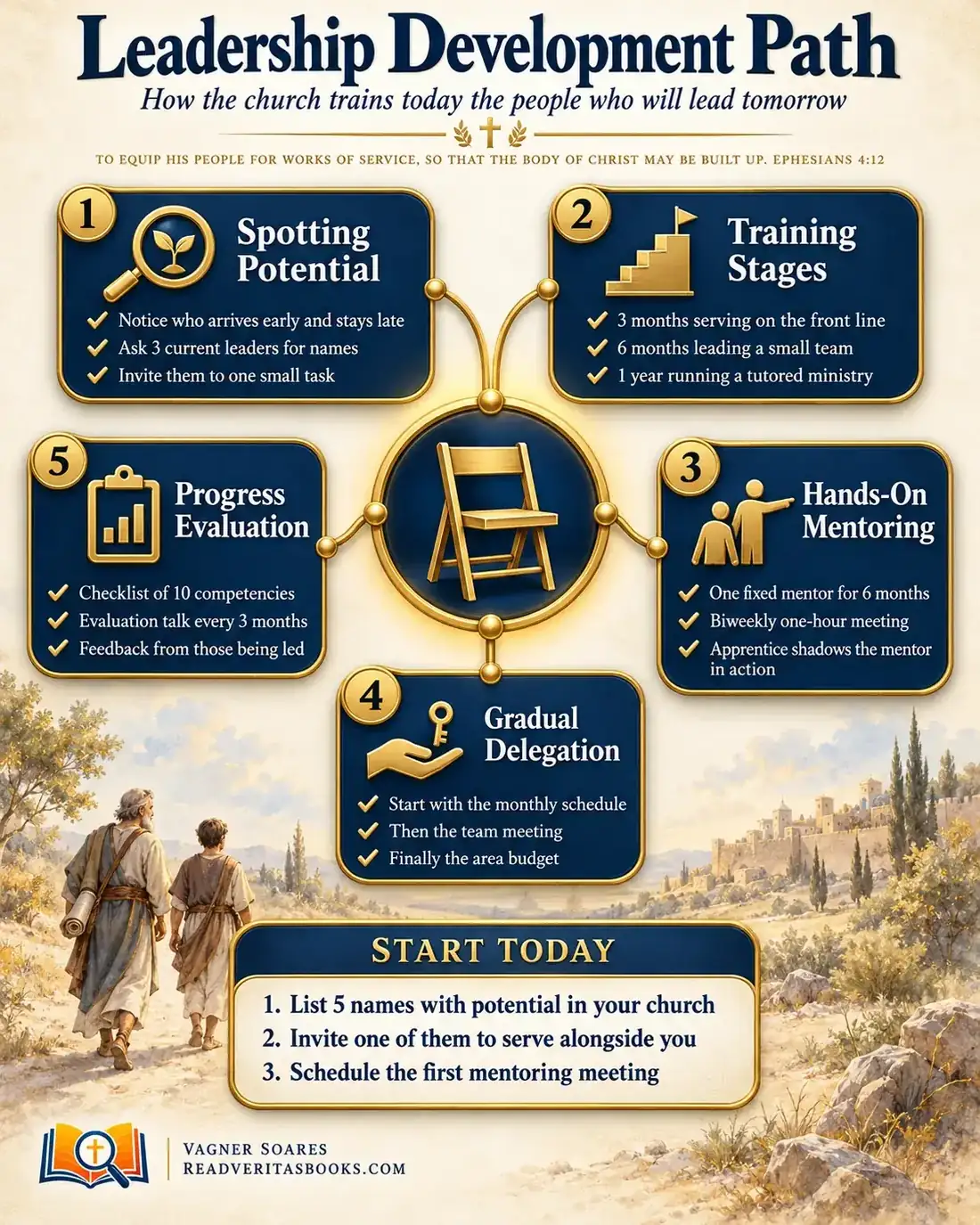
In many churches, the same handful of leaders has carried everything for years. When one of them moves, falls ill, or simply burns out, the ministry stalls, because no one was prepared to step in. Goodwill is there. What is missing is a clear route that shows how someone goes from helping to leading.
This guide turns the "Leadership Development Path" mind map into that route: spotting potential, organizing stages, mentoring hands-on, delegating gradually, and evaluating progress, without turning the church into a business school.
To equip his people for works of service, so that the body of Christ may be built up.
Ephesians 4:12
Why churches run out of reserve leaders
It is rarely a lack of people. It is a lack of process. Church leaders wait for someone to arrive ready-made, and until that person shows up, those already in front pile up roles. When a gap finally opens, it gets filled in a hurry by whoever is closest, not by someone who was prepared.
A leadership pathway makes church leadership development predictable: there are stages, there is someone walking alongside, and there are criteria for moving on. No one is handed a load they had no time to prepare for. And because the route is written down, those who serve understand that growing in ministry does not depend on being the pastor's friend.
Advertisement
Paul, Timothy and the twelve: training means entrusting people who will teach others
In Ephesians 4, Paul says that Christ gave the church apostles, prophets, evangelists, pastors and teachers, and verse 12 explains why: to prepare God's people for service. The passage does not describe a leadership program, but it shows the direction of pastoral work. Leaders exist to equip others, not to do everything themselves.
In 2 Timothy, Paul, imprisoned and near the end, writes to the young pastor he left in Ephesus: "And the things that thou hast heard of me among many witnesses, the same commit thou to faithful men, who shall be able to teach others also" (2 Timothy 2:2). There are four generations in that verse: Paul, Timothy, the faithful men and the others. The standard is not charisma but faithfulness joined to the ability to teach. The text says nothing about timelines or courses, but it shows training that is already thinking about who comes next.
Jesus adds a detail churches often miss. In Mark 3:14, "he ordained twelve, that they should be with him, and that he might send them forth to preach". First life together, then the sending.
Paul also asks for caution. Of deacons he writes, "let these also first be proved" (1 Timothy 3:10), and he warns Timothy, "Lay hands suddenly on no man" (1 Timothy 5:22). These texts deal with church offices, not every volunteer role, but the principle carries over to church administration: responsibility is handed over after a season of observation, never on impulse.
Spotting potential: how to see who is ready for the next step
Leadership potential shows up more in ordinary serving than in speeches. The risk is trusting your own perception alone and always choosing the same visible people. These steps widen your view.
- Watch for a month who arrives early and stays late, who notices a visitor without being told, and who follows through without reminders.
- Ask three current leaders for names, separately: "Who on your team already looks after others without having a title?". Names that come up more than once deserve attention.
- Look at character before skill. Can this person be trusted with information, treat people who disagree with respect, and accept correction?
- Invite them to one small task with a clear start and finish, such as coordinating the welcome team for one service. Watch how they handle surprises and whether they come back to tell you how it went.
- Make the invitation in a personal conversation. Tell them what you have seen, explain that this is a season of learning, and make it clear they are free to say no.
Training stages: three visible steps
The timeframes below come from the map and work as a guide. Adjust them to each person's pace, but don't skip stages, because each one teaches something the next will require.
3 months serving on the front line
Simple roles, such as greeting or tech support. The person learns the team's culture: schedules, how people are treated, what to do when someone doesn't show up.
6 months leading a small team
A group of three to six people, with close support, to practice scheduling, communication and care. The first mistakes happen here, where the damage is limited and the conversation is easy.
1 year running a ministry under a tutor
A whole area, with a tutor available for hard decisions. At the end of the year, the question is not "did they pass?" but "can they carry on alone, and are they already training someone?".
The rule for moving up: advance when the person already does well what the stage requires and the people they lead confirm it. When in doubt, extend the stage with one specific goal instead of promoting out of pity or haste.
Advertisement
Hands-on mentoring: a model for the biweekly meeting
Leadership is learned by watching someone lead up close. Each apprentice has one fixed mentor for at least 6 months, and short, regular meetings are worth more than long, rare conversations. Use this agenda for the biweekly one-hour meeting.
- First 10 minutes: how are you? Ask about family, work and spiritual life before tasks.
- Up to minute 25: what has happened since we last met? The apprentice shares one good situation and one hard one.
- Up to minute 40: what would I do differently? The mentor responds and shares how they once handled something similar.
- Up to minute 50: what is the next step? Agree on a single goal for the next two weeks.
- Last 10 minutes: pray for the team and write two lines about what you agreed.
Between meetings, the apprentice shadows the mentor in action, at a team meeting, a visit or a planning session. Ten minutes afterward is enough: "Why did I decide that? What would you have done?".
Gradual delegation: what the person decides alone at each stage
Delegating means transferring trust in the right measure. When Jethro saw Moses judging the people from morning to evening, he said, "The thing that thou doest is not good", because "thou art not able to perform it thyself alone" (Exodus 18:17-18). His advice was to choose able men and agree on a limit: "every great matter they shall bring unto thee, but every small matter they shall judge" (Exodus 18:21-22). Moses kept leading. He simply focused on what only he could resolve.
The map suggests an order that moves from operational to strategic: the monthly schedule, the team meeting, the area budget. These rules help at each step.
- If the person is just starting with the schedule, they draft it, you review it together before publishing, and you explain every change.
- If they have built three schedules without major corrections, they publish on their own and only tell you about last-minute swaps.
- If they are running the team meeting for the first time, you attend as support and give feedback afterward, in private.
- If money is involved, show them the area's numbers and how spending gets approved. They propose, you approve, until the leadership decides to widen their authority.
- If something goes wrong, talk the same day, without exposing anyone in front of the team.
- If it involves discipline, serious conflict or risk to people, they always bring it to you, at any stage.
Hand these rules over in writing, so they neither freeze nor overstep.
Progress evaluation: how to adapt it to your church's size
Without evaluation, development turns into guesswork. The map suggests a checklist of 10 competencies, a conversation every 3 months, and feedback from those being led. The competencies might be reliability, communication, care for people, organization, devotional life, ability to teach, teamwork, response to criticism, meeting deadlines, and training new helpers.
In the quarterly conversation, mentor and apprentice go over the checklist, celebrate progress, and choose one or two goals. The aim is not to pass or fail anyone but to set the next step. Keep a few written lines each time.
Small church (up to about 100 people)
The pastor can mentor two or three apprentices. The checklist fits on one sheet, and team feedback can be an informal chat with those who serve alongside the apprentice. Don't skip the quarterly conversation just because everyone knows each other.
Medium-sized church
Each ministry names its mentors, and one person from the leadership tracks the whole group in a simple spreadsheet. Team feedback can come from three questions: do you feel cared for? Are instructions clear? What could this person improve?
Large church
The pathway needs one overall coordinator and a single record in the church management system. The risk is that evaluation turns cold. Keep the mentor in charge of the conversation and use the records only to make sure no one falls through the cracks.
A worked example: the church about to lose its welcome team coordinator
Picture a church of 175 members whose welcome team coordinator announces in January that she is moving away at the end of the year. She leads ten volunteers and is the only one who knows how to build the schedule.
In February, she notes who arrives early and looks after visitors, while the pastor asks the worship leader and the children's ministry leader for names. Two names come up twice: a young man from the parking team and an older woman on the welcome team. Both coordinate the welcome for the Easter service. Both do well, but only the woman comes back the next day to talk about what could have gone better.
In March, the coordinator talks with her and becomes her mentor. Since the woman has served on the front line for years, the first stage is shortened. In April, she starts leading the four people who serve on Sunday evenings. Their biweekly meetings happen after the Wednesday service, and each one ends with two lines written in a notebook.
In May, she builds her first schedule and they review it together. By July, she publishes it on her own. In August, she runs the team meeting, with private feedback afterward. At the September conversation, the checklist shows growth in organization, but the team mentions that she avoids correcting people who miss shifts without notice. That becomes the goal for the quarter.
In December, the coordinator moves. The new leader takes over with the pastor as her tutor, and she already has her eye on the young man from the parking team for the next round.
Mistakes that slow down leadership development
Choosing only the most visible people. Talent on stage doesn't guarantee care for people, so listen to other leaders before you invite anyone.
Delegating and disappearing. The person is handed a whole area and never has another meeting with anyone. Within months frustration sets in, and they often quietly step away.
Treating the pathway like a course with a diploma. Development is ongoing, and evaluations exist to set the next step, not to close the process.
Signs the pathway is working
- When a leader is away for a month, the ministry carries on without the pastor having to step in.
- Apprentices can tell you which stage they are in and what their current goal is.
- Mentoring meetings are on the calendar, not just "when we can".
- Leaders who were trained are already walking alongside someone newer.
Frequently asked questions
How long does it take to develop a leader in the church?
It depends on the person and the area. The stages on the map add up to almost two years, but they are a guide. Move forward when the competencies are solid, not when the calendar says so.
What if the person doesn't want to lead?
Respect that. Not every faithful servant wants or needs to lead, and pushing strains the relationship. Keep valuing their service and leave the door open.
Who can mentor church leaders?
Someone with experience in the area, maturity, and real time to give. It doesn't have to be the pastor. One mentor can walk well with two or three apprentices at most.
How do you train Christian leaders in a small church?
Start with a single apprentice. Use the same pathway, shorten the first stage if the person has served for a while, and build mentoring into activities that already exist. One well-trained leader a year already changes things in a small church.
Developing leaders means investing in the church's future with patience and intention. To map out the route for each role, see the leader development plan and the guide to ministry onboarding. To correct without discouraging learners, see how to give feedback to a volunteer without discouraging anyone; to evaluate without coldness, read about ministry evaluation that doesn't feel corporate; and, looking further ahead, prepare for pastoral succession without crisis.

Vagner Soares is a presbyter with pastoral ordination, a mentor and a digital entrepreneur with more than 10 years of experience in technology, digital marketing and education.
Keep reading
 People managementSigns of burnout in those who serve: what to watch for before the person disappearsLearn to spot signs of volunteer burnout in your church, understand the causes, have a caring conversation, redistribute the load, and prevent it.Read the article
 People managementConflicts between volunteers: how to mediate without taking sidesLearn to mediate conflicts between volunteers without taking sides: hear both people, separate facts from feelings, agree on a practical step and follow up.Read the article
 People management · Reference guideThe Complete Guide to People Management in the Church: From Recruiting to Ongoing CareRecruit, develop, evaluate, care for, and retain volunteers and leaders with a five-part path and practical steps you can start using in your church today.Read the article