
Pastoral succession without crisis: how to prepare the church in advance
Learn how to plan pastoral succession years ahead: training the successor, a gradual transition, clear communication, and continuity of the vision.

In this article
- Why pastoral succession turns into a crisis when nobody talks about it
- Moses, Joshua and Paul: handing over the care of God's people
- Early planning: a written plan before any names
- Training the successor: two candidates, supervised practice
- Gradual transition: a shared pulpit and one area per quarter
- Communicating to the church: who hears first and what to say
- Continuity of vision: what stays, what changes, and the pastor emeritus role
- A worked example: the 180-member church that chose not to wait
- What to do this week
- Signs your succession is on the right track
- Frequently asked questions
Free mind map
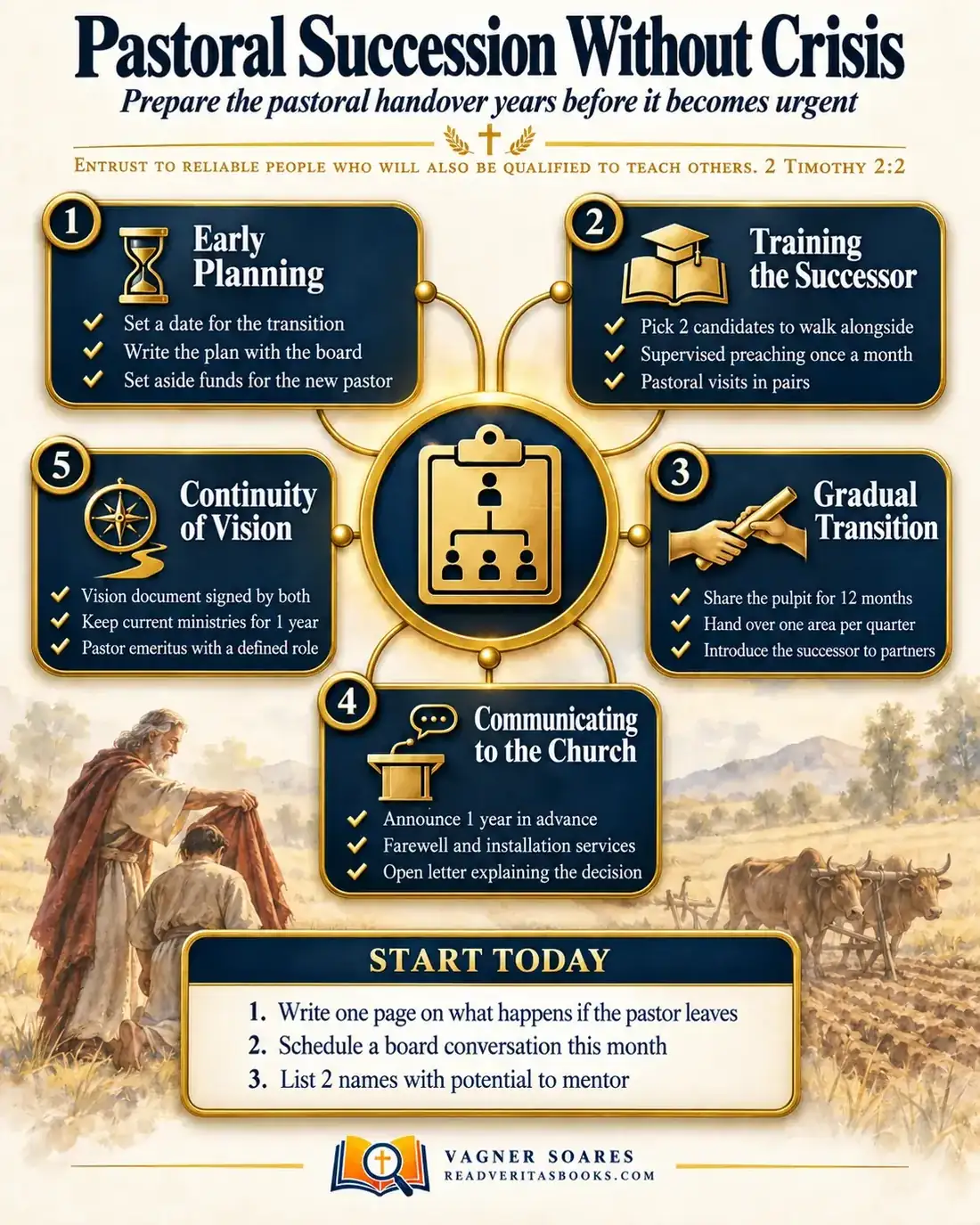
This whole guide on one page
The five steps in this article as an infographic you can print, pin on the notice board or send to your team.
In many churches, the question "who steps in if the pastor leaves?" only comes up when there is no time left to answer it calmly. An illness, a call to another church, or years of weariness, and suddenly the leadership has to decide under pressure while each group rallies behind a different name.
This guide shows how to make pastoral succession a process rather than a shock: writing a pastoral succession plan, training the people who could step in, handling the church leadership transition in stages, communicating the decision, and protecting the vision afterward, including the pastor emeritus role.
Entrust to reliable people who will also be qualified to teach others.
2 Timothy 2:2
Why pastoral succession turns into a crisis when nobody talks about it
Succession rarely becomes a crisis for lack of good candidates. It almost always comes from lack of time. The silence usually has good intentions: the pastor does not want to look like he is on his way out, the board does not want to look like it is pushing him toward the door, and the most important conversation of the coming years keeps getting postponed.
Planning ahead is not the same as scheduling a goodbye. It means calmly answering two different questions: what would happen if the pastor could not continue next month, and what will happen when he finishes his season a few years from now. A good plan answers both.
Advertisement
Moses, Joshua and Paul: handing over the care of God's people
The Bible does not give us a succession manual, but it shows leaders who took seriously the question "who will care for the people after me?"
In Numbers 27:15-23, Moses has just heard that he will not enter the promised land. His first response is not to defend his position but to ask God for a leader, "that the congregation of the LORD be not as sheep which have no shepherd." God points to Joshua, and Moses lays his hands on him before Eleazar the priest and the whole congregation. The text adds: "thou shalt put some of thine honour upon him." Authority is handed over in public and in part, while Moses is still alive. Deuteronomy 34:9 records the fruit: after Moses died, "the children of Israel hearkened unto him." The text does not say every pastor should pick his own successor, since it is God who chooses Joshua. It shows a transition that was prepared, public, and recognized by the people.
In Acts 20:28-32, Paul says goodbye to the elders of Ephesus. He reminds them that the flock is "the church of God" and closes with "I commend you to God, and to the word of his grace." He leaves no single heir, but trained leaders and a church that belongs to God, not to its founder. In 2 Timothy 2:2 that logic becomes a method. And when Paul writes about leaders, he asks that an elder be "Not a novice" (1 Timothy 3:6), yet he tells Timothy, "Let no man despise thy youth" (1 Timothy 4:12). Maturity matters more than age.
The principle for church administration is simple: succession is an act of care for a flock that belongs to God. That is why it deserves preparation, transparency, and time.
Early planning: a written plan before any names
The first step is to put succession on paper, before you even think about candidates. Check what your church's bylaws say about selecting a new pastor (who nominates, who votes, what quorum), and talk to an attorney if anything is unclear. Build a reserve into the budget for the season when two pastors will serve together, with guidance from your accountant.
The plan fits on two sheets. Use this template as a starting point.
Contingency page (unexpected departure)
- For the first few weeks, services are led by the associate pastor or, if there is none, by the elder the board appoints.
- The board chair calls a special meeting within seven days.
- Decisions on building projects, hiring, and structural changes are put on hold.
- One person communicates with the church, using wording approved by the board.
Long-term succession plan
- Transition marker: the age or year when the pastor intends to finish his season, recorded in the minutes.
- Selection criteria, in order: character, a calling recognized by the leadership, care for people, team leadership, preaching.
- Who leads the process and how the church will be consulted, according to the bylaws.
- Rough stages and timing for training, transition, and installation, reviewed by the board every year.
Notice that no name appears on the page. The plan protects the process, and the process protects the people. For the longer horizon, see long-term succession planning.
Training the successor: two candidates, supervised practice
No one is ready to pastor a church simply because they preach well. Training a successor involves character, closeness to people, and real decisions. Walking alongside two candidates widens your options, avoids naming an heir too early, and gives the leadership more to go on as they discern.
- Agree with the board on two people who already serve faithfully. Talk to each one and make clear that this is training, not a promise of a position.
- Set a monthly mentoring meeting with the pastor on a fixed date.
- Give each candidate one sermon a month and review content, clarity, and presence that same week.
- Bring the candidate on home and hospital visits and to counseling sessions people have agreed to. That is where they learn the care that never shows from the pulpit.
- Hand over a real administrative responsibility, such as chairing the leaders' meeting.
- Every six months, write an evaluation with the board using the plan's criteria.
- At the end of the period, the board decides whether to present a name, continue the training, or open an outside search.
If no internal successor emerges, the work is not wasted: both people have become better leaders. The leadership development pathway helps you structure this process.
Advertisement
Gradual transition: a shared pulpit and one area per quarter
Switching pastors overnight forces the church to adjust to everything at once: a new voice in the pulpit, a new way of making decisions, new priorities. A transition of about twelve months moves trust over a little at a time, along with responsibility.
The current pastor becomes the successor's main supporter. Each quarter, one area changes hands (small groups, volunteers, administration, counseling), and the successor preaches more and more often. He should also meet the missions you support, neighboring churches, and partner organizations.
The decision rule needs to be in writing. If a matter belongs to an area already handed over, the successor decides and informs the pastor. If the area has not been handed over yet, the pastor decides and involves the successor. If the decision affects the whole church, the two take it to the board together.
Adapting it to the size of your church
In a small church of up to a hundred people, there is often no budget for two salaries. The transition can be shorter, with the successor working part time and the current pastor gradually reducing his load. What matters is keeping the shared pulpit and the decision rule.
In a medium-sized church, a full year is usually workable, and it helps to ask one board member to check in with both pastors every month. In a large church, every staff pastor needs to know whom they will report to and from what date.
Communicating to the church: who hears first and what to say
How the church finds out matters as much as the decision itself. When the news leaks through rumors, people fill the gaps with assumptions.
The order matters: first the board, then the pastoral staff and ministry leaders, and then the whole church on the same weekend, so no one hears it secondhand. Ideally, announce it about a year before the installation, with the current pastor, the successor, and the board telling the same story. For handling resistance, read how to communicate a big change to the church.
Template for an open letter to the church
Dear church family, after much prayer and many conversations with the board, we want to share the next steps in the pastoral care of our church.
Pastor (name) will finish his season as senior pastor in (month and year). This decision was made peacefully, not because of any conflict. Over the coming months, Pastor (successor's name) will take on responsibilities step by step, preaching more often and working alongside our ministries.
Our farewell and installation service will be on (date). If you have questions, please reach out to (name and contact). We thank God for the road behind us and entrust to him the road ahead.
Continuity of vision: what stays, what changes, and the pastor emeritus role
A healthy succession does not erase the church's history or freeze its future. A vision document signed by both pastors helps preserve values and mission. If your church does not have one yet, start with vision and values in a living document.
The point to watch is balance. If the new pastor changes everything in the first months, the church feels it has lost its identity. If he cannot change anything, he becomes a caretaker of the past. A good rule is to keep current ministries for about a year and agree on which larger changes will be discussed in the second.
The other point is the one stepping back. Without an agreed role, comparisons and divided loyalties appear. The pastor emeritus agreement can read: "The pastor emeritus may preach when invited, take part in ceremonies, and counsel those who seek him out. He will not attend board meetings or comment publicly on the new leadership's decisions. If someone comes to him to complain about the new pastor, he will listen and encourage that person to speak directly with the senior pastor."
A worked example: the 180-member church that chose not to wait
Consider a church of 180 members whose pastor is 61 and has served there for almost twenty years. Nobody mentions succession until he spends two weeks in the hospital. When he returns, he himself asks for the subject to go on the agenda.
At the first meeting, the board writes the contingency page and records in the minutes that the pastor plans to finish his season at 65. The treasurer, with the accountant, works out how much the church can set aside for a year with two salaries. The chair reads the bylaws and sees that the choice requires approval by the members' meeting.
Two people are chosen for training: a 38-year-old deacon who coordinates the small groups and the 31-year-old youth leader. For eighteen months, both preach once a month, make visits with the pastor, and take charge of one administrative area. The six-monthly evaluations are kept in the board's folder.
The board presents the deacon to the members' meeting, which approves him; the youth leader stays in his ministry, better prepared. The staff hears on Thursday and the letter is read on Sunday. For a year the two share the pulpit and areas change hands every quarter. At the installation service, the outgoing pastor lays hands on his successor and receives the title of pastor emeritus, with the agreement already signed.
What to do this week
- Write your church's contingency page using the template above.
- Schedule a board conversation this month and agree on a deadline for the long-term plan.
- Write down two names with potential and talk with the board before approaching them.
If your church is already facing a sudden departure, the crisis protocol for the first 24 hours puts the first steps in order.
Signs your succession is on the right track
- The subject goes on the board's annual agenda without awkwardness.
- Candidates receive written evaluations and know what they need to develop.
- No one learned about the decision through a rumor.
- The pastor emeritus is honored in public and does not become a "court of appeal".
Frequently asked questions
Do we need to have a successor chosen already?
No. What matters most is a clear selection process and starting to develop people with potential. The name may emerge along the way.
How do you choose a new pastor when there is no internal successor?
Follow the plan's criteria and what your bylaws require. Form a small search committee, listen to the church, talk with more than one candidate, and ask for references. An interim pastor keeps you from deciding in a hurry.
What does a pastor emeritus do?
A pastor emeritus has finished his season and is still honored by the church. He may preach when invited and offer counsel, as the written agreement allows, but he should not compete with the new pastor's leadership.
Succession without crisis grows out of conversations the leadership chooses not to postpone. Keep going with the leadership development pathway, vision and values in a living document, and the guide to a leader's departure without crisis.

Vagner Soares is a presbyter with pastoral ordination, a mentor and a digital entrepreneur with more than 10 years of experience in technology, digital marketing and education.
Keep reading
 Church administration · Reference guideThe Complete Church Administration Guide, From Bylaws to Annual ReviewOrganize your church administration in five areas: roles, processes, communication and data, crises and review, with practical steps to start today.Read the article
 Church administrationCrisis protocol: what to do in the first 24 hours of an emergency at churchLearn what to do in the first 24 hours of a church crisis: safety first, one spokesperson, clear roles, a written incident record and a review afterward.Read the article
 Church administrationHow to protect church members' data responsibly (data protection in plain language)Learn what counts as sensitive data, how to store member records securely, ask for consent, limit access and respond if your church has a data leak.Read the article