
The History of Christian Preaching: What Twenty Centuries of the Pulpit Teach Us
The history of Christian preaching from the apostles and church fathers to the Reformation, the revivals, and today's pulpit, with lessons for preachers.
In this article
- Where preaching begins: the Bible itself
- The early church and the church fathers
- The Middle Ages and the preaching orders
- The Reformation: the text back at the center
- Revivals and the modern pulpit
- Four traits that appear in every fruitful era
- A worked example: using history to plan a series
- Common mistakes when studying the history of preaching
- A 7-day plan for learning from history
- Questions for reflection or a small group
- Frequently asked questions
- Keep going
Preaching was not born with the modern church. It began with Jesus proclaiming the kingdom in the villages of Galilee, continued with Peter at Pentecost and with Paul in the synagogues and public squares of the empire, and it has never stopped since. Knowing that history frees preachers from two mistakes: believing that everything they do is new, and believing that everything old is useless. Here you will find a map of twenty centuries of the pulpit, four recurring traits, and a way to use them in your next sermon.
Where preaching begins: the Bible itself
Long before Augustine, Luther or Spurgeon, Scripture already shows what preaching is, in four model passages.
Ezra and the Levites: read and explain
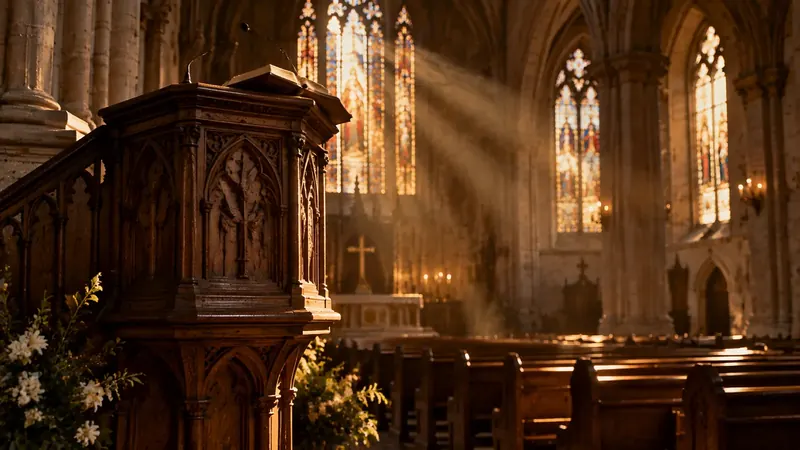
In Nehemiah 8:1-8, the people who have returned from exile gather in Jerusalem. Ezra stands on a pulpit of wood (Nehemiah 8:4) and reads the law from early morning until midday, while the Levites help the people understand. Verse 8 is almost a definition of expository preaching:
So they read in the book in the law of God distinctly, and gave the sense, and caused them to understand the reading.
Nehemiah 8:8
There is no show: there is reading, explanation and understanding, and the result is weeping, joy and obedience.
Jesus: the text fulfilled in him
In Luke 4:16-21, Jesus enters the synagogue in Nazareth, reads from the prophet Isaiah, sits down and declares that this Scripture has been fulfilled in the hearing of those present. After the resurrection, on the road to Emmaus, he does the same with the whole Hebrew Bible:
And beginning at Moses and all the prophets, he expounded unto them in all the scriptures the things concerning himself.
Luke 24:27
Here is the root of Christ-centered preaching: explain the text and show how it points to Christ without forcing it.
Peter and Paul: one gospel, different audiences
In Acts 2:14-41, Peter explains what the crowd has just seen by quoting the prophet Joel and two psalms of David, ending with a call to repentance. In Acts 17:2-3, Paul spends three sabbaths in the synagogue at Thessalonica reasoning from the Scriptures, "opening and alleging" that the Christ had to suffer and rise from the dead. In Acts 17:22-31, before Greek philosophers, he starts from the altar to the unknown god and arrives at the resurrection. The starting point changes; the message does not.
Paul to Timothy: preaching when it is unwelcome
Near the end of his life, Paul writes to the young pastor in Ephesus: "Preach the word" (2 Timothy 4:2). In verses 3 and 4 he warns that a time would come when people would not endure sound doctrine and would gather teachers to suit their own desires. Tailoring the message to the audience is not a new temptation. In 1 Corinthians 2:1-2 Paul recalls coming to Corinth without excellency of speech, determined to know nothing but Jesus Christ and him crucified.
Advertisement
1. The early church and the church fathers
Around the middle of the second century, Justin Martyr described the Christians' Sunday gathering: the memoirs of the apostles or the writings of the prophets were read, and then the one presiding urged those present to imitate these good things. The pattern of Nehemiah 8 was still alive.
In the centuries that followed, the church fathers developed the homily, an exposition that followed the text read in the service. Origen, in the third century, preached whole series on books of the Old Testament. John Chrysostom, in the fourth century, preached in Antioch and later in Constantinople, working through books such as Genesis, Matthew and Romans. He became famous for clear, practical sermons, courageous in the face of power, and died in exile; his nickname means "golden mouth." Augustine wrote "On Christian Doctrine," often described as the first Christian treatise on preaching, and insisted that the preacher must teach, delight and persuade.
Lesson: early preaching was both biblical and pastoral. Chrysostom explained the text verse by verse and spoke about money, family and injustice.
2. The Middle Ages and the preaching orders
In many places, preaching lost its place. In the thirteenth century, the Franciscans and the Dominicans arose, the latter officially called the Order of Preachers, devoted to preaching to ordinary people in the towns, with simple language and everyday examples.
Lesson: when the church grows cold, renewal comes through a return to preaching, and preaching for ordinary people does not have to be shallow.
Advertisement
3. The Reformation: the text back at the center
In the sixteenth century, with Luther, Zwingli and Calvin, the sermon returned to the center of worship. Preaching was in the language of the people, with the text as the authority. In Zurich, Zwingli began to preach through the Gospel of Matthew from start to finish rather than only the calendar readings. In Geneva, Calvin expounded entire books of the Bible over years, chapter after chapter, several times a week. This continuous reading, called lectio continua, is the basis of the book-by-book exposition many churches practice today.
In the following century, the English Puritans popularized a plain sermon in three movements: the doctrine the text teaches, the reasons that support it, and the "uses," that is, its applications to life.
Lesson: preaching book by book protects the preacher from his favorite topics and the congregation from the preacher's whims.
4. Revivals and the modern pulpit
In the eighteenth century, Whitefield and Wesley preached in the open air to crowds too large for the churches, and Whitefield also took that preaching to the American colonies. In New England, Jonathan Edwards stood out in the same period. In the nineteenth century, Spurgeon combined solid doctrine with vivid language in London, and his sermons, printed every week, circulated around the world.
In the twentieth century, radio, television and later the internet extended the pulpit, with blessings and temptations: fame, shallowness and messages shaped by the audience, the risk Paul describes in 2 Timothy 4:3-4.
Four traits that appear in every fruitful era
- It explains the text. From Ezra to Calvin, the faithful preacher helps people understand what the Bible says, not only what he thinks.
- It speaks clearly to the people. In 1 Corinthians 14:19 Paul says that in the church he would rather speak five words with understanding than ten thousand in an unknown tongue. Clarity is a form of love.
- It shows courage before power. When the Sanhedrin forbade the apostles to speak in the name of Jesus, Peter and John answered: "For we cannot but speak the things which we have seen and heard" (Acts 4:20).
- It grows out of a life of prayer. In Acts 6:4 the apostles reorganize the church so as not to neglect two priorities: "But we will give ourselves continually to prayer, and to the ministry of the word."
A worked example: using history to plan a series
Imagine the pastor of a small congregation who has preached loose topics for years. He decides to apply the lessons of history in a series on Philippians, starting with Philippians 1:12-18.
- Read and explain, as in Nehemiah 8. He reads the passage and explains its setting: Paul is in prison, some preach Christ out of envy and strife, others out of goodwill, and Paul rejoices that Christ is proclaimed.
- Follow the book, as in the Reformation. He takes the next text in order instead of jumping to chapter 4.
- Organize like the Puritans. Doctrine: God uses even bad circumstances to advance the gospel. Reason: Paul's own account in verses 12 to 14. Use: how to respond when others serve from wrong motives, and how to examine your own.
- Speak clearly, like Chrysostom. He swaps technical terms for examples from church life and sums up the main idea in one simple sentence.
- Pray before and after, as in Acts 6:4. He sets aside time to pray over the text and for the people who will hear it.
The point is not to imitate the past, but to let it correct the habits of the present.
Common mistakes when studying the history of preaching
- Nostalgia. Ecclesiastes 7:10 warns against asking why the former days were better. Every era had weak preaching.
- Hero worship. The Corinthians were divided between Paul and Apollos, and Paul answered: "I have planted, Apollos watered; but God gave the increase" (1 Corinthians 3:6). Study the great preachers, but do not put them in Christ's place.
- Copying the style and losing the principle. Whitefield's open-air preaching answered a specific context. What carries over is the principle (clarity, faithfulness, courage), not the form.
- Despising the present. The internet brings risks, but it also carries the gospel where no pulpit ever reached.
A 7-day plan for learning from history
- Day 1: read Nehemiah 8:1-12 and note what Ezra and the Levites do.
- Day 2: read Luke 24:13-35 and notice how Jesus explains the Scriptures.
- Day 3: compare Acts 17:1-4 with Acts 17:22-31 and note what changes and what stays.
- Day 4: read 2 Timothy 4:1-5 and write down one present-day temptation the text exposes.
- Day 5: read an old sermon and look for the four traits.
- Day 6: evaluate your last sermon with the same four questions.
- Day 7: choose a short book of the Bible to preach in order and pray for that series.
Questions for reflection or a small group
- Which of the four traits is weakest in your preaching or church?
- When are you tempted to adjust the message to please people?
- What would change if your church heard a whole book of the Bible in order?
- Which preacher from the past has most shaped your faith, and why?
- Where does prayer fit in your preparation today?
Frequently asked questions
Who were the great preachers in history?
Among the names most often mentioned are John Chrysostom and Augustine in the early church, Luther and Calvin in the Reformation, Whitefield, Wesley and Edwards in the eighteenth-century revivals, and Spurgeon in the nineteenth century. All of them combined faithfulness to the text with clarity.
What was preaching like in the early church?
The apostles explained the Scriptures in the light of Christ, as Acts 2 and Acts 17 show. In the following centuries, preaching accompanied the public reading of Scripture in worship, with explanation and practical exhortation.
How did preaching change in the Reformation?
The sermon returned to the center of worship, in the language of the people, and many Reformers began preaching through whole books in order. For the Reformers, Scripture was the final authority, above tradition.
Why study the history of Christian preaching?
It shows that today's challenges are not new, and that the church has been renewed whenever it returned to explaining the Word with clarity, courage and prayer.
Keep going
Our Spanish-language ebook on the history of Christian preaching develops each of these periods, and a companion title on expository preaching is a natural next step. Continue right away with how to prepare an expository sermon, see when thematic preaching makes sense, and work on your delivery with effective communication in the pulpit.

Vagner Soares is a presbyter with pastoral ordination, a mentor and a digital entrepreneur with more than 10 years of experience in technology, digital marketing and education.
Keep reading
 PreachingHow to Prepare an Expository Sermon, Step by StepA clear method for preparing an expository sermon: choose the passage, study its context, find the main idea, outline the points and apply the text to life.Read the article
 PreachingEffective Communication in the Pulpit: How to Speak with Clarity and ConfidencePreaching tips: clear structure, concrete language, voice and pauses, eye contact, illustrations, and handling nerves, all while depending on the Spirit.Read the article
 PreachingTopical Preaching: How to Prepare a Message by Theme Without Betraying the TextWhat topical preaching is, when to use it, the risk of forcing verses, and a five-step method for a topical sermon that respects every passage cited.Read the article