
The birth of Jesus in the Bible: the full account, in order
The full account of the birth of Jesus, joining what Matthew and Luke each record, in chronological order, with the prophecies both writers quote and what tradition added on its own.
In this article
- Where it really begins
- Before: Zacharias and Elisabeth
- The announcement to Mary
- Joseph's dream
- The census and the journey
- The birth
- The shepherds
- The wise men: how many, when and where
- Herod and the flight to Egypt
- The prophecies the Gospel writers quote
- What the text says and what tradition added
- A prayer
- Questions for reflection or small group
- Sources
Two of the four Gospels tell the birth of Jesus, and they tell different things. Luke narrates the announcement to Mary, the census, the manger and the shepherds. Matthew narrates Joseph's dream, the wise men, Herod and the flight to Egypt.
They do not contradict each other: they complement each other. But the nativity scene everyone knows, with shepherds and wise men together at the manger, is a later blend. This article puts everything in order and marks what each text actually says.
Our main source is the Bible itself. The wording here is the King James Version, as it stands.
Where it really begins
John tells no manger and no shepherds. He sums the whole thing up in one verse:
And the Word was made flesh, and dwelt among us, (and we beheld his glory, the glory as of the only begotten of the Father,) full of grace and truth.
John 1:14
The Word was made flesh. That is the event. Everything else is the detail of how it happened.
And Paul says it from another angle: "made himself of no reputation, and took upon him the form of a servant, and was made in the likeness of men" (Philippians 2:7-8).
Before: Zacharias and Elisabeth
Luke's account does not open with Mary, but with an elderly priest:
There was in the days of Herod, the king of Judaea, a certain priest named Zacharias, of the course of Abia: and his wife was of the daughters of Aaron, and her name was Elisabeth.
Luke 1:5
Zacharias and Elisabeth were old and childless. An angel announces to him, in the temple, the birth of John the Baptist. Zacharias doubts and is struck mute until the birth (Luke 1:5-25).
Six months later, the same angel goes to Nazareth.
Advertisement
The announcement to Mary
And the angel said unto her, Fear not, Mary: for thou hast found favour with God. And, behold, thou shalt conceive in thy womb, and bring forth a son, and shalt call his name Jesus. He shall be great, and shall be called the Son of the Highest: and the Lord God shall give unto him the throne of his father David: And he shall reign over the house of Jacob for ever; and of his kingdom there shall be no end.
Luke 1:30-33
Mary asks one question — how shall this be — and then accepts. She goes to visit Elisabeth, and there speaks the song known as the Magnificat: "My soul doth magnify the Lord" (Luke 1:46).
When John is born, Zacharias recovers his voice and prophesies (Luke 1:57-80).
Joseph's dream
Matthew tells the same story from the other side:
Now the birth of Jesus Christ was on this wise: When as his mother Mary was espoused to Joseph, before they came together, she was found with child of the Holy Ghost.
Matthew 1:18
Joseph, discovering the pregnancy, decided to put her away privately rather than expose her. An angel appears to him in a dream and explains. And gives the name:
And she shall bring forth a son, and thou shalt call his name Jesus: for he shall save his people from their sins.
Matthew 1:21
Jesus means the Lord saves, and the verse explains why: for he shall save his people from their sins.
Advertisement
The census and the journey
And it came to pass in those days, that there went out a decree from Caesar Augustus that all the world should be taxed. (And this taxing was first made when Cyrenius was governor of Syria.) And all went to be taxed, every one into his own city. And Joseph also went up from Galilee, out of the city of Nazareth, into Judaea, unto the city of David, which is called Bethlehem; (because he was of the house and lineage of David:) To be taxed with Mary his espoused wife, being great with child.
Luke 2:1-5
Luke dates the event with administrative precision: "this taxing was first made when Cyrenius was governor of Syria" (Luke 2:2). It is history placed in time, not a legend floating free.
From Nazareth to Bethlehem is about ninety miles.
The birth
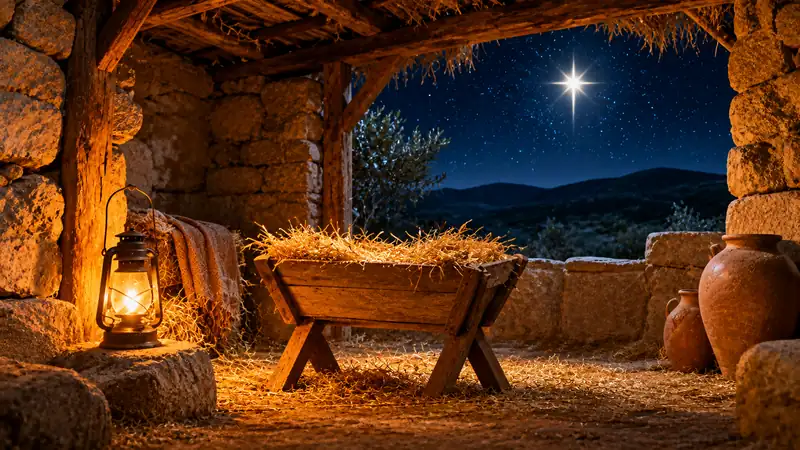
And she brought forth her firstborn son, and wrapped him in swaddling clothes, and laid him in a manger; because there was no room for them in the inn.
Luke 2:7
Three facts, and no more: swaddling clothes, a manger, and no room. Luke does not say how many animals were there, or whether it was a cave or a stable, or that an innkeeper turned them away. The word inn points to a lodging place that was full, not necessarily to someone shutting a door.
The shepherds
And there were in the same country shepherds abiding in the field, keeping watch over their flock by night. And, lo, the angel of the Lord came upon them, and the glory of the Lord shone round about them: and they were sore afraid. And the angel said unto them, Fear not: for, behold, I bring you good tidings of great joy, which shall be to all people. For unto you is born this day in the city of David a Saviour, which is Christ the Lord. And this shall be a sign unto you; Ye shall find the babe wrapped in swaddling clothes, lying in a manger. And suddenly there was with the angel a multitude of the heavenly host praising God, and saying, Glory to God in the highest, and on earth peace, good will toward men. And it came to pass, as the angels were gone away from them into heaven, the shepherds said one to another, Let us now go even unto Bethlehem, and see this thing which is come to pass, which the Lord hath made known unto us. And they came with haste, and found Mary, and Joseph, and the babe lying in a manger. And when they had seen it, they made known abroad the saying which was told them concerning this child. And all they that heard it wondered at those things which were told them by the shepherds. But Mary kept all these things, and pondered them in her heart. And the shepherds returned, glorifying and praising God for all the things that they had heard and seen, as it was told unto them.
Luke 2:8-20
The announcement goes first to shepherds: a job of low social standing, men spending the night outdoors. Not to the priests, not to the palace. That order is part of the message.
Eight days later he is circumcised and named (Luke 2:21), and then presented at the temple, where Simeon and Anna recognise him (Luke 2:22-38).
Lord, thank you that you came to a manger and announced yourself first to shepherds.
Prayer
The wise men: how many, when and where
This is where tradition parts company with the text.
Now when Jesus was born in Bethlehem of Judaea in the days of Herod the king, behold, there came wise men from the east to Jerusalem, Saying, Where is he that is born King of the Jews? for we have seen his star in the east, and are come to worship him.
Matthew 2:1-2
The text does not say there were three. It says they brought three kinds of gift. Nor does it call them kings: the word is wise men, scholars from the east, most likely Babylonian or Persian astronomers.
And they did not arrive at the manger:
And when they were come into the house, they saw the young child with Mary his mother, and fell down, and worshipped him: and when they had opened their treasures, they presented unto him gifts; gold, and frankincense and myrrh.
Matthew 2:11
When they were come into the house. This is no longer the stable. On top of that, Herod orders the killing of children "from two years old and under, according to the time which he had diligently inquired of the wise men" (Matthew 2:16), which suggests a considerable gap since the birth.
The gifts carry their own meaning: gold, for a king; frankincense, for a priest; myrrh, used for burial.
Herod and the flight to Egypt
And when they were departed, behold, the angel of the Lord appeareth to Joseph in a dream, saying, Arise, and take the young child and his mother, and flee into Egypt, and be thou there until I bring thee word: for Herod will seek the young child to destroy him. When he arose, he took the young child and his mother by night, and departed into Egypt: And was there until the death of Herod: that it might be fulfilled which was spoken of the Lord by the prophet, saying, Out of Egypt have I called my son. Then Herod, when he saw that he was mocked of the wise men, was exceeding wroth, and sent forth, and slew all the children that were in Bethlehem, and in all the coasts thereof, from two years old and under, according to the time which he had diligently inquired of the wise men. Then was fulfilled that which was spoken by Jeremiah the prophet, saying, In Rama was there a voice heard, lamentation, and weeping, and great mourning, Rachel weeping for her children, and would not be comforted, because they are not.
Matthew 2:13-18
The killing of the children of Bethlehem is the part of the account that almost never appears in nativity plays. It is the other side of the birth: power reacting with violence.
The family flees to Egypt and returns after Herod's death, settling in Nazareth (Matthew 2:19-23). Luke closes the same way: "they returned into Galilee, to their own city Nazareth. And the child grew, and waxed strong in spirit" (Luke 2:39-40).
The prophecies the Gospel writers quote
Matthew builds his account by marking fulfilments. Four are worth seeing.
The virgin and the name Immanuel:
Therefore the Lord himself shall give you a sign; Behold, a virgin shall conceive, and bear a son, and shall call his name Immanuel.
Isaiah 7:14
Matthew quotes it: "Behold, a virgin shall be with child, and shall bring forth a son, and they shall call his name Emmanuel, which being interpreted is, God with us" (Matthew 1:22-23).
The place:
But thou, Bethlehem Ephratah, though thou be little among the thousands of Judah, yet out of thee shall he come forth unto me that is to be ruler in Israel; whose goings forth have been from of old, from everlasting.
Micah 5:2
That is the answer the scribes give Herod when he asks where the Messiah was to be born (Matthew 2:5-6). Bethlehem was a town of no importance.
The coming out of Egypt: "called my son out of Egypt" (Hosea 11:1), quoted in Matthew 2:15.
The weeping in Ramah: "A voice was heard in Ramah, lamentation, and bitter weeping; Rahel weeping for her children" (Jeremiah 31:15), quoted in Matthew 2:17-18 over the killing of the children.
And the prophecy most read at Christmas, from Isaiah:
For unto us a child is born, unto us a son is given: and the government shall be upon his shoulder: and his name shall be called Wonderful, Counsellor, The mighty God, The everlasting Father, The Prince of Peace.
Isaiah 9:6
What the text says and what tradition added
What the Bible says: he was born in Bethlehem in the days of Herod; he was laid in a manger; there was no room in the inn; wise men from the east brought three kinds of gift; the wise men found him in a house.
What tradition added: the date of 25 December; a cave with an ox and a donkey; an innkeeper who turned them away; that the wise men were three, were kings, and had names; shepherds and wise men together at the manger.
None of the additions is a sin or ruins the celebration. But it helps to know where the text ends and the custom begins, especially when teaching.
A prayer
Lord Jesus, thank you that you did not come to a palace. Thank you that the announcement went first to shepherds and that your name says what you came to do: save your people from their sins. Let this Christmas not stop at the decorations but reach you. In your name, amen.
Prayer
Questions for reflection or small group
- Which part of the story did you know from tradition rather than from the text?
- Why do you think the announcement went first to the shepherds?
- What does it mean that the name Jesus means the Lord saves?
- How would you tell this account to a child without inventing anything?
How many wise men were there?
The text says neither how many there were nor that they were kings. Matthew 2:1 speaks of wise men from the east and mentions three kinds of gift: gold, frankincense and myrrh. That is where the idea of three came from.
Did the wise men come to the manger?
No. Matthew 2:11 says they found him "when they were come into the house." Herod also ordered the killing of children two years old and under (Matthew 2:16), which suggests time had passed since the birth.
Was Jesus born on 25 December?
The Bible gives no date. The 25th of December was fixed centuries later. The time marker Luke does give is the census under Cyrenius, governor of Syria (Luke 2:2), in the days of Herod.
Why did the announcement go to shepherds?
The text does not explain, but the fact is striking: theirs was a job of low social standing. The announcement went neither to the temple nor to the palace, but to men watching their flock by night (Luke 2:8-20).
Why do Matthew and Luke tell different things?
Because they write from different perspectives. Luke follows Mary: the announcement, the census, the manger, the shepherds. Matthew follows Joseph: the dream, the wise men, Herod, Egypt. Together they give the whole picture.
If you want to study the Gospels in more depth, the ebook Las 13 Cartas de Pablo Explicadas Versículo por Versículo (in Spanish) goes deeper into this subject.
Sources
- The Holy Bible, King James Version. Primary source for this article: every biblical quotation comes from it, and the other sources serve only to show where each Christian tradition put its reading of the text in writing.
- eBible.org. The Holy Bible, King James Version.
- BibleProject. Hebrews (video).
Consulted on November 15, 2026.
Free
Read the whole Bible in one year
Download the plan as a PDF: 365 days, Old and New Testament side by side, so you can start today — not on January 1st.
One study a week, nothing else. One click to leave. Privacy policy
Done. Your plan is here: Download the PDF
I couldn’t register that right now. Please try again in a moment.

Vagner Soares is a presbyter with pastoral ordination, a mentor and a digital entrepreneur with more than 10 years of experience in technology, digital marketing and education.
Keep reading
 Bible studyWhat Advent is: origin, meaning and how to keep itWhat Advent is, where it comes from, what the four weeks and the candles mean, what the Bible says about two comings, and how to keep it at home.Read the article
 PreachingChristmas message: a ready outline and Bible texts to preachA Christmas message outline ready to preach, with three points, the texts for each part, alternative passages by angle and the mistakes to avoid.Read the article
 Bible studyBible verses about faith for hard days, sorted by situationBible verses about faith sorted by situation, from fear to perseverance, with context notes, examples of faith in Scripture and a prayer for days of doubt.Read the article