
Marketing and communication · Reference guide
Complete guide to marketing and communication for churches: from identity to distribution
A complete guide to church communication: identity and voice, a content calendar, digital channels, handling image crises and the metrics that matter.

In this article
- Church marketing without turning into advertising
- Light, seasoned speech and a good name: what the Bible teaches about communicating
- Identity and voice: knowing who the church is before you post
- Content calendar: how to plan the month in five steps
- Digital channels: what to keep in a small, medium or large church
- Reputation crisis management: when to respond, where and with what words
- Metrics that matter and the ones that only look important
- A worked example: the church that had vanished from the internet
- First steps for this week
- Frequently asked questions
Free mind map
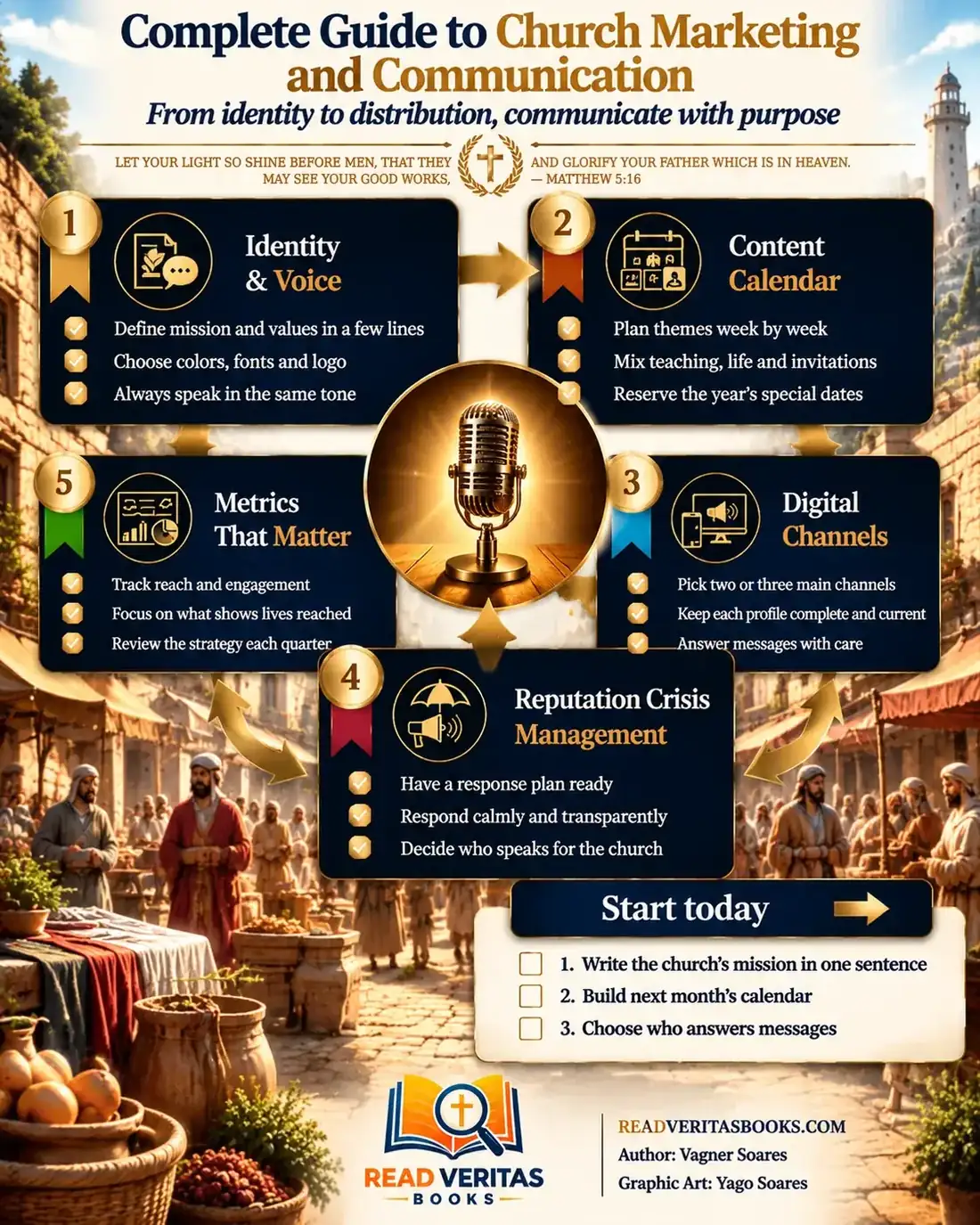
This whole guide on one page
The five steps in this article as an infographic you can print, pin on the notice board or send to your team.
Communicating well is not vanity or a sales strategy: it is a way of serving. Someone walking by, a first-time visitor or a person looking for help online can only find the church if it shows up in a way that is clear, welcoming and consistent.
This guide walks through a local church's communication from identity to distribution: who the church is and how it speaks, how to plan content, which channels to keep, what to do when the church's reputation takes a hit and which numbers deserve attention. It is written for small teams working with volunteers and simple tools.
Let your light so shine before men, that they may see your good works, and glorify your Father which is in heaven.
Matthew 5:16
Church marketing without turning into advertising
Many church leaders wince at the word marketing, and fairly so when it brings to mind empty slogans. Yet every church already communicates, whether it means to or not: the sign out front, the profile nobody has touched for months, the announcements group where no one knows the service time. The question is not whether the church will communicate, but whether it will do so with care.
Good church communication is truthful, because it shows the church as it really is; useful, because it answers where, when, for whom and how to get there; and consistent, because it keeps the same identity and tone everywhere. When a visitor finds one time on the website, another on the profile and a third on the poster by the door, they conclude that nobody is looking after it.
Advertisement
Light, seasoned speech and a good name: what the Bible teaches about communicating
The opening verse is often used as a call to promotion, but the context asks for more care. In Matthew 5:16, in the Sermon on the Mount, Jesus has just called his disciples the salt of the earth and the light of the world. The light is their good works, and the goal is that people glorify the Father, not that they admire the church. The text does not command advertising: it says that a faithful, visible life points to God.
In Colossians 4:5-6, Paul, writing from prison, instructs believers about their conduct toward outsiders: "Let your speech be alway with grace, seasoned with salt, that ye may know how ye ought to answer every man." The subject is everyday conversation with people who are not Christians, not social media, but the principle carries over: tone matters as much as content.
In 2 Corinthians 8:20-21, Paul explains why the gift for the poor believers in Judea would be carried by more than one trusted person: so that no one could accuse them over how that money was handled. He adds: "Providing for honest things, not only in the sight of the Lord, but also in the sight of men." The passage is about finances, but it shows that reputation before onlookers is a legitimate concern, as long as it grows out of honesty rather than polish.
The principle for church administration: communicate to serve, speak with grace and show only what is true.
Identity and voice: knowing who the church is before you post
Identity is not a logo. The logo, colors and fonts are the clothing; identity is what the church is for its neighborhood. A church that sees itself as "a family that welcomes the weary" will choose different photos and words from one that sees itself as "a Bible teaching center for the city". Neither is wrong, but each needs to know which it is.
Voice is the way the church talks: addressing readers as "you" or as "brothers and sisters", using or avoiding insider terms, writing short or long announcements. When every volunteer writes in their own style, the church seems to have five personalities. The practical fix is a one-page voice guide, approved by the leadership and handed to everyone who posts. A model to adapt:
- We are a neighborhood church that welcomes families and teaches the Bible simply.
- Our voice is warm, clear and hopeful. Any text that sounds cold, sarcastic or overblown goes back for revision.
- We address the reader as "you" and explain insider terms ("cell" becomes "a small group that meets in homes").
- Every announcement answers four questions: what, when, where and for whom.
- We never post photos of children without their parents' permission, or prayer requests with names without consent.
- We use two colors and a single font, the same on posters, the screen and social media.
For the visual side, see how to build a simple visual identity.
Content calendar: how to plan the month in five steps
Jesus speaks of someone who wants to build a tower and first sits down to count the cost (Luke 14:28). The context is the cost of following him, not media planning, but the wisdom of measuring your strength before you start applies here too.
- Start from the church calendar, not from social media. List the services, events, campaigns and special dates of the quarter (Easter, Christmas, the church anniversary, baptisms) and note when promotion for each one should begin.
- Choose one theme per week, ideally tied to the pastor's sermon series.
- Spread three kinds of content across the week: teaching (a verse explained, an excerpt from the sermon), life (a real story from a ministry, with permission from those shown) and invitation (the next gathering, with day, time and place).
- Pick a frequency the team can sustain for a whole year. Two well-made posts a week are worth more than seven in the first month and none in the third.
- Set a production day and one person who approves: next week's content is ready on Wednesday, and the coordinator checks dates and names on Thursday.
The step-by-step version with a spreadsheet template is in the article on a simple editorial calendar for church social media.
Advertisement
Digital channels: what to keep in a small, medium or large church
Before any social network there is the place visitors check first: the church's listing on maps and in search. Address, service times, phone number and a current photo of the building answer half of a newcomer's questions.
Small church (up to about 100 people)
A map listing, one main social network and a broadcast list for weekly announcements. One or two volunteers are enough, as long as someone checks messages every day and replies within one working day.
Medium church
There is room for a simple website with service times and contacts, plus two social networks. Split the roles among three or four people: who writes, who photographs, who replies and who approves. A shared folder of approved photos prevents improvising, and basic SEO for your website helps you show up when people search for a church nearby.
Large church
The risk is fragmentation: every ministry opens its own profile and the church ends up speaking with ten voices. Agree that no ministry starts a public channel without approval, that there is one communication coordinator and that publicity requests come in through a form with a deadline. At this scale, email marketing for churches reaches people who do not follow social media.
Reputation crisis management: when to respond, where and with what words
James writes to scattered believers facing trials: "let every man be swift to hear, slow to speak, slow to wrath" (James 1:19). The context is receiving the Word and controlling anger, but the counsel fits the moment the church is criticized in public: listen and find out first, respond second. A decision rule keeps you from improvising:
- If the complaint is specific and true (noise, cars blocking a neighbor's driveway, no reply to a message), acknowledge it briefly, say what will change and offer a direct conversation.
- If it is opinion or provocation, reply once politely or do not reply at all; never argue in the comments.
- If it involves a particular person (a member, a child, a leader), give no details in public and take the matter to the leadership the same day.
- If the information is false, correct the fact once, with something verifiable, without attacking whoever spread it.
- If there is a possible crime, a risk to someone or a legal issue, follow your crisis protocol and speak with a lawyer before publishing any statement.
Decide in advance who speaks for the church: one or two people, always the same ones. A model reply to a valid complaint:
"Hello, [name]. Thank you for letting us know. You are right about the cars after our Wednesday service, and we have already assigned a team to direct parking. If you would like to talk in person, our number is [number]. Pastor [name], on behalf of the church."
For everyday cases, see how to handle negative comments on social media.
Metrics that matter and the ones that only look important
Proverbs 27:23 advises: "Be thou diligent to know the state of thy flocks". It is wisdom for someone who lives off livestock, reminding them that riches do not last and that what you have must be watched closely. It is not about statistics, but it points to the essential thing: knowing the real condition of people.
Likes and followers are easy to see and say little. A funny post can reach many people and bring no one; a plain announcement can reach few and fill the parents' meeting.
The useful numbers are different: new visitors and how they found the church (one question on the welcome card does it), messages answered the same day and visitors who came back a second time. They take more work, because the welcome team has to write them down, but they show lives reached. The opposite caution also applies: measuring everything wears out volunteers. Choose three numbers, record them monthly and review the strategy every quarter. See also the simple indicators every church should track.
A worked example: the church that had vanished from the internet
Picture a church of 175 members in a residential neighborhood. Its social profile was set up by a young man who moved away a year ago, and the last post is about an event that has already happened. On the map listing, the service time is still the old one.
The pastor calls in the teacher who writes the bulletin and a deacon who enjoys photography. In their first one-hour meeting, the three write the voice guide and correct the address and times on every channel. The teacher sets up a spreadsheet listing each channel, who has access and the date of the last update.
The following week they plan the month: the sermon series on family, a baptism on the third Sunday and a charity sale. They decide to post on Wednesday and Saturday and send a single announcement on Friday through the broadcast list. The deacon photographs only people who have given permission.
In the second month, a neighbor complains in a public review about cars parked across his driveway after the Wednesday service. The pastor talks with two deacons, confirms the problem, assigns a volunteer to direct parking and replies in three sentences, offering to talk. The case is logged in the office incident book.
At the quarterly review, the team looks at the three agreed numbers. Likes have barely moved, but several welcome cards mention the map listing and the profile. The decision is to keep the rhythm and train one more person to answer messages while the teacher is on vacation.
First steps for this week
- Search for your church the way a visitor would and write down every wrong or outdated detail.
- Correct the address, times and contacts on every channel on the same day.
- Draft the voice guide and bring it to the next leadership meeting.
- Decide who answers messages and how quickly.
- Add the question "How did you hear about our church?" to the welcome card.
Frequently asked questions
Where should a small church start with its communication?
With its map and search listing, with the correct address and service times, and with one well-kept channel. Answering messages the same day already makes a big difference to someone looking for a church.
Do I need to hire an agency or a marketing professional?
Not necessarily. Many churches communicate well with organized volunteers, a voice guide and free tools. Paying for help can make sense for a specific project, such as a new website, when the church is able to.
How many times a week should a church post on social media?
There is no right number. The best rhythm is the one your team can keep up for a year without burning out. Two well-made posts a week usually serve better than an intense routine that lasts only a few weeks.
Communication serves the church's purpose, not the other way around. To go deeper into each part, see how to build a simple visual identity, take care of basic SEO for your website, handle negative comments on social media and use email marketing for churches.

Vagner Soares is a presbyter with pastoral ordination, a mentor and a digital entrepreneur with more than 10 years of experience in technology, digital marketing and education.
Keep reading
 Marketing and communicationHow to create a simple editorial calendar for your church's social mediaCreate a simple editorial calendar for church social media: fixed themes, monthly planning, an ideas bank, a posting schedule and a review of what worked.Read the article
 Marketing and communicationEmail marketing for churches: the channel that reaches people who skip WhatsAppSet up email marketing for your church: a permission-based list, a weekly newsletter, content that works and free tools like Mailchimp and Brevo.Read the article
 Marketing and communicationPhotography and video at the service: how to record without distracting the congregationHow to record the service with photos and video without distraction: discreet positioning, quiet equipment, image consent, the right moments and quick editing.Read the article