
Email marketing for churches: the channel that reaches people who skip WhatsApp
Set up email marketing for your church: a permission-based list, a weekly newsletter, content that works and free tools like Mailchimp and Brevo.

In this article
- Is email worth it for your church? A rule for deciding
- Letters read to everyone: what Scripture shows about getting the message through
- Contact list: sign-up and consent templates
- Ideal frequency for the size of your church
- Content that works: building the newsletter in six steps
- Simple tools: what to weigh before choosing
- An example: the 145-member church that only announced on WhatsApp
- Mistakes that send the newsletter to spam or to oblivion
- Frequently asked questions
- Signs your email is doing its job
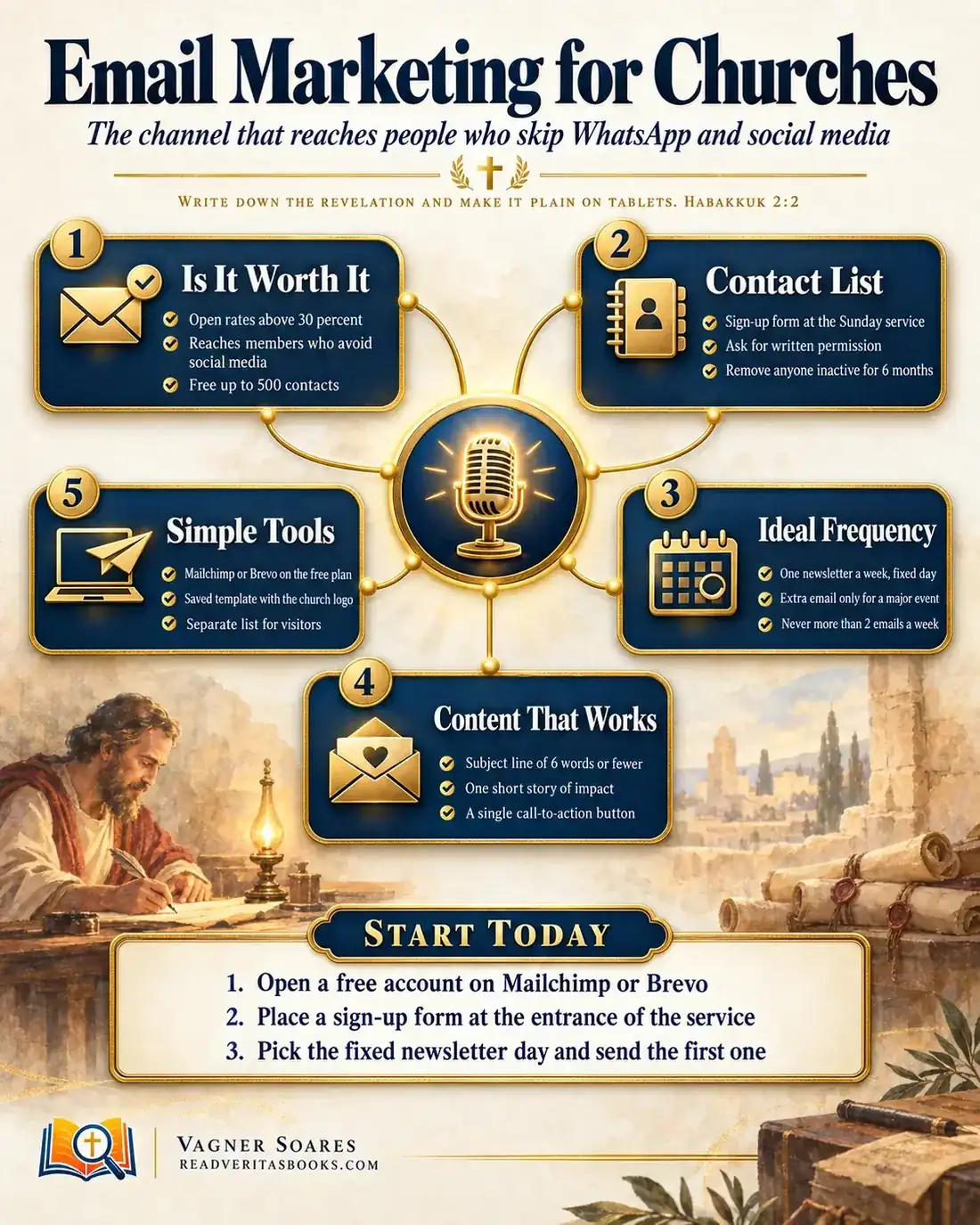
Free mind map
This whole guide on one page
The five steps in this article as an infographic you can print, pin on the notice board or send to your team.
The retreat announcement went out on WhatsApp, on Instagram and on the screen at church. Even so, the week of the event someone asks, "Why didn't anyone tell me?" Some people muted the groups, others do not follow the church online, and a few barely use either.
Email marketing for churches does not replace the service, the groups or the conversation in the foyer; it catches what they miss. This guide shows you when it is worth it, how to build a list with permission, how often to send, what to put in a church email newsletter and which tools to use.
Write down the revelation and make it plain on tablets
Habakkuk 2:2
Is email worth it for your church? A rule for deciding
The honest question is not whether email is modern, but whether someone in your church is missing information today. Almost always someone is: the grandfather who has an email address but is in no group, the professional who muted WhatsApp so she could get work done, the new family nobody has added anywhere yet. And the list belongs to the church: social platforms change their rules and reach without warning, while a well-kept list stays.
- If more than one important announcement a month "never reached" someone, a weekly newsletter is worth starting.
- If nobody can set aside an hour a week for it, start every other week and train a volunteer.
- If nearly everyone is in the same group and reads everything, use email only for major events and visitors.
- If your leaders want email as a dumping ground for whatever did not fit in the Sunday announcements, wait and agree on priorities first.
The numbers on the map (open rates above 30 percent, free up to 500 contacts) are benchmarks, not promises. Use the first as a goal and compare your church with itself over the months. Free plans change, so check the current limits before you rely on them.
Advertisement
Letters read to everyone: what Scripture shows about getting the message through
In Habakkuk 2:2 the prophet had just brought God his complaint about the injustice of his day. The answer was to write the vision clearly: "make it plain upon tables, that he may run that readeth it." The text is about a revelation awaiting its fulfilment, not about communication techniques. But it shows that what is written to be read has to be clear for someone with little time.
In Acts 15 the apostles and elders in Jerusalem settled a question that was dividing the churches and put the decision in writing. They did not send the letter alone: Judas and Silas went with it. In Antioch they gathered the believers and delivered the letter, "Which when they had read, they rejoiced for the consolation" (Acts 15:30-31). Afterwards the two messengers spoke at length to the brothers and strengthened them (Acts 15:32). The text does not say the letter was enough. The written record travelled together with people. Email keeps the right information, but it does not replace the phone call and the visit.
Paul asked that his letter to the Colossians be read in Laodicea as well (Colossians 4:16), and he told the Thessalonians, "I charge you by the Lord that this epistle be read unto all the holy brethren" (1 Thessalonians 5:27). These are apostolic letters, with an authority no newsletter has. The principle we can draw is about reach: what serves the whole church should reach the whole church, not only those who happen to be in the right group.
Contact list: sign-up and consent templates
A good list is small and real, not large and purchased. Every address should belong to someone who asked to hear from you. It is the golden rule applied to communication: "all things whatsoever ye would that men should do to you, do ye even so to them" (Matthew 7:12). Permission also improves deliverability and keeps the church out of spam folders.
Privacy and anti-spam rules vary by location, so learn what applies to your church regarding consent and the use of contact details. Explain what the email will be used for, keep a record of who agreed and always offer a way to unsubscribe. For specific questions, check with a lawyer or the church's accountant, and see how to protect your members' data responsibly.
Sign-up form template
Place the form at the entrance of the service, on paper or through a QR code:
- Full name
- Email address
- A checkbox, never pre-ticked, with the text "Yes, send me the church's weekly email newsletter with the schedule, announcements and news. I know I can unsubscribe at any time using the link at the end of every message."
- Optional question "Is this your first visit to our church?", with yes or no
- Date of sign-up, filled in by the team
Keep paper forms in a dated folder. An online form records the date automatically.
Template for people who have not opened in six months
Subject: Do you still want to hear from us?
Hi [name], it has been a while since our emails were opened in your inbox, and we do not want to take up space for nothing. If you would like to keep receiving them, click "Keep me on the list." If you do not click by [date], we will remove your address, no problem at all. You are always welcome at our services.
Anyone who does not respond comes off the list. Removing is not rejecting: it is respect, and it keeps your numbers honest.
Ideal frequency for the size of your church
A church email should be expected, not dreaded. The rule on the map applies to everyone: one newsletter a week on a fixed day, extra emails only for a major event and never more than two emails a week. Thursday or Friday usually works, because families are planning their weekend.
Small church (up to about 100 people)
If the schedule hardly changes, a short newsletter every other week is enough to begin with. One person sends it and another knows how to step in. A simple text, almost a letter, does more than a template full of images.
Medium church
Here the fixed day makes the difference. Agree on an internal deadline: ministries send their announcements by Tuesday, the person in charge builds the newsletter on Wednesday and sends it on Thursday. Anything that arrives later waits for the next week, unless it is a major event.
Large church
The risk is that every ministry wants its own email. Split the list by audience (children's ministry parents, volunteers, visitors) and keep one rule: across all lists, nobody receives more than two emails a week. Someone approves what goes out, as part of your internal communication plan.
Advertisement
Content that works: building the newsletter in six steps
A good church email can be read in a minute. Follow this order every week:
- Choose one highlight, the single thing people need to know or do this week, and put it at the top.
- Write a subject line of six words or fewer, such as "Couples retreat: registration now open".
- Open with two or three personal sentences, signed by the pastor or someone on the team, in a conversational tone rather than an official one.
- Put everything else in a short list of dates, with day, time and place.
- Share in a few lines something that happened at church, with permission from anyone mentioned.
- Use one call-to-action button, such as "Register", send yourself a test and read it on your phone before it goes out.
If step 1 turns up three highlights, two of them need another channel or another week.
Simple tools: what to weigh before choosing
Ordinary email with blind copy is free, but it only suits small, temporary groups. For the whole church it has no automatic unsubscribe link, lands in spam easily, and one person forgetting the blind copy exposes everyone's address.
Email marketing tools like Mailchimp and Brevo offer free plans, drag-and-drop editors, automatic unsubscribes and open reports. Try both for a week and keep the one your team finds easier. If the church already uses a church management system that sends email, check that it handles unsubscribes and records consent before opening another account.
Whatever you choose, three things do not change. Open the account with an official church address, never a volunteer's personal inbox. Have two administrators, a strong password and two-step verification, as explained in basic digital security for churches. And save a template with your logo, colors and a footer with the church address, to reuse every week.
An example: the 145-member church that only announced on WhatsApp
Take a church of 145 members where every announcement goes through one general WhatsApp group. In the month of the retreat, three families say they never heard about registration; two of them were in the group, with notifications muted. The pastor suggests the leadership try an email newsletter for three months.
The volunteer secretary takes it on, with a deacon as backup. They open an account on a free plan using the office's official address, both as administrators, and write down on a sheet kept in the office cabinet who has access. On the next two Sundays the sign-up form sits at the entrance and the QR code appears on the screen. Nobody imports a phone address book. The list starts with 64 addresses, all with consent.
The agreed rhythm: ministry announcements by Tuesday, assembly on Wednesday, the pastor reads the draft and it goes out Thursday at 5 p.m. The first subject line is "Retreat: register by Sunday", followed by five lines of dates, the story of the previous week's baptism (with the family's permission) and one button to the form.
After each send, the secretary logs in a simple spreadsheet the date, subject, opens, clicks and replies. After three months the leadership reviews that sheet: steady open rates, two older members who are grateful, and part of the registrations coming through the button. The church keeps the newsletter, creates a visitor list with three welcome emails and schedules the reconfirmation email for month six.
Mistakes that send the newsletter to spam or to oblivion
- Importing your phone contacts or WhatsApp numbers without asking. Start with people who opted in and invite everyone else.
- Sending one long email covering ten topics. One highlight and a short list of dates are enough.
- Hiding the unsubscribe link. Always keep the opt-out visible.
- Leaving the account tied to the personal inbox of whoever set it up. When that person leaves, the list leaves too.
Frequently asked questions
How do I email church members without ending up in spam?
Use a tool built for bulk sending, write only to people who signed up and keep the unsubscribe link visible. Avoid all-caps subject lines full of exclamation marks, and remove people who have not opened in a long time.
Can I use the email addresses from our membership records for the newsletter?
Only if people agreed to that use. The safest path is to ask for specific consent for the newsletter and confirm the details with a lawyer or accountant.
Is the free plan of Mailchimp or Brevo enough for a church?
For most small and medium churches it is usually enough at the start. Check the current limits on contacts and sends, because they change.
Who should handle the church's email marketing?
An organized volunteer with support from someone in communications is usually enough. What matters is one person responsible, a backup with access to the account and a leader who reads the draft.
Signs your email is doing its job
- You hear "nobody told me" less and less.
- People reply to the newsletter with questions and prayer requests.
- Your open rate holds steady or rises compared with previous months.
- The newsletter goes out on the right day even when the person in charge is on holiday.
A well-kept email is like a bulletin board that arrives at home on the right day. To go further, review how to protect your members' data, bring order to your church WhatsApp groups, learn to follow up with visitors without being pushy and fit the newsletter into the complete guide to church marketing and communication.

Vagner Soares is a presbyter with pastoral ordination, a mentor and a digital entrepreneur with more than 10 years of experience in technology, digital marketing and education.
Keep reading
 Marketing and communication · Reference guideComplete guide to marketing and communication for churches: from identity to distributionA complete guide to church communication: identity and voice, a content calendar, digital channels, handling image crises and the metrics that matter.Read the article
 Marketing and communicationHandling negative comments on your church's social media with graceLearn when to respond, what tone to use, when not to respond and how to moderate negative comments on church social media while learning from each one.Read the article
 Marketing and communicationBasic SEO for the church website: show up for people searching in your neighborhoodLearn basic SEO for your church website: local keywords, titles, site speed, fresh content and Google Business Profile so neighbors can find you.Read the article