
How to Follow Up With First-Time Church Visitors Without Being Pushy
Follow up with church visitors through three touches in four weeks: when to write, what tone to use, which invitation to offer and when to stop.

In this article
- Why church visitor follow-up so often stalls
- What the Bible teaches about welcoming those who come
- Quick first contact: from Sunday to Tuesday
- Message tone: three ready-to-use follow-up texts
- Contact frequency: the three-touch decision rule
- Invitation to the next step, adapted to church size
- Respecting silence: what you gain and what to watch
- A worked example: four visitors over four weeks
- Signs your follow-up is working
- Mistakes that turn welcome into pressure
- Frequently asked questions
Free mind map
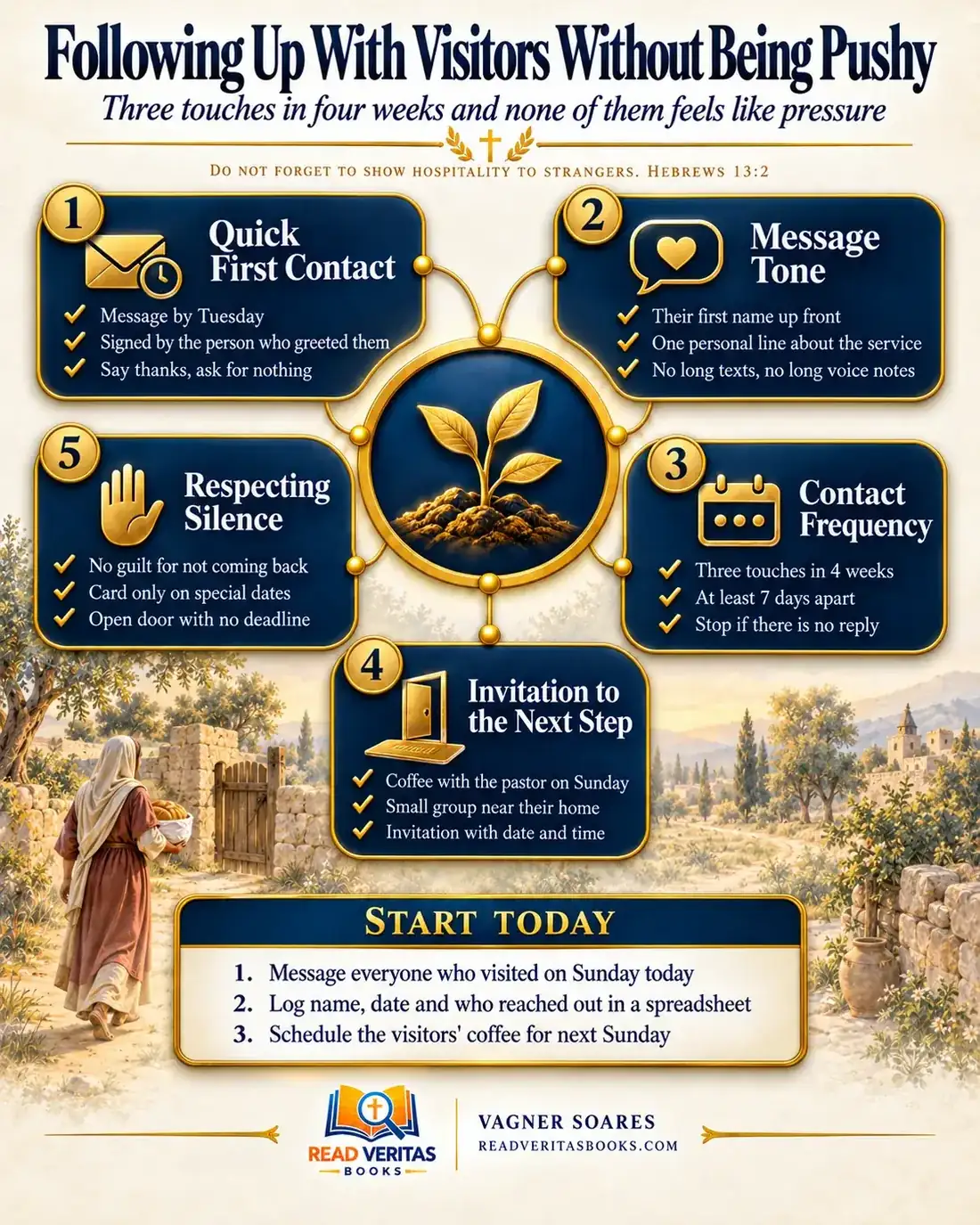
This whole guide on one page
The five steps in this article as an infographic you can print, pin on the notice board or send to your team.
It's Sunday night and the visitor list is in your hands: a few names, a phone number scribbled in a hurry, a family who slipped out before the benediction. You know you should reach out, but you hesitate. What if the message feels like pressure? As you wait, the week goes by, and a visitor's brave first step fades into silence.
This guide offers a path that fits any welcome team's routine: three touches in four weeks, each with a clear purpose, a named person responsible and a defined point where you stop.
Do not forget to show hospitality to strangers
Hebrews 13:2
Why church visitor follow-up so often stalls
First-time visitors almost always arrive carrying a story: a recent move, a loss, a desire to return to faith, or simply an invitation they accepted to be polite. A visit signals openness, but openness is not yet commitment.
On the church's side, the problem is rarely a lack of goodwill. It's two fears that cancel each other out: seeming pushy and seeming indifferent. When nobody has a clear task, everyone assumes someone else already wrote, and nobody does.
That's why follow-up works best as a small process decided before Sunday: who writes, when, what they say and when they stop. The goal is making sure nobody leaves without being noticed and without knowing an easy next step.
Advertisement
What the Bible teaches about welcoming those who come
Hebrews 13:1-2: hospitality that isn't forgotten
The letter to the Hebrews was written to weary Christians tempted to pull back. In chapter 13 the writer turns to practical counsel: "Let brotherly love continue. Be not forgetful to entertain strangers: for thereby some have entertained angels unawares" (Hebrews 13:1-2). Hospitality there meant opening your home to travelling believers and to strangers, which cost time and food. The mention of angels recalls Abraham welcoming three visitors (Genesis 18:1-8).
The text doesn't promise that every visitor is an angel, and it doesn't teach a follow-up method. It says hospitality can be forgotten, so it needs intention. For church administration the principle is plain: whatever depends only on someone's memory ends up postponed.
Luke 10:5-7: offering peace and leaving the answer to the other person
When Jesus sends out the seventy, he tells them what to say on entering a house: "Peace be to this house." Then he adds: "if the son of peace be there, your peace shall rest upon it: if not, it shall turn to you again" (Luke 10:5-6). He also tells them to stay in the house that received them: "Go not from house to house" (Luke 10:7).
The passage is about a specific mission, not church visitors. Still, it shows a posture: the offer is sincere, but the response belongs to the other person. That's the basis for knowing when to stop: a visitor's silence isn't the failure of whoever wrote.
Romans 15:7 and 1 Peter 4:9: welcoming without demands or grumbling
Paul writes to a church divided between groups with different convictions: "Wherefore receive ye one another, as Christ also received us to the glory of God" (Romans 15:7). He's speaking of believers among themselves, not visitors, but the principle holds: welcome doesn't wait for the other person to fit in first. Peter adds the right spirit: "Use hospitality one to another without grudging" (1 Peter 4:9).
Quick first contact: from Sunday to Tuesday
Speed matters more than perfect wording. A short message in the first few days arrives while the memory of the service is still fresh. Here is the sequence, in order:
- On Sunday, the welcome team asks for the minimum: name, phone number and one question, "Can we send you a message this week?" Only those who say yes go on the list.
- Whoever talked with the visitor writes down one line about the conversation, such as "moved here from out of state a month ago".
- On Sunday night or Monday, the welcome coordinator assigns the names. Each visitor gets one person responsible, ideally whoever shook their hand.
- By Tuesday evening, that person sends the first message, signed with their own name and offering thanks only.
- They then log the date in the spreadsheet, which only the team can access.
- If the visitor replies, the conversation follows their pace, with no invitations tacked on.
Message tone: three ready-to-use follow-up texts
A church guest follow-up text should sound like a person talking, not a campaign. Every message carries two personal touches: the name spelled correctly and something only someone who was there could say. Two or three lines are enough.
Touch 1, week one: thank-you
"Hi (name)! This is (your name) from church. I'm the one who met you at the door on Sunday. It was great to meet you and (personal line, for example: to hear you've just moved to the area). Thanks for coming. Take care!"
Touch 2, week two or three: a specific invitation
"Hi (name), how are you? Next Sunday, right after the morning service, Pastor (name) is having a quick coffee with people who've visited in the last few weeks. It takes about twenty minutes. We'd love for you to come. If you can't make it, no problem at all."
Touch 3, end of the month: an open door
"Hi (name)! Just wanted to say we're thinking of you. If you ever want to talk, simply reply to this message. All the best."
Notice what these texts don't do: they don't ask why the person hasn't come back, they don't ask for an RSVP and they don't attach the monthly calendar. Each one has a single purpose.
Advertisement
Contact frequency: the three-touch decision rule
How many times is too many? The limit is fixed: no more than three touches in four weeks, never two less than seven days apart. Within that limit, the visitor's response decides:
- If they replied to the first message with interest, the invitation can go out in week two.
- If they only replied "thanks", send the invitation in week three.
- If they didn't reply to the first, send the invitation anyway, because one unanswered message isn't a no.
- If the first two went unanswered, skip the third and log "closed, no reply".
- If the person came back to a service, the face-to-face conversation replaces the next message.
- If they asked not to be contacted, stop right away, thank them and record the request.
- If they shared a serious need, such as grief or illness, it leaves the sequence and moves to pastoral care, with their permission.
Put the planned date of each touch in the spreadsheet on day one.
Invitation to the next step, adapted to church size
"Come back anytime" is kind, but it doesn't help anyone decide. A good invitation is concrete and low-commitment, with a date, time, place and the name of who will be there, so all they have to do is say yes.
Small church, up to about 100 people
The pastor probably knows every face, and the invitation can come from them: coffee after the service or a simple lunch with another family.
Medium church, from 100 to a few hundred people
A visitors' coffee on a fixed date, say one Sunday a month, keeps invitations organized. Keep a list of small groups by neighborhood handy, and before passing a visitor's number to a group leader, ask if they're happy for you to do so.
Large church
With many visitors at each service, the risk is turning welcome into a queue. A regular welcome event, coordinators for each service and a spreadsheet or church management system with filters all help, as the article on hospitality ministry in large churches explains. But every visitor still has one named person responsible.
Respecting silence: what you gain and what to watch
Stopping after two unanswered messages has a cost: maybe someone needed one more reminder. Pushing on has a bigger cost: the church becomes the number that won't leave them alone. Between the two risks, choose the first, because the door stays open.
Stopping isn't forgetting. Care changes shape: instead of regular messages, an occasional gesture, like a birthday card, if the person shared the date and agreed to be contacted. If they return, they should find the same joy as on their first Sunday.
Watch two things. Silence after a conversation about a crisis calls for discernment: a single pastoral contact may be appropriate, never a new sequence. And decide how long the church keeps the details of people who didn't return. Data protection rules vary from country to country, so check with a local lawyer and see how to protect the personal data of the people who visit.
A worked example: four visitors over four weeks
Consider a church of 165 members with four volunteers on the welcome team and a coordinator. One Sunday four visitors arrive: a couple who just moved to the neighborhood, a university student invited by a classmate and an older man who came with his granddaughter.
That evening the coordinator assigns names: the couple goes to the volunteer who chatted with them in the children's area, the student to the youngest volunteer, the older man to the deacon who greeted him. Each one writes the personal line and the planned dates in the spreadsheet, with simple columns: name, visit date, person responsible, touches 1 to 3, reply and status.
By Tuesday the thank-you messages have gone out. The couple replies warmly, and in week two they get the invitation to coffee with the pastor. They come. The pastor mentions a small group three streets from their home and asks if he can pass their number to the leader, who writes to them the same day. Status: "connected to a small group".
The student only replied "thanks". In week three she gets the invitation to Saturday's youth gathering, with the time and address, and doesn't answer. Because she replied to the first touch, she receives the open-door message at the end of the month.
The older man didn't reply to the thank-you or the invitation, so the deacon logs "closed, no reply". Two months later he comes back with his granddaughter. The deacon greets him by name, without asking where he's been.
At the end of the month the team spends fifteen minutes reviewing the spreadsheet and notes one lesson: the coffee invitation got more replies when it said how long it would take.
Signs your follow-up is working
The signs that the process works show up well before any membership numbers:
- Sunday's messages go out by Tuesday without anyone having to chase them.
- Every visitor who agreed to contact has one named person responsible.
- The replies that come back are conversations, not just "ok".
- Requests to stop are rare and honored immediately.
- People who return, even months later, are greeted by name.
- When a volunteer is away, follow-up carries on.
To track this with a few simple numbers, see the simple metrics every church should track.
Mistakes that turn welcome into pressure
- Waiting for the perfect message: while the team debates wording, the week slips by. Approve the three texts and personalize only the name and one line.
- Adding visitors to group chats without asking: nobody should land in a group without permission. Offer it and let them choose.
- Asking for too much information on day one: address and date of birth can wait. A phone number and permission are enough.
- Leaving follow-up to a single person: when they're away, everything stops. Spread the names across the team and use the spreadsheet as shared memory.
Frequently asked questions
How soon after the visit should I send the first message?
Ideally by the following Tuesday. By then they still remember who greeted them.
Can I send the same message to every visitor?
You can start from a template, as long as each message includes the person's name and one personal line about the service. Without those touches, it reads as automated.
Who should handle first-time guest follow-up: the pastor or the welcome team?
The first touch works best coming from whoever greeted the person, because they remember that face. The pastor steps in with the invitation and in situations that need care.
What if a visitor asks to stop receiving messages?
Thank them warmly, take them out of the sequence and note the request in your spreadsheet.
Following up with visitors is a ministry of small gestures: a message at the right time, a clear invitation and the humility to stop. For those who find their place, prepare the next step with small groups that don't fizzle out in 3 months, keep your church WhatsApp groups organized and make sure you protect the personal data of the people who visit.

Vagner Soares is a presbyter with pastoral ordination, a mentor and a digital entrepreneur with more than 10 years of experience in technology, digital marketing and education.
Keep reading
 Growth and expansionHow a Church Can Grow Without Losing Its IdentityLearn how your church can grow without losing its identity: set non-negotiable values, sort what can change and teach who you are to newcomers.Read the article
 Growth and expansionPreparing the church to grow: structure today the space and culture of tomorrowPrepare your church to grow: infrastructure with room to spare, documented processes, a welcoming culture, leadership in depth and signs that it is time.Read the article
 Growth and expansion · Reference guideComplete guide to healthy church growth: from welcome to multiplicationA complete guide to healthy growth: welcoming visitors, a structure that can handle growth, new leaders, a preserved identity and multiplication.Read the article