
How to organize accountability reports for recurring donors and church partners
Build accountability reports for your church's recurring donors and partners with a one-page format, real stories and a direct contact channel.

In this article
- Why silence costs more than a report
- Other people's money in the church's hands: what Scripture shows
- What donors want to see before any spreadsheet
- Reporting frequency by church size
- Simple visual format: a one-page report template
- Impact stories told with permission
- Direct contact channel: who answers and how
- An example: the church that only wrote in December
- Mistakes that make a faithful partner quietly walk away
- Frequently asked questions
- Signs your accountability is working
Free mind map
This whole guide on one page
The five steps in this article as an infographic you can print, pin on the notice board or send to your team.
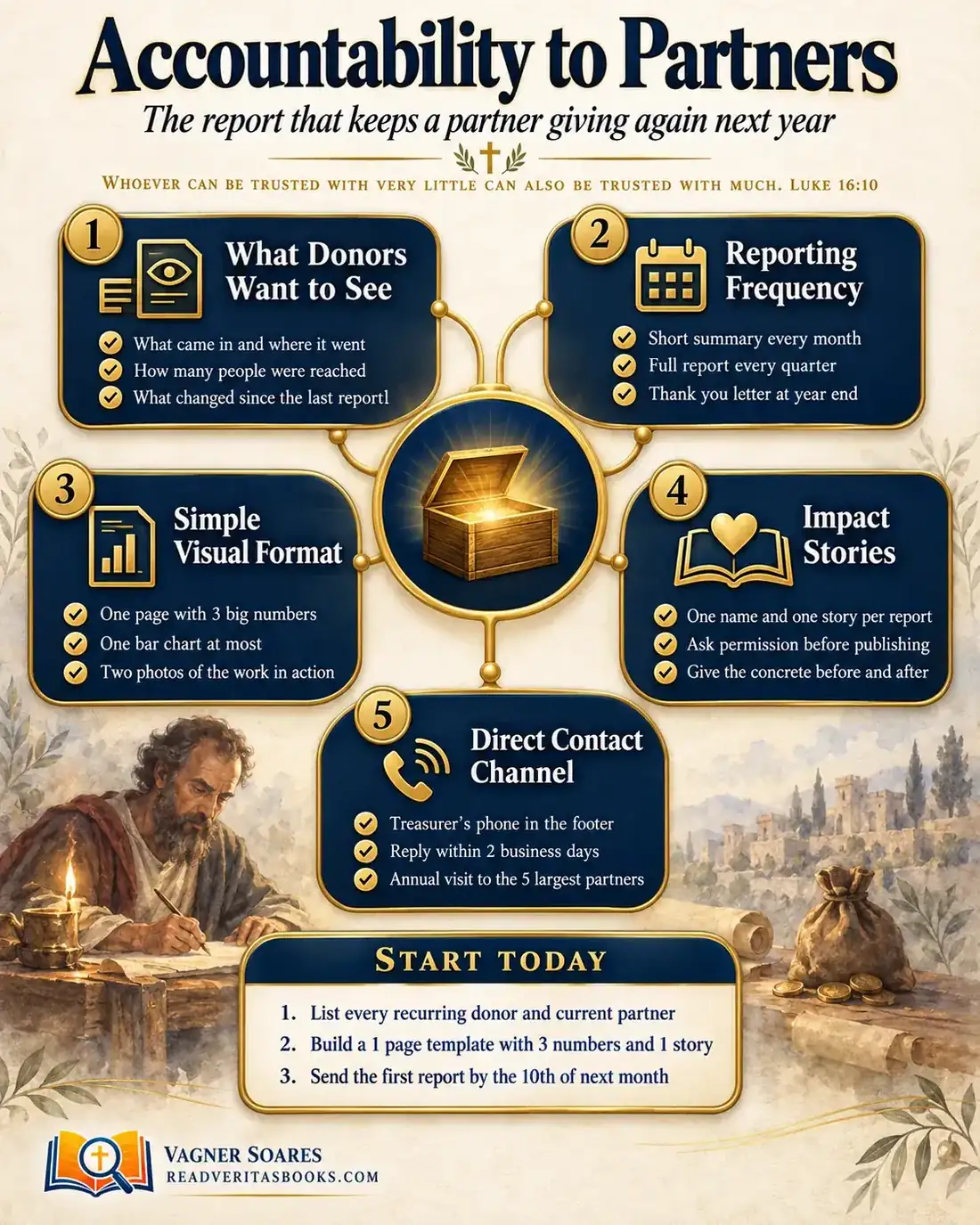
Every month, someone keeps supporting your church or a mission project without being reminded: a member who gives by automatic transfer, a local business that sponsors an outreach, another congregation that sends a fixed monthly gift. Too often, these partners only hear from you when there is a new request. Over time the silence cools the relationship, and the support ends without explanation.
This guide shows you how to organize simple, consistent accountability to donors: reports for your recurring donors and church partners that they can read in two minutes and that keep them giving again next year.
Whoever can be trusted with very little can also be trusted with much
Luke 16:10
Why silence costs more than a report
People who give regularly are entrusting your church with something they worked hard for. Reporting back honors that trust; it is more than a formality. Silence, on the other hand, is never neutral. When partners hear nothing, they fill the gap with guesses: the project stopped, the money went somewhere else. It is almost never true, but the doubt has already done its damage. Informed partners pray with more clarity, tell others about the work and renew their commitment.
Advertisement
Other people's money in the church's hands: what Scripture shows
The New Testament does not hand us a reporting template, but it does show how the first leaders handled resources and news that belonged to other churches.
Paul and the gift for Jerusalem
In 2 Corinthians 8, Paul is gathering a collection from the churches of Macedonia and Achaia for poor believers in Judea. He does not carry the money alone. He travels with a brother "who was also chosen of the churches to travel with us with this grace" (2 Corinthians 8:19) and explains why: to avoid anyone blaming him over the way this gift is handled. Then he sums it up: "Providing for honest things, not only in the sight of the Lord, but also in the sight of men" (2 Corinthians 8:21).
The passage does not set up an audit system. It says that an apostle thought it necessary for his honesty to be visible to those who had given. The principle is plain: being right before God is not enough; the people who give have a right to see it.
Antioch hears the mission report
In Acts 14, Paul and Barnabas finish their first missionary journey and return to Antioch, the church that had sent them. There they "gathered the church together" and "rehearsed all that God had done with them" (Acts 14:27). This is not a financial report, and it would stretch the text to call it one. But it shows that those who send deserve to hear the outcome.
Philippi and the partnership of giving and receiving
In Philippians 4:15-18, Paul thanks a church that had supported him more than once. He confirms that he received what they sent through Epaphroditus and adds: "Not because I desire a gift: but I desire fruit that may abound to your account" (Philippians 4:17). His thanks confirms receipt, names the person who carried the gift and treats it as sharing in the work, not as a transaction.
Taken together, these passages give church administration three habits: make honesty visible, tell what God did with what was sent, and say thank you in a personal, specific way.
What donors want to see before any spreadsheet
Most partners do not want a detailed balance sheet. They want answers to three questions: did the money arrive, was it used as agreed, and did it make a difference? When one answer is missing, doubt starts to take the place of trust.
The first question takes one sentence: the total received in the period. The second needs the main spending categories in plain words, such as "food", "team travel" or "school supplies", not accounting terms only the treasurer understands. The third needs a measure your team can count honestly, such as families served, children in the program or visits made.
It is worth adding what changed since the last report: a milestone, a new challenge, a change of course. If a gift was designated for a specific purpose, show separately how much went to that purpose; a church that mixes designated funds with the general account loses the ability to answer the second question.
Reporting frequency by church size
Irregular reports send the message that the church only remembers its partners when it needs something. The rhythm on the map has three levels: a short summary every month, a full one-page report every quarter and a thank-you letter at year end. What changes from church to church is who does it and how.
Small church (up to about 100 people)
One person usually handles everything, often the treasurer. Keep the monthly summary to three or four lines, sent on the same day each month. The quarterly report can be made in an ordinary word processor and saved as a PDF, and the year-end letter can be signed by hand by the pastor.
Medium church
Split the job: the treasurer closes the numbers by a fixed date and a second person, from communications or the church office, writes the text and picks the photos. An email list just for partners keeps the report from getting lost among service announcements.
Large church
Each project needs its own person responsible for results, while the finance office consolidates the amounts in a church management system or a shared folder. The risk here is that the report turns into marketing; keep the same simple format for everyone.
Whatever your size, share the calendar in your first mailing so partners know when to expect news.
Advertisement
Simple visual format: a one-page report template
Long reports rarely get read to the end. Use the same template every time: when partners recognize the layout, they find information faster. Here is a model you can copy and adapt.
At the top, the title and the period: "After-School Tutoring Program, second-quarter report".
Right below, three big numbers side by side: amount received this quarter, amount spent this quarter, children served each week. If there is a balance, one short line explains where it is kept and what it will be used for.
Next, a single bar chart at most, showing how spending was split across four or five categories, without a rainbow of colors.
In the middle of the page, two real photos of the work, with permission from those pictured, and one story paragraph of no more than five sentences.
Then one sentence about the next quarter: "In the coming months, we hope to open one more group on Thursdays."
In the footer, the contact line: "Questions or ideas? Call or email our treasurer using the details below; we reply within 2 business days." And one last line: "The full statement for this period is available to any partner who asks."
Impact stories told with permission
Numbers show size; stories show meaning. The story does not need to be dramatic. It needs to be true, specific and told with respect. Follow these steps each quarter:
- Choose one person or family per report, rotating between programs through the year.
- Talk with them before writing: explain where the text will be sent and who will read it.
- Ask for written permission to use their name, photo and details, and offer the option of using only a first name or no name at all.
- Describe the concrete before and after: the starting situation and what changed, without exaggeration or promises.
- Read the final text to the person or send it to them before publishing.
- File the permission in the same folder as the report, with the date.
Data protection and image rules vary by location, so get consent and check with a lawyer if you are unsure what applies to your church. Children and sensitive situations, such as illness, debt or violence, call for extra care: it is usually better to tell the story without a face or a name. Before sending, ask one last question: would the person mentioned feel respected reading this?
Direct contact channel: who answers and how
A report with no room for questions feels like a press release. Put the name, phone number and email of the treasurer (or whoever looks after partners) in the footer of every report, and set a response time your team can actually keep, such as 2 business days. Log every question you receive and apply these rules:
- If the question is about an amount or an expense, reply with the exact figure and offer the detail for that category.
- If a partner raises a criticism, say thank you, tell them when you will come back with an answer and take the matter to the leadership before giving a final reply.
- If a partner says they will reduce or end their support, call instead of replying in writing, thank them for what they gave and sincerely ask why.
- If a partner asks for a receipt or statement for tax purposes, check with a local accountant what the church can issue before promising any document.
- If the same question comes up three times, answer it in the next report.
For the partners who carry the most weight, including partner churches, schedule a visit, a call or a coffee once a year to say thank you. No document replaces that contact.
An example: the church that only wrote in December
Picture a church of 190 members that supports a missionary couple in a rural region and an after-school tutoring program for children in the neighborhood. It has 38 recurring donors, including members and former members who moved away, two partner churches and a bakery that donates the children's snacks. The only contact was a campaign message in December. In March, one of the partner churches says it will review its mission commitments.
The pastor brings together the treasurer, a church member who handles communications and the tutoring coordinator. In the first week, the treasurer builds a spreadsheet with 41 rows: name, contact, type of support, designated purpose and start date. He finds that six donors give to missions and not to tutoring, which changes what each one needs to read.
In the second week, the communications volunteer builds the one-page template with the three numbers for the quarter and the contact footer. The coordinator talks with the mother of one student, who gives written permission to tell her son's story with his first name only and no photo of his face. The pastor calls the partner church, thanks them and promises the first report by the 10th of the following month.
From then on, the monthly summary always goes out on the 10th, in four lines. The treasurer logs every question in a tab of the spreadsheet, with the date, who answered and when. At year end, the letter goes out signed by the pastor, with a recap of all four quarters. The partner church renews its support and asks to visit the program. None of this required new resources, only a calendar that was kept.
Mistakes that make a faithful partner quietly walk away
The first is reporting only when you are about to ask again: every report starts to sound like the introduction to a request. Keep the calendar even in months without a campaign.
The second is packing the page with technical detail to look transparent. Too many numbers hide as much as too few.
The third is publishing stories without consent. And the fourth is leaving questions unanswered: one ignored message undoes months of good reports.
Frequently asked questions
Do I need a different report for each partner?
No. One standard template sent to everyone covers most situations. Separate only by program if you have designated gifts, and save personalization for the year-end letter.
What should church donor reports say when results for the period were weak?
The same numbers as always, without dressing them up, and a short explanation of what will be adjusted. Trust grows when partners also receive the hard news.
Who should prepare accountability reports for donors?
Usually the treasurer pulls the numbers while another person handles the text and photos. Splitting the work prevents overload and builds in a natural second check.
Should I list donors' names in the report?
Generally, no. The report shows what came in and where it went, not who gave how much. Thank people by name only with each donor's permission.
Signs your accountability is working
- Partners reply to the monthly summaries with comments, questions or prayer requests.
- Questions are answered within the agreed time, and your log shows it.
- In the annual conversation, partners mention details of the program they could only know from your reports.
Consistent accountability turns an occasional donor into a long-term partner. To go deeper, read how to keep financial transparency without exposing donors, how to manage designated funds without mixing accounts, how to run an internal audit without creating suspicion, how to use email marketing for your church and the complete guide to church financial management.

Vagner Soares is a presbyter with pastoral ordination, a mentor and a digital entrepreneur with more than 10 years of experience in technology, digital marketing and education.
Keep reading
 Financial planning · Reference guideThe Complete Guide to Church Financial Management: Five Pillars That Hold the Books TogetherOrganize your church finances with a budget, transparency, a reserve, accountability, and a crisis plan. A practical guide for pastors and treasurers.Read the article
 Financial planningChurch reserve fund: how much to save and how to start smallLearn how to build your church's reserve fund: how much to save, how to start with 5% of income, and when that money should stay untouched.Read the article
 Financial planningWhat to do when church giving drops: a calm plan for the first 30 daysA plan for the first 30 days after giving drops: diagnose the cause, cut non-essential costs, communicate openly, use the reserve wisely and recover.Read the article