
Church reserve fund: how much to save and how to start small
Learn how to build your church's reserve fund: how much to save, how to start with 5% of income, and when that money should stay untouched.

In this article
- Why keep a reserve: what it really protects
- Saving with a purpose: Joseph, the ant and the rich man's barns
- How much to save: a calculation that fits on one page
- Starting small: percentage, account and date
- When not to use it: the rule that protects the reserve
- Annual review: a thirty-minute agenda
- Example: the 130-member church that started with 1,200 a month
- Mistakes that drain the reserve before it grows
- Frequently asked questions
- Signs your reserve is working
Free mind map
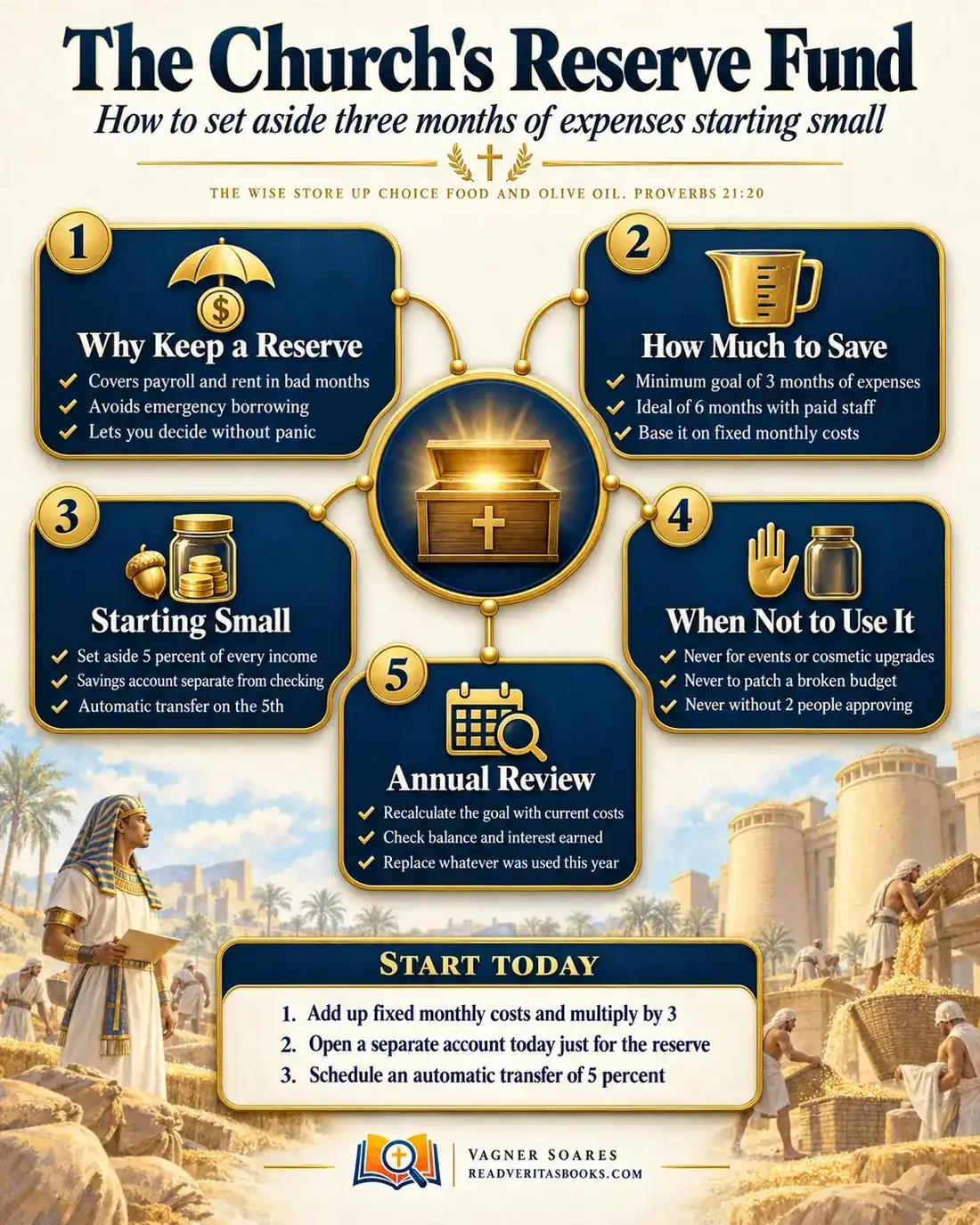
This whole guide on one page
The five steps in this article as an infographic you can print, pin on the notice board or send to your team.
The month when giving drops rarely sends a warning. Summer vacations empty the pews, a family that gave faithfully moves away, the roof starts leaking the same week rent is due. When a church runs with an empty cushion, every surprise turns into an emergency meeting, a rushed cut or an expensive loan.
This guide shows you how to build a church reserve fund starting small: why you need one, how much to save, how to take the first step without starving your ministries, when not to touch that money and how to review it once a year.
The wise store up choice food and olive oil
Proverbs 21:20
Why keep a reserve: what it really protects
A church emergency fund does not exist to protect money. It protects people and commitments. When a church hires a secretary, rents a hall or supports a pastor, it takes on obligations that come due on schedule, whether the month is good or bad.
There is a less visible benefit too: better decisions. When cash is tight, leaders decide under pressure, cut the wrong ministry or take a loan whose interest weighs on them for months. A few weeks of breathing room let you pray, seek advice and choose calmly. With a reserve in place, a slow month stops being a crisis and becomes just a slow month.
A reserve is not spare cash for projects, and it does not replace the budget. A church that closes in the red every month has a budget problem and needs to deal with that first.
Advertisement
Saving with a purpose: Joseph, the ant and the rich man's barns
The opening verse has a second half that often gets forgotten: the fool, the proverb says, uses up everything he has (Proverbs 21:20). The proverb compares two households. In one there is something stored away; in the other, everything that comes in is consumed.
In Genesis 41, Joseph interprets Pharaoh's dreams and announces seven years of plenty followed by seven years of famine. His advice is to appoint officers and “take up the fifth part of the land of Egypt in the seven plenteous years,” keeping the food “for store to the land against the seven years of famine” (Genesis 41:34-36). When the famine came, “Joseph opened all the storehouses” (Genesis 41:56). The text does not set a percentage for the church, nor does it promise that every crisis will be announced in advance. It shows a principle: set aside a portion in good times, with someone accountable and a defined purpose, and use the reserve when the season it was built for arrives.
Proverbs 6:6-8 points to the ant, which, with no overseer, “Provideth her meat in the summer.” For a church, that means a monthly habit that does not depend on anyone remembering.
The balance comes in Luke 12:16-21, the parable of the rich man who tears down his barns to build bigger ones and rest on his goods. Jesus concludes: “So is he that layeth up treasure for himself, and is not rich toward God” (Luke 12:21). The parable does not condemn planning; it condemns hoarding for yourself as your source of security. A reserve with a goal, a limit and a purpose of service is the opposite of those barns.
How much to save: a calculation that fits on one page
Before building a tower, Jesus says, a person sits down first and counts the cost (Luke 14:28). To set your goal, follow these steps:
- Gather the bank statements for the last six months, so one unusual month does not skew the number.
- Pull out only the fixed costs that cannot stop: salaries and payroll costs, rent, power, water, internet, insurance, loan payments already committed.
- Leave out events, campaigns and special projects, which can be postponed in a crisis.
- Work out the monthly average of those costs. That is your fixed monthly cost.
- Multiply it by three. The result is your minimum goal.
- If your church has paid staff, set six months as a second goal, because payroll is the most sensitive expense.
- Put the goal in the monthly financial report, next to the balance, so leaders can see how far there is to go.
Break the goal into milestones: one month of fixed costs saved first, then two, then three.
Small, medium or large
In a small church of up to about 100 people with no staff, three months is usually enough. In a medium church with one or two employees, it is worth working toward six months. In a large church, six months is the starting point, and it helps to keep the operating reserve apart from funds with their own purpose, such as building or missions, as the article on designated funds without mixing the accounts explains.
Starting small: percentage, account and date
Many churches never start because they wait for money to be left over, and it almost never is. The way forward is to decide in advance how much goes aside, where it sits and what day it leaves the main account.
Percentage or fixed amount
Setting aside 5 percent of every deposit, lean months included, tracks reality: when giving rises, the reserve grows faster; when it falls, the transfer shrinks without choking the budget. A fixed amount is more predictable, but it bites in a bad month and tempts leaders to skip the transfer. If 5 percent is impossible right now, start with 2 or 3 and set a date to raise it.
Where the money sits
If the reserve lives in the same account as everyday spending, it will get spent without anyone noticing. Open a separate account in the church's name, with access limited to the people responsible for finances. First check with your accountant and your bank which type of account fits and how to record it in your books. Once the balance grows, read the article on conservative investments for the reserve.
Transfer day
Schedule an automatic transfer early in the month, for example on the 5th, based on the previous month's income, so the 5 percent follows reality. That way saving never depends on someone remembering.
Advertisement
When not to use it: the rule that protects the reserve
A reserve without usage rules becomes a spare checking account. One event that ran over budget or a paint job someone calls urgent, and within a few months the fund is gone. Whenever someone asks for a withdrawal, apply this rule:
- If income dropped this month and fixed costs cannot be covered, use the reserve to fill the gap and review the budget at the next meeting.
- If an urgent repair keeps the building from being used safely, use the reserve and record the reason.
- If the request is for an event, a campaign or a cosmetic upgrade, do not use it. Those costs need their own budget line.
- If the books have closed in the red three months running, do not plug the hole with the reserve. The problem is structural and calls for cutting expenses.
- If only one person is deciding, stop. No withdrawal happens without two recorded approvals.
Sample policy to adopt in the minutes
“The church reserve fund exists to ensure payment of fixed costs in months when income falls and to cover urgent repairs that prevent safe use of the building. It is built by a monthly deposit of 5 percent of income, transferred to a separate account by the 5th of each month. It may not be used for events, campaigns, cosmetic upgrades or a permanent budget deficit. Every withdrawal requires the approval of two leaders, recorded in the minutes with date, amount and reason, and must come with a plan to rebuild the fund.”
Two approvals protect both the money and the people. When Paul organized the collection for the believers in Judea, he made sure no one could fault the way that gift was handled: “Providing for honest things, not only in the sight of the Lord, but also in the sight of men” (2 Corinthians 8:21).
Annual review: a thirty-minute agenda
Churches grow, hire and move. An old goal can go out of date, and a reserve that has been used needs rebuilding. Set aside one agenda item at the meeting where next year's budget is approved:
- The treasurer presents the goal, the opening balance, deposits, interest earned and the current balance.
- Someone who does not operate the account compares the bank statement with the internal records.
- Leaders go over every withdrawal of the year, with date, amount, reason and the two approvals.
- The fixed monthly cost is recalculated at current prices, along with the matching goal.
- If there were withdrawals, the rebuilding plan is approved, for example a higher percentage for a few months.
- Everything goes into the minutes, and the congregation receives a summary with totals, without exposing who gives.
A reserve that stands still while costs rise is shrinking; one that has passed its goal comfortably can lower its percentage and send the surplus to mission. Ask your accountant whether the account still fits.
Example: the 130-member church that started with 1,200 a month
Consider a church of 130 members with no reserve at all. In July, giving drops because of the holidays, and the treasurer has to pay the part-time secretary two days late.
She and the pastor run the numbers, in local currency. Average income over the last six months is 24,000. Fixed costs (the secretary's pay and payroll costs, pastoral support, rent, power, water, internet and cleaning) come to 18,000. The minimum goal is therefore 54,000, and 5 percent of income gives 1,200 a month. The treasurer writes down what everyone needs to see: at that pace, the first milestone, one month of fixed costs, arrives in a little over a year.
At the August meeting, leaders adopt the policy in the minutes and name the two people who approve withdrawals: the treasurer and the chair of the finance committee. That same week the separate account is opened and the transfer is scheduled for the 5th.
Fourteen months later the reserve holds 16,800. A leak appears above the electrical panel, and the repair costs 4,000. The treasurer applies the rule: it is an urgent repair that keeps the building from being used safely. Both approve, the withdrawal is recorded with date, amount and reason, and the work is paid outright. At the next meeting the rebuilding plan is approved: 7 percent for nine months.
In November, at the annual review, the rent has gone up and fixed costs have risen to 19,500, with a new goal of 58,500. The church is still a long way off, but for the first time a surprise was handled without an emergency meeting, without a loan and without paying anyone late.
Mistakes that drain the reserve before it grows
Waiting for leftover money before starting is the most common mistake. Every month you put it off is a month without breathing room, so begin with whatever percentage is possible.
Keeping the reserve in the everyday account comes next. Without a separate account and its own statement, the money slips away in small expenses.
Using it and forgetting to refill it drains the reserve quietly. Every withdrawal should leave the meeting with a rebuilding plan, with a percentage and a timeline.
Frequently asked questions
Does a small church really need a reserve fund?
Yes. The amount will match the size of the budget, but the logic is the same.
How much should a church keep in its operating reserve?
The minimum benchmark is three months of fixed costs. With paid staff, aim for six months, because payroll is the most sensitive commitment.
Can the reserve earn interest?
It can, as long as the account is low risk and lets you reach the money quickly, because it has to be available in the hard month. Ask your accountant which options fit your church and how to record the earnings.
Isn't keeping a reserve a lack of faith?
Not when it has a goal, a limit and a purpose of service. Joseph stored up in plenty to feed people in famine. What Jesus condemns in Luke 12 is hoarding for yourself, not managing wisely what has been entrusted to the church.
Signs your reserve is working
- The monthly report shows the goal, the balance and how far there is to go, and leaders read those numbers without alarm.
- The transfer on the 5th happens without anyone having to remember it.
- No withdrawal has happened without two approvals recorded in the minutes.
- A slow month came and went without late salaries or a loan.
A reserve built a little at a time gives your church something no emergency appeal can: peace of mind to get through hard months. To keep working on your church finances, read how to prepare a plan for a drop in giving, how to handle a renovation without straining your finances, how to build the annual budget in 5 steps and the complete guide to church financial management.

Vagner Soares is a presbyter with pastoral ordination, a mentor and a digital entrepreneur with more than 10 years of experience in technology, digital marketing and education.
Keep reading
 Financial planningHow to organize accountability reports for recurring donors and church partnersBuild accountability reports for your church's recurring donors and partners with a one-page format, real stories and a direct contact channel.Read the article
 Financial planningWhat to do when church giving drops: a calm plan for the first 30 daysA plan for the first 30 days after giving drops: diagnose the cause, cut non-essential costs, communicate openly, use the reserve wisely and recover.Read the article
 Financial planning · Reference guideThe Complete Guide to Church Financial Management: Five Pillars That Hold the Books TogetherOrganize your church finances with a budget, transparency, a reserve, accountability, and a crisis plan. A practical guide for pastors and treasurers.Read the article