
Church Renovation Without Compromising Finances: How to Plan the Project Debt-Free
Plan your church renovation with a realistic budget, a dedicated fund, phases paid with cash in hand and a contingency reserve, so the project ends debt-free.

In this article
- Why so many renovations end in debt
- Counting the cost before you build: what Nehemiah and Jesus teach
- A realistic budget in six steps
- A dedicated fund: model rules to approve
- Construction phases: the rule that decides when to start
- Trusted suppliers for small, medium and large churches
- The contingency reserve: what to weigh and what to watch
- Example: a church of 140 members and a roof that can't wait
- Signs the renovation is under control
- Frequently asked questions
Free mind map
This whole guide on one page
The five steps in this article as an infographic you can print, pin on the notice board or send to your team.
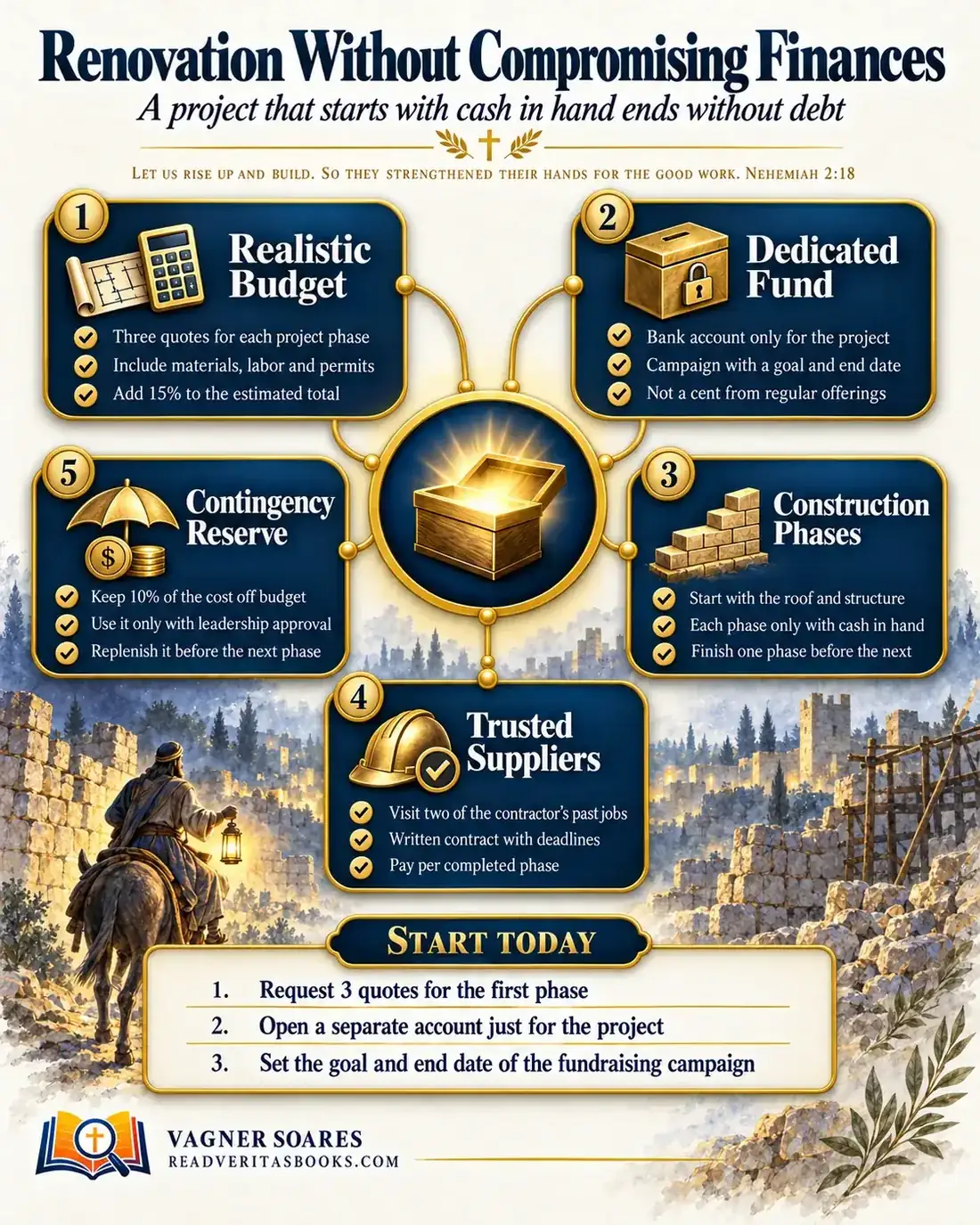
The roof has started leaking over the back rows, the restrooms can't handle Sunday attendance anymore and the children's room has outgrown its walls. Your leadership agrees the church renovation is necessary, but the question that keeps everyone up at night is a different one: how do you do the work without it swallowing the church budget for years?
This guide lays out a path that takes more patience than money: budget realistically, keep the project money separate, build in phases paid with cash in hand, choose trustworthy suppliers and hold a reserve for surprises.
Let us rise up and build. So they strengthened their hands for the good work
Nehemiah 2:18
Why so many renovations end in debt
Hardly any church decides to go into debt. Debt arrives in small steps. The work starts on the money from an enthusiastic campaign, a problem nobody foresaw turns up, the contractor asks for an advance, giving cools off and, by the time leadership notices, there is an open wall in the sanctuary and three bad options: a loan, overdue bills or a stalled project.
The central idea of this article is simple: a project that starts with cash in hand ends without debt. It is not a magic rule, it is a discipline: accepting to do less at a time so that nothing is ever left half finished.
Advertisement
Counting the cost before you build: what Nehemiah and Jesus teach
The verse that opens this guide has a context that often gets forgotten. Nehemiah was cupbearer to the king of Persia. He asked permission to go to Jerusalem and arrived with letters that secured timber for the work (Nehemiah 2:8). Before speaking to any leader, he went out at night with a few men and inspected the broken walls and the burned gates (Nehemiah 2:12-15). Only then did he call the people to build.
The passage does not teach a budgeting technique, and it would be stretching it to say Nehemiah drew up a spreadsheet. But it shows an order: see the reality with your own eyes, gather the resources, and only then mobilize the people.
Jesus uses the same logic in an illustration. Speaking to the crowds about the cost of following him, he asks which of them, intending to build a tower, "sitteth not down first, and counteth the cost" (Luke 14:28). The subject is discipleship, not construction, and that is exactly why the picture works: Jesus starts from something everyone already considered common sense. Whoever skips the counting risks hearing, "This man began to build, and was not able to finish" (Luke 14:30).
Proverbs adds a practical word: "Prepare thy work without, and make it fit for thyself in the field; and afterwards build thine house" (Proverbs 24:27). Secure your livelihood first, then build. For a church, the weekly ministry comes before the building project, and the project must not consume what keeps the ministry going.
A realistic budget in six steps
A realistic budget is built on actual quotes, not on guesses made around a meeting table. Follow this sequence for every phase:
- Describe the problem before the solution. List what is wrong (leaks, a restroom without accessibility, old wiring) and ask someone with construction experience to assess it. If there are structural signs, such as cracks, hire a qualified professional for a written assessment.
- Break the project into phases and write the scope of each one: what is included, what is not, the standard of materials and finishes. One page per phase is enough.
- Send exactly the same text to three contractors. Without the same scope, comparing prices tells you nothing.
- Compare line by line: materials, labor, delivery, debris removal, final cleanup and whatever permits your local authority requires (confirm with a local professional). The cheapest bid is often just the most incomplete one.
- Add 15% to the chosen amount to absorb price changes and small adjustments.
- Keep the scope, the bids and the reason for your choice in the project file.
A dedicated fund: model rules to approve
Project money should never mix with everyday operating money. In one account, it is easy to use renovation funds to pay the electric bill or to pull from regular offerings to buy cement. If your church already runs other funds, see how to organize designated funds without mixing the accounts.
Paul took this care seriously when he organized the collection for the believers in Jerusalem. He made sure a brother chosen by the churches traveled with Titus, "Avoiding this, that no man should blame us in this abundance which is administered by us", and explained his reason: "Providing for honest things, not only in the sight of the Lord, but also in the sight of men" (2 Corinthians 8:20-21). Being honest was not enough; the honesty had to be visible.
Here is wording your leadership can adapt and approve in the minutes before launching the campaign:
- The building fund receives only gifts designated for the renovation and is held in a separate bank account opened for that purpose alone.
- No money from regular offerings moves into the fund, and no money from the fund pays ordinary church expenses.
- Every withdrawal requires the approval of two designated people and a receipt filed in the project folder.
- The balance is reported to the church every month, with income, expenses and how much is still needed for the current phase.
- When the project ends, leadership decides what happens to any surplus and tells the church.
When the tabernacle was built, the craftsmen told Moses the people were bringing "much more than enough", and Moses had it announced that no one should bring more (Exodus 36:5-7). The text does not promise every campaign a surplus. It shows that giving for a project has a target, and that respecting donors includes telling them when the target has been reached.
Advertisement
Construction phases: the rule that decides when to start
Breaking the renovation into phases lets you start without having the full amount. The order follows safety, not appearance: roof, structure and hazardous systems first; then what improves use; finishes and paint last. A church with a sound roof and old paint is better off than the other way around.
So you don't reopen the debate at every meeting, agree on a decision rule:
- If the full cost of the phase, including margin and reserve, is already in the fund, the phase can start.
- If money is short but people are at risk, do only the minimum emergency repair, close off the area and pay for that repair as maintenance; the full phase waits.
- If the previous phase has unfinished items, no new front is opened.
- If giving stalls, the work pauses between phases and leadership says so openly.
- If someone wants to change the plan mid-project, the change goes ahead only with a new quote and written approval.
Trusted suppliers for small, medium and large churches
Personal trust matters, but it needs verification. In any church three practices apply: visit at least two finished jobs and talk to the clients, sign a contract with scope, amounts and dates for each phase, and pay per inspected phase, never the full amount up front. For the contract itself, see how to manage contracts with suppliers and service providers.
Small church (up to about 100 people)
Choose one person with some construction experience to follow the work and another to handle the paperwork. A simple contract reviewed by someone you trust already protects a great deal. If the contractor is a church member, treat them like any other: written bid, comparison and contract. That protects the friendship if something goes wrong.
Medium church
Form a building committee of three to five people with clear roles: who follows the work, who checks invoices and payments, who keeps the church informed. Anyone with family or business ties to a contractor stays out of the selection.
Large church
The size of the project justifies an independent professional who supervises and measures each phase before payment, plus a selection process with published deadlines and criteria.
The contingency reserve: what to weigh and what to watch
Even with good planning, surprises happen: a rotten beam, old plumbing, a material whose price jumped. The reserve keeps the church from halting the work or borrowing money.
It is not the 15% margin. The margin is part of the budget and covers foreseeable variations. The reserve, 10% of the phase cost, sits apart in the fund, is not counted as available and covers only what nobody could foresee.
There is a real tension here. A reserve that is too large delays the start and leaves the roof leaking longer; one that is too small pushes the church toward a loan at the first scare. The percentage is a starting point: very old buildings, where nobody knows what is inside the walls, call for more.
Watch three things: who may authorize its use, decided before work begins; a record of every withdrawal in the minutes, with date, reason, amount and who approved it (see how to keep minutes and official records in order); and replenishing it before the next phase is released.
Proverbs 22:7 observes that "the borrower is servant to the lender". It is a statement of wisdom, not a law against every loan. The reserve exists so that one surprise does not put the church in that position.
Example: a church of 140 members and a roof that can't wait
Imagine a church of 140 members whose roof started leaking in winter. It also needs new restrooms and a bigger children's room. The figures are only illustrative.
The assessment
The pastor asks a member who worked for years as a building foreman to walk through the building with the treasurer. They find broken tiles, clogged gutters and a crack. Leadership pays an engineer, whose report says the crack is not structural. The project is split into three phases: roof and gutters, restrooms, children's room with painting.
Phase one on paper
The one-page roof scope goes to three companies. The bids come in at 52,000, 58,000 and 71,000. The 52,000 bid leaves out gutters and debris; once corrected, it tops 60,000. Leadership picks the 58,000 bid, which is complete and has good references. With the 15% margin and 10% reserve, the phase target becomes 72,500.
The fund and the campaign
The church already had 20,000 in gifts designated for building. It opens an account just for the renovation, with the treasurer and a deacon approving every withdrawal, and launches a six-month campaign. Meanwhile, replacing the broken tiles is paid as maintenance, in a separate decision that is recorded.
The work
In the fifth month the target is reached. The contract sets payment per phase, measured by the volunteer foreman. In the second week a rotten beam turns up: 4,000. Leadership approves using the reserve, records it in the minutes and refills it before the restroom phase. When the roof is done, the church receives a one-page report with photos, invoices and the balance, and only then is the phase two campaign launched.
Signs the renovation is under control
Before the work is finished, look for these:
- Everyday bills are paid on time, and no ministry has had its budget cut because of the project.
- Any member can find out within minutes how much is in the fund and how much the current phase still needs.
- Every payment matches an inspected phase and a filed receipt.
- Changes to the plan have a new quote and written approval.
- The reserve, if it was used, covered only genuine surprises and has already been refilled.
Frequently asked questions
Is a loan for a church renovation never acceptable?
Each leadership team decides based on its own situation, but the safest path is a project paid with cash in hand. If you do consider a loan, review with your accountant how the payments would affect the regular budget over the whole term.
How do you run a church capital campaign without pressuring people?
Give information instead of pressure: what will be done, what it costs, by when, and how the money will be controlled. Report the balance every month and thank the congregation as a whole, without revealing who gave or how much.
How long should a fundraising campaign last?
It depends on the amount and the size of your church. Campaigns that run too long lose momentum, so one campaign per phase, each with a realistic goal and end date, usually works better.
Can volunteers work on the project?
They can help with simple tasks such as cleaning and painting, with guidance and attention to safety. Structural, electrical or plumbing work should go to licensed professionals.
A well-planned renovation serves the church for years without weighing down the budget. To round out your planning, see how to approach planning physical growth with space and construction, how to maintain a church reserve fund and how to handle reporting to donors and partners.

Vagner Soares is a presbyter with pastoral ordination, a mentor and a digital entrepreneur with more than 10 years of experience in technology, digital marketing and education.
Keep reading
 Financial planningBasic Legal Obligations of the Church: The Minimum Every Treasurer Should KnowLearn the minimum a church treasurer needs to know to keep things in order: registration, required filings, essential records and when to call an accountant.Read the article
 Financial planningHow to Teach About Giving at Church Without Sounding Self-InterestedLearn to talk about giving like a teacher, not a collector: the right tone, frequency, transparency and examples that build trust in your church.Read the article
 Financial planning · Reference guideThe Complete Guide to Church Financial Management: Five Pillars That Hold the Books TogetherOrganize your church finances with a budget, transparency, a reserve, accountability, and a crisis plan. A practical guide for pastors and treasurers.Read the article