
Basic Legal Obligations of the Church: The Minimum Every Treasurer Should Know
Learn the minimum a church treasurer needs to know to keep things in order: registration, required filings, essential records and when to call an accountant.

In this article
- What the law expects of a church, in a nutshell
- Caesar, Paul and the collection: what the Bible says about accountability
- Registration and tax ID: where the church's legal existence begins
- Basic tax obligations: what exempt status covers and what it doesn't
- Documents every treasurer should have: a filing model
- When to call an accountant: a decision rule
- Common mistakes to avoid: what tends to put a church out of compliance
- An example: the treasurer who started in January
- Your first week with the church's legal obligations
- Signs your treasury is in good standing
- Frequently asked questions
Free mind map
This whole guide on one page
The five steps in this article as an infographic you can print, pin on the notice board or send to your team.
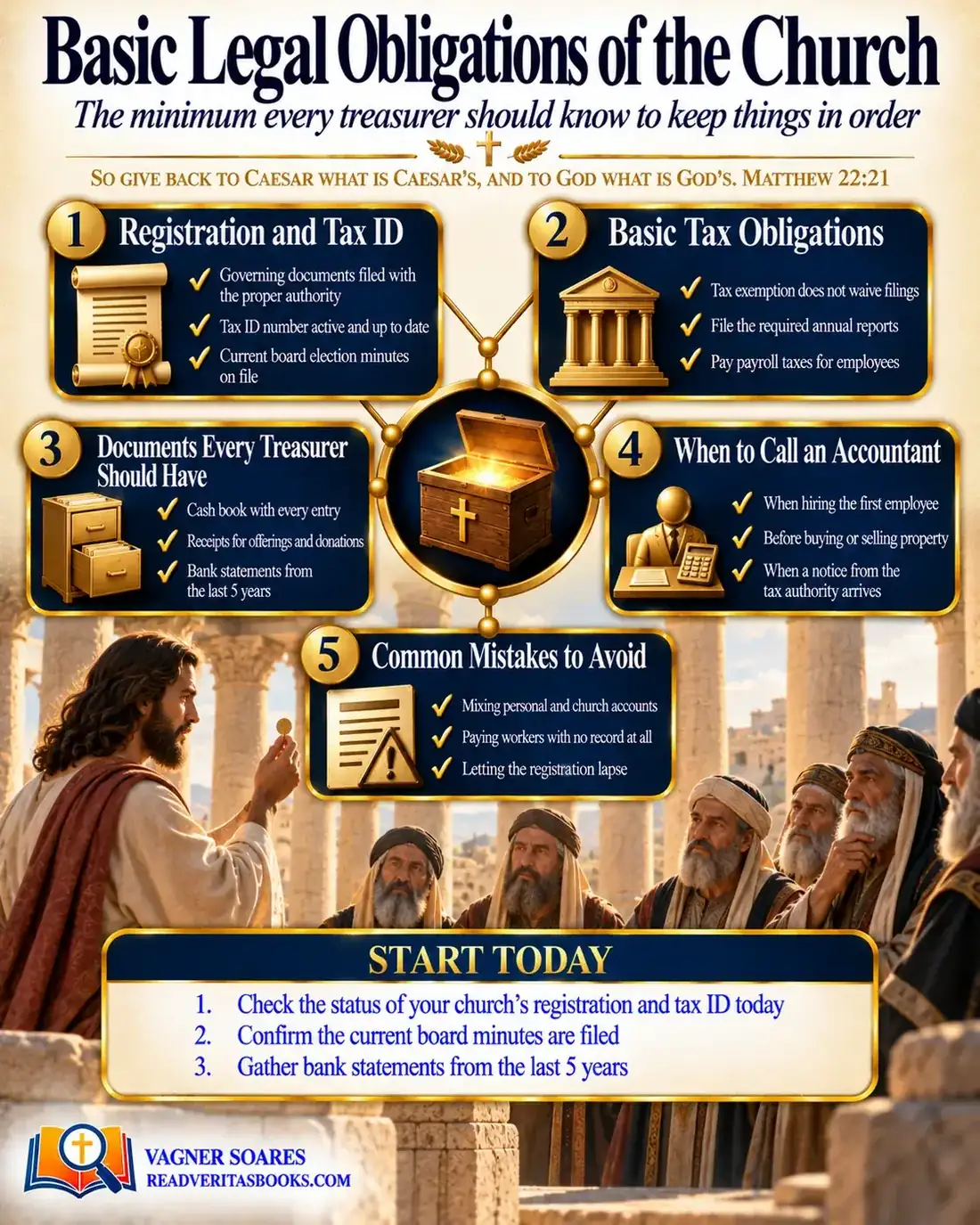
You agreed to be treasurer because you are organized and trustworthy, and you quickly found out the role goes far beyond counting the offering. Words like tax ID, minutes, filings and exempt status start showing up, and it can feel like one oversight could cause real trouble for the church.
This guide gathers the minimum a church treasurer needs to know about the church's legal obligations: registration and tax ID, basic tax obligations, the records you can't do without, when to call an accountant and the mistakes that most often leave churches out of compliance. It doesn't replace an accountant or attorney. It helps you know what to check, what to keep and what to ask.
So give back to Caesar what is Caesar's, and to God what is God's
Matthew 22:21
What the law expects of a church, in a nutshell
In the eyes of the state, a church is a legal entity: it has a name, an address, legal representatives, a bank account and often a building and staff. All of that comes with duties. Together they form a routine that usually falls to the treasurer.
Staying current protects the church. With records out of order, it can have its account frozen, lose a gift, struggle to hire or get stuck when dealing with its own property. It also protects you, because good records show you acted with care. You don't need to be an expert: you need to know the basics, keep your records organized and recognize when to ask for help.
Advertisement
Caesar, Paul and the collection: what the Bible says about accountability
In Matthew 22:17-21, Pharisees and Herodians try to trap Jesus with a question about paying tribute to Caesar. Jesus asks for the coin, asks whose image is on it and answers that Caesar should be given what is his and God what is God's. The text doesn't put Caesar on the same level as God, and it doesn't make every government demand sacred. But it makes clear that meeting civic duties is not a lack of faith.
Paul tells the believers in Rome: "Render therefore to all their dues" (Romans 13:7). Notice the word "dues." The text doesn't ask anyone to pay what isn't owed, so a tax exemption the law grants a church doesn't contradict the passage. The principle is to give exactly what is due.
In 2 Corinthians 8:20-21, Paul is organizing the churches' collection for the poor believers in Jerusalem and explains why he doesn't handle it alone: he wants to avoid anyone blaming him for how that gift is managed. "Providing for honest things, not only in the sight of the Lord, but also in the sight of men." The passage isn't about taxes; it is about reputation in handling gifts. Today, being honest in the sight of men means keeping records that any authorized person can check.
Registration and tax ID: where the church's legal existence begins
A church gains legal standing by registering its governing documents as local law requires, and its tax identification number lets it operate in its own name. Without them, it can't open an account, sign contracts or prove its standing. Whenever the board changes or the bylaws are amended, the official records need to keep up. If you have just taken over, check in this order:
- Find the current bylaws and the proof that they were filed, and keep copies in the treasury file.
- Compare the bylaws with the minutes of recent congregational meetings. An approved amendment that was never filed is an open item.
- Confirm that the minutes of the current board's election are on file. Banks and agencies ask for them to see who represents the church.
- Check the status of the church's registration and tax ID with the relevant authorities, save the proof and confirm the address and legal representative.
- Ask the bank who is listed as the account's representative.
- Take the list of open items to your pastor and accountant and agree on who handles each one and by when.
To keep minutes and official documents in order, see how to never lose a church record again.
Basic tax obligations: what exempt status covers and what it doesn't
What church tax-exempt status means
Many treasurers assume that because the church is tax-exempt, it never has to report anything to the tax authority. That isn't the case. Exempt status usually covers certain taxes tied to the church's purposes; exactly which ones, and under what conditions, is a question for your accountant. In some places the exemption must be applied for, renewed or documented with the proper authority.
What still applies
Exempt status doesn't release the church from the filings that apply to it. Ask your accountant which ones apply, how often and in what format, because names and due dates depend on where you are and change over time. If the church has employees, payroll taxes need to be checked every month, with receipts kept on file. Payments to independent contractors may also create reporting duties.
A calendar instead of memory
At the start of each year, ask your accountant for a written calendar of the church's obligations. Put the dates on the treasury calendar a week ahead and mark each one as done, noting who filed it and where the confirmation is kept.
Advertisement
Documents every treasurer should have: a filing model
Jesus taught that "He that is faithful in that which is least is faithful also in much" (Luke 16:10). In the treasury, the least is the everyday paperwork: the receipt, the invoice, the bank statement. Set up the file in paper folders or a shared folder, with access decided by the board.
Index of the treasury file
- Church documents, with current bylaws, proof of registration, tax ID confirmation and election minutes.
- Cash book, with every entry recorded on the day it happens, with date, amount, description and receipt number.
- Expense receipts, numbered in the same order as the cash book.
- Receipts for identified offerings and donations, with a copy of each receipt issued.
- Bank statements by month, for at least the last 5 years.
- Employees and contractors, with contracts, receipts and proof of payroll payments.
- Filing calendar and confirmations of every filing.
- Accountant's guidance, with questions, answers and the date of each conversation.
Ask your accountant whether any records should be kept longer. Folder 4 holds donors' personal information, which needs careful handling in line with the privacy laws that apply to you: keep it restricted and don't pass donor lists around in group chats. See also how to keep member data responsibly.
Sample donation receipt
Received from [donor's name] the sum of [amount in figures and words] on [date], as a voluntary gift designated for [purpose or general church support].
[Church name], [registration or tax ID number], [city and date]. Signed by the treasurer and a second board member.
When to call an accountant: a decision rule
Proverbs observes that "Without counsel purposes are disappointed" (Proverbs 15:22). It is general wisdom, not a command to hire anyone, but it describes the treasury well: on your own, you are deciding in the dark. An accountant, ideally one with experience serving churches and nonprofits, is a regular partner, and some situations call for a conversation right away:
- If the church is about to hire its first employee, talk with your accountant before making any promise, to understand the correct setup and the total cost.
- If someone will receive regular payments, for example for cleaning or maintenance, ask about contracts, receipts and any withholding before the first payment.
- If the church is buying, selling or leasing property, consult your accountant and, where needed, an attorney before signing, because congregational approval and tax effects may be involved.
- If a notice arrives from the tax authority or another agency, don't ignore it or answer it alone; take it to your accountant the same day and track the response date it gives.
- If none of this happens, still schedule a check-in every quarter to review the calendar and open items.
Bring your questions in writing and file the answers in folder 8.
Common mistakes to avoid: what tends to put a church out of compliance
Almost all of them start with good intentions or a lack of time.
Using a personal account "just this once"
The treasurer receives an offering in their own account because the church's account had a problem, or pays an urgent bill out of pocket and reimburses themselves later. The trail disappears and it becomes impossible to prove what belonged to whom. The rule is simple: everything goes through the account in the church's name.
Paying workers with no record at all
A member does the cleaning and receives a monthly payment agreed on verbally. Years later, no one can say on what terms it was arranged. Every payment to someone who provides a service needs a receipt or contract, in the form your accountant recommends. And a regular monthly payment may create an employment relationship, so check with your accountant. See how to manage contracts with vendors and service providers.
Letting the registration lapse
Missed filings, forgotten renewals or outdated information can leave the church out of good standing, and the church often finds out only when the bank declines a transaction. Checking the church's status a few times a year avoids the surprise.
Keeping everything on one person's phone
If receipts live in the treasurer's messaging app and that person steps down, the church loses its history. Keep copies in the church's files and do a formal handoff at every leadership change, with a list of documents, logins and open items.
An example: the treasurer who started in January
Take a church of 135 members that elects a new treasurer in January. Working through the registration check, the treasurer finds three problems: the minutes of the last election were never filed, the bank still lists the previous treasurer as representative and the tax ID record shows the church's old address.
The treasurer writes each open item on a sheet with three columns: the problem, who will fix it and by when. That same week it turns out the custodian receives a monthly payment with no receipt or contract, and two years of bank statements are missing.
In the second week, the treasurer brings everything in writing to the accountant and leaves with the year's filing calendar, guidance on setting up the custodian's payment correctly and a list of documents to update the address. The church secretary takes charge of filing the minutes; the pastor, as president, signs what the bank requires.
By the end of the month, the treasurer has requested the missing statements, set up the eight folders and given the board a one-page summary: what is resolved, what is in progress and the date of the next review.
Your first week with the church's legal obligations
- Check the status of your church's registration and tax ID and keep the proof.
- Find the current bylaws and the current board's election minutes, and confirm both are filed.
- Gather bank statements from the last 5 years and note any missing periods.
- List everyone who receives any payment from the church and confirm each payment has a receipt or contract.
- Schedule your first meeting with the accountant and bring your questions in writing.
Signs your treasury is in good standing
- You can find the receipt for any cash book entry in a few minutes.
- The latest filings on your accountant's calendar are marked as done.
- The bank, the registration record and the tax authority all show the same board and address.
- Another board member could find the records if you were away for a month.
Frequently asked questions
Does a small church really need to be registered?
To open a bank account in its own name, sign contracts and prove its standing, a church needs to be formally organized. Talk with an accountant or attorney about the steps that apply where you are.
Does a tax-exempt church still have to file anything?
Usually, yes. Exempt status covers certain taxes, but it doesn't remove reporting duties. Ask your accountant for the list of filings that apply to your church and their due dates.
Is the treasurer personally liable for mistakes?
It depends on the situation, local law and what your bylaws say. That is why it pays to document everything, share approvals with a second person and seek legal advice whenever you are unsure.
Do I need an accountant if the church handles little money?
It is a good idea. Even small churches have obligations to meet, and an accountant familiar with church accounting basics helps you avoid penalties and loose ends that would cost more later.
Caring for legal obligations is part of faithful stewardship of what the church receives. Next, see how to plan hiring your first administrative employee, how to run an internal audit without suspicion and explore the complete guide to church financial management.

Vagner Soares is a presbyter with pastoral ordination, a mentor and a digital entrepreneur with more than 10 years of experience in technology, digital marketing and education.
Keep reading
 Financial planningHow to build your church's annual budget in 5 simple stepsBuild your church's annual budget in 5 steps: review last year, list fixed expenses, project income cautiously, set aside for emergencies and get approval.Read the article
 Financial planningChurch Renovation Without Compromising Finances: How to Plan the Project Debt-FreePlan your church renovation with a realistic budget, a dedicated fund, phases paid with cash in hand and a contingency reserve, so the project ends debt-free.Read the article
 Financial planning · Reference guideThe Complete Guide to Church Financial Management: Five Pillars That Hold the Books TogetherOrganize your church finances with a budget, transparency, a reserve, accountability, and a crisis plan. A practical guide for pastors and treasurers.Read the article