
Hiring Your Church's First Administrative Employee: When It Makes Sense and What It Costs
Find out whether it is time to hire your church's first administrative employee, what it really costs, and how to onboard them without straining the budget.

In this article
- What changes when your church becomes an employer
- Paying fairly and delegating wisely: what Scripture shows
- When it makes sense: measured signs, not just fatigue
- Employee or volunteer: where the line falls depends on church size
- Costs beyond salary: the whole calculation before you say yes
- Hiring process: a job description and interview you can use
- Integrating into the team: the first ninety days
- Example: a church of 130 members, from fatigue to a decision
- Mistakes that turn a good hire into a problem
- Frequently asked questions
- First steps for this week
Free mind map
This whole guide on one page
The five steps in this article as an infographic you can print, pin on the notice board or send to your team.
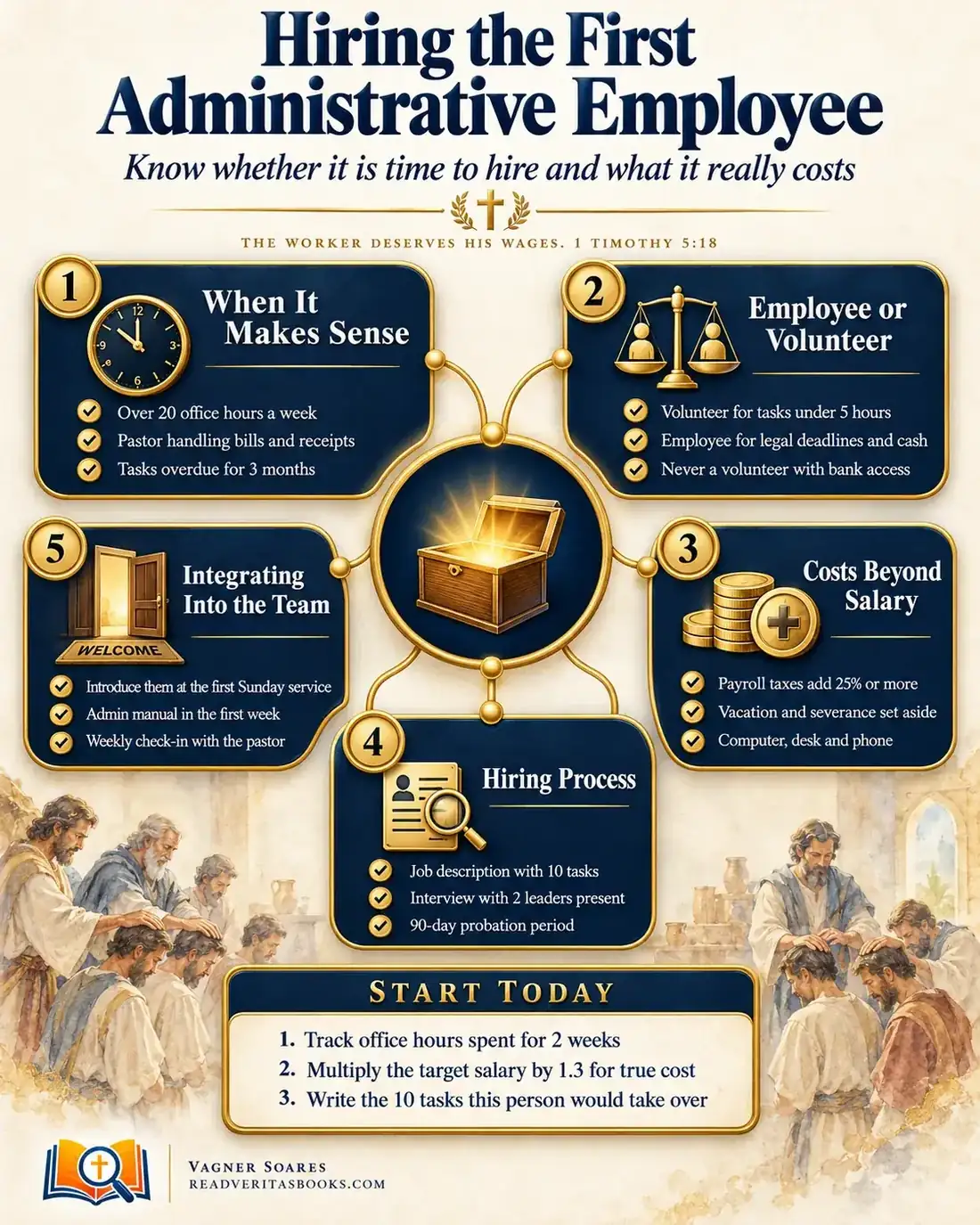
Every week looks the same. The pastor writes the sermon in between paying a bill, filing a receipt and returning a vendor's call. The volunteer who helps in the office, already giving far more than she signed up for, says she can't keep up. At the next leadership meeting someone finally asks out loud: is it time to hire someone?
This guide helps you answer with facts instead of fatigue: the signs that hiring makes sense, what should stay with volunteers, what an employee really costs, and how to hire and onboard that person without unbalancing the budget.
The worker deserves his wages
1 Timothy 5:18
What changes when your church becomes an employer
Until now, administration has run on goodwill. With a first employee, the church takes on a monthly commitment, with employer obligations, that can't be paused when giving dips.
Planned well, the hire gives the pastor hours back for visiting, counseling and study, and gives administration a consistency that busy volunteers can't guarantee. Made on impulse, it turns a salary into a burden and can leave someone jobless a few months later, which hurts that person and the church's witness. So the right question has three parts: does the work justify the position, can the budget carry it with margin, and does leadership know exactly what this person will do?
Advertisement
Paying fairly and delegating wisely: what Scripture shows
The church in Jerusalem grew, and a complaint arose: the widows of the Greek-speaking Jews were being overlooked in the daily distribution. The apostles said, "It is not reason that we should leave the word of God, and serve tables" (Acts 6:2), and asked the church to choose seven men "of honest report, full of the Holy Ghost and wisdom" (Acts 6:3).
The passage says nothing about salaries or contracts, and it would be a stretch to read it as a command to hire staff. What it does show is a principle of organization: when practical service pulls leaders away from prayer and the Word, the answer is to delegate to people chosen with care, not to ask more of the same few.
In 1 Timothy 5:17-18, Paul writes about supporting elders who rule well and teach, quoting the Law about the ox that treads out the grain and Jesus' words about the worker and his wages. The focus is on those who lead and teach, not on an office employee, but the principle is broad: work done creates a fair claim. Deuteronomy adds punctuality when it protects the poor hired worker: "At his day thou shalt give him his hire, neither shall the sun go down upon it" (Deuteronomy 24:15). For a church, that means hiring only when you can pay on time, in the lean months too.
When it makes sense: measured signs, not just fatigue
Moses' father-in-law warned him, "Thou wilt surely wear away, both thou, and this people that is with thee" (Exodus 18:18). Many church offices live something similar, but exhaustion doesn't prove you need an employee; sometimes what's missing is organization.
For two weeks, ask everyone who touches administration (pastor, treasurer, office volunteers) to log each task and the time it took in a spreadsheet. Then look for three signs. Use these numbers as a practical reference, not a rule: the total goes over 20 hours a week; the pastor is the one paying bills and checking receipts; some tasks have been stuck for more than 3 months, such as records, reports or filing. Then apply this rule:
- If no sign or only one shows up, don't hire yet. Reorganize and redistribute the work; the article on running the church office can help.
- If two signs show up but the budget can't carry the position with a reserve, start building that reserve now and schedule another measurement a few months out.
- If two or three signs show up and the budget covers the full cost, consider a part-time position.
- If the hours clearly exceed part-time and the backlog keeps growing even after reorganizing, discuss a full-time role using your accountant's estimate.
Employee or volunteer: where the line falls depends on church size
Three rules apply at any size. Occasional tasks of up to 5 hours a week (again, a reference) can stay with volunteers. Anything with a due date, a penalty or a daily check needs a fixed, named person responsible, hired or not. And bank access is restricted to whoever the board designates, with dual approval: whoever prepares a payment does not approve it. What changes with size is where the line falls.
Small church (up to about 100 people)
There is rarely enough work for a full-time role. The usual answer is someone for a few hours or part-time handling payments, records and documents, while volunteers keep the welcome desk, the bulletin board and the room calendar.
Medium-sized church
With more ministries, the calendar starts to clash. The employee becomes the point of contact for ministry leaders: collecting requests, managing the calendar and keeping the files.
Large church
The first employee is rarely the last. Write down the boundaries of the role so the first person you hire doesn't end up responsible for everything, and keep volunteers where their presence is part of the ministry, such as hospitality.
Advertisement
Costs beyond salary: the whole calculation before you say yes
Jesus asked which of you, intending to build a tower, "sitteth not down first, and counteth the cost" (Luke 14:28). He was speaking about the cost of following him, but the picture fits anyone about to take on a payroll. Work through the numbers in this order:
- Set the hours and a salary in line with what similar roles pay in your area.
- Ask your accountant or payroll provider for a full estimate, including employer taxes and required benefits. The rate depends on your location and the type of role, so don't rely on a figure found online.
- Add monthly set-asides for paid leave and any severance, and move that amount into a separate account every month.
- Include the computer, desk, phone, software and workspace, separating one-time costs from monthly ones.
- Compare the total cost with giving in the lowest months of the past year, not with the average.
- Build a reserve of a few months of that cost, for example three, before opening the position; see how in the article on a reserve fund.
- Record the decision in the minutes, with the approved amount and where the money comes from.
If the math only works in a good month, it doesn't work. Starting with fewer hours and paying on time is better.
Hiring process: a job description and interview you can use
Hiring through friendship or a recommendation doesn't always end well. A simple process protects the candidate and the church's witness, which should provide for honest things "not only in the sight of the Lord, but also in the sight of men" (2 Corinthians 8:21). Even if the candidate is a member, follow the same steps.
Sample job description
Hand this out before the interview: the first line describes the role, the rest are the ten main tasks.
- Administrative assistant, part-time, supervised by the senior pastor.
- Answers phone calls, messages and visitors during agreed hours.
- Keeps member and visitor records up to date.
- Prepares the week's payments for the treasurer to approve.
- Files receipts, invoices and statements, on paper and digitally.
- Manages the room schedule and the events calendar.
- Prepares simple monthly reports for the treasurer.
- Drafts and files minutes and correspondence as directed.
- Buys office supplies within the approved limit.
- Supports ministries with registrations and announcements.
- Keeps the office procedures manual current.
Interview guide
Two leaders sit in on every interview, ask the same questions and write their impressions on a form.
- Tell us about a job where you handled deadlines or money.
- What would you do if two leaders asked for something urgent at the same time?
- How would you respond if you noticed an error in a payment already approved?
- How do you handle the personal information of people who contact the office?
- What do you expect from working inside a church, and what don't you expect?
Agree on a 90-day probation period with written goals and a review scheduled before it ends. Your accountant or an attorney handles the paperwork; leadership sets the goals.
Integrating into the team: the first ninety days
On the first Sunday, invite your new employee up front, explain the role in two sentences and pray for them as a church. In the first week, hand over the administrative manual and read the main procedures together. Set a fixed weekly check-in with the pastor, about 30 minutes, to align priorities and also ask how the person is doing.
Over the first three months, these balances need attention. Warmth and boundaries: treating the employee as a brother or sister is good, but the working relationship has hours, goals and reviews, and saying so at the start keeps a later correction from feeling like a break in fellowship. One supervisor: leaders' requests go through that person or a single channel, or the employee ends up taking direction from five places. Availability and rest: agree on what is truly urgent and respect the contracted hours.
Example: a church of 130 members, from fatigue to a decision
Imagine a church of 130 members where the pastor handles all payments alone and a retired volunteer opens the office three mornings a week. In March, she says she needs to cut back. The pastor suggests measuring before hiring.
For two weeks, the pastor, the treasurer and the volunteer log everything in a shared spreadsheet. The total comes to 26 hours a week, 7 of them the pastor's, spent only on payments and vendors. Member records have been stuck since December. All three signs are there.
Leadership divides the tasks: welcome desk and bulletin board to two volunteers, the room calendar to a deacon, and payments, records, filing and reports to a part-time position. The accountant runs the numbers: for a salary of $2,000, the monthly cost with taxes and set-asides comes to $3,300, plus $4,000 for a computer and desk (illustrative figures only). The board decides to build a three-month reserve of total cost first and records it in the minutes.
Of four candidates, one is a member. The treasurer and a deacon interview all of them with the same questions. They choose a candidate with office experience; the member who wasn't selected gets a personal reply from the pastor. The 90-day goals are updated records, payments handed to the treasurer by Thursday and the year's filing in order. At the review, two are met and the third gets another month. The pastor's 7 hours go back to visits and study.
Mistakes that turn a good hire into a problem
- Hiring someone because they need a job. The role needs the right fit; help that person in other ways.
- Approving a salary based on average giving, without looking at the lean months or the reserve.
- Letting the same person prepare and approve payments, or giving the bank login to someone the board has not designated.
- Hiring informally "as a trial". The right arrangement depends on local law and the type of work relationship, so talk to an accountant or attorney before day one.
Frequently asked questions
What does a church employee cost beyond salary?
Add employer taxes, set-asides for leave and severance, any benefits, equipment and workspace. The total is well above the salary itself, and the exact rate depends on your location and the role.
Can a small church hire someone part-time?
Yes. If your measured hours land around 20 a week, part-time is often the safest first step. Ask your accountant how to set it up correctly.
Can we hire a church member as our church secretary?
You can, as long as they go through the same process as every other candidate. Make clear that reviews will follow the written goals, not the friendship.
Can the employee handle money alone?
It isn't a good idea. They can record transactions and prepare payments, but approval should stay with the treasurer or require two signatures. That protects both the church and the employee.
First steps for this week
- Set up a spreadsheet with columns for task, person and time, and ask everyone who runs the office to fill it in for two weeks.
- List what has been stuck for more than three months, ready for the next leadership meeting.
- Book time with your accountant for a full cost estimate of a part-time position.
Hiring well honors both those who work and those who give. Before day one, prepare your church administrative manual, review the basic legal obligations every treasurer should know, care for your team with the guide to people management and place this decision within the complete guide to church financial management.

Vagner Soares is a presbyter with pastoral ordination, a mentor and a digital entrepreneur with more than 10 years of experience in technology, digital marketing and education.
Keep reading
 Financial planningHow to Teach About Giving at Church Without Sounding Self-InterestedLearn to talk about giving like a teacher, not a collector: the right tone, frequency, transparency and examples that build trust in your church.Read the article
 Financial planning · Reference guideThe Complete Guide to Church Financial Management: Five Pillars That Hold the Books TogetherOrganize your church finances with a budget, transparency, a reserve, accountability, and a crisis plan. A practical guide for pastors and treasurers.Read the article
 Financial planningChurch Renovation Without Compromising Finances: How to Plan the Project Debt-FreePlan your church renovation with a realistic budget, a dedicated fund, phases paid with cash in hand and a contingency reserve, so the project ends debt-free.Read the article