
How to Teach About Giving at Church Without Sounding Self-Interested
Learn to talk about giving like a teacher, not a collector: the right tone, frequency, transparency and examples that build trust in your church.

In this article
- Why silence teaches the wrong lesson too
- What Paul did when he had to ask for money
- Message tone: words that invite instead of collect
- Frequency of the topic: a calendar that takes it out of improvisation
- Transparency as the foundation: the report that comes before the request
- Teaching vs pressuring: a rule for deciding in the moment
- Examples that work: stories that show the fruit
- One example from start to finish
- Mistakes that make a church sound self-interested
- Signs your teaching is being heard as care
- Frequently asked questions
Free mind map
This whole guide on one page
The five steps in this article as an infographic you can print, pin on the notice board or send to your team.
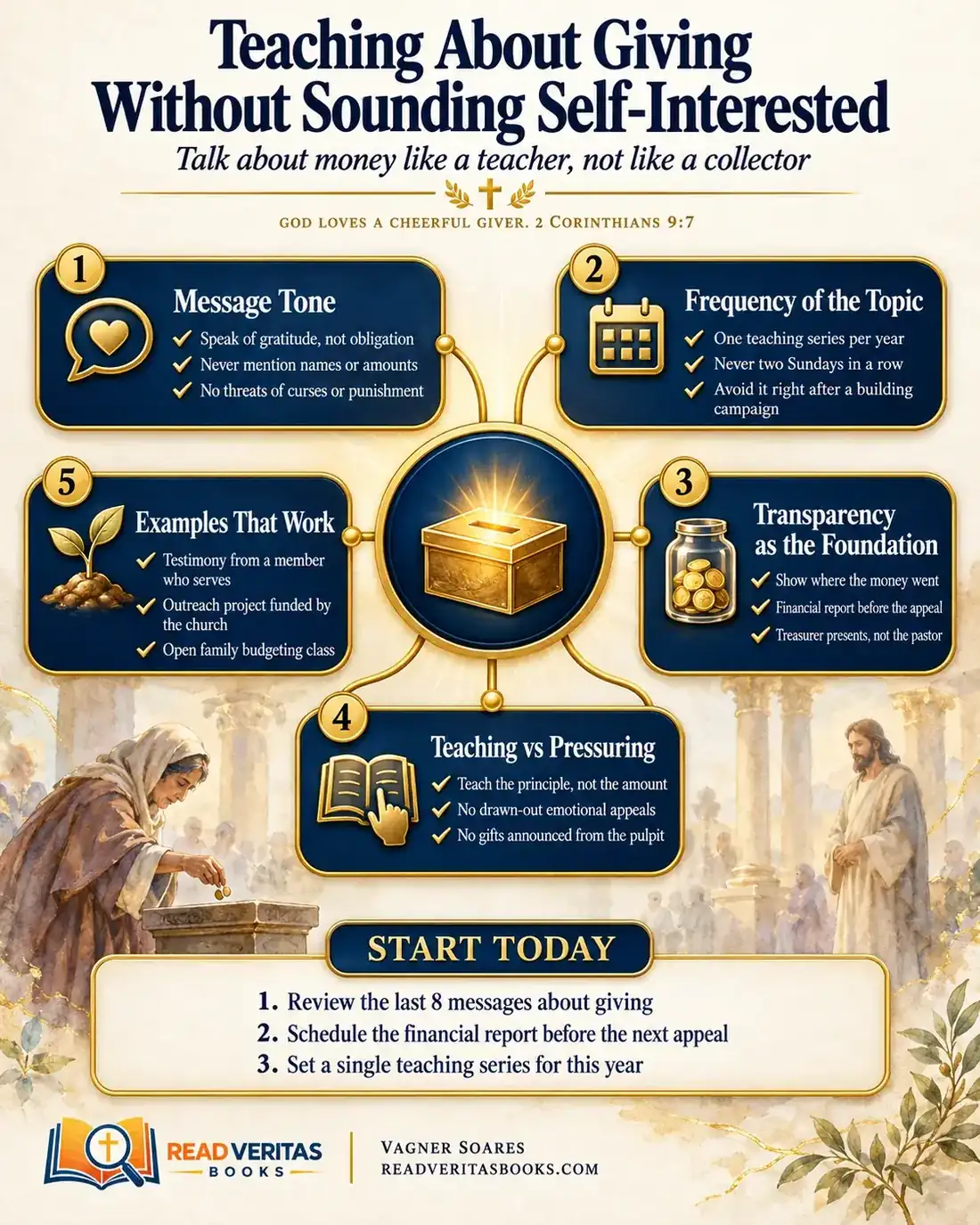
You know you need to talk about money. Bills keep coming, ministries depend on resources, and Scripture speaks about generosity without embarrassment. Yet every time the topic comes up, you can feel the tension: people looking down, visitors shifting in their seats, and someone saying on the way out that this church only cares about money.
This guide shows you how to talk about giving like a teacher, not like a collector: the tone of your messages, how often to raise the topic, transparency, the line between teaching and pressuring, and examples that inspire without making anyone uncomfortable.
God loves a cheerful giver
2 Corinthians 9:7
Why silence teaches the wrong lesson too
Many pastors, afraid of sounding self-interested, simply stop talking about giving. The result is a church that gives out of habit, or doesn't give at all, without ever understanding what Scripture says about generosity and Christian stewardship. Silence doesn't protect the church's reputation. It only pushes the topic into the tight moments, which are exactly the worst ones.
The discomfort rarely comes from the topic itself. It comes from the delivery: frequent requests, amounts mentioned from the pulpit, urgency in every service. When you fix the delivery, the content can be heard as teaching again.
Advertisement
What Paul did when he had to ask for money
Chapters 8 and 9 of 2 Corinthians are the longest New Testament passage about an offering. Paul was organizing a collection among the Gentile churches for poor believers in Judea. The money wasn't for him, and still he writes with a care that works as a model.
First, he refuses the tone of a command: "I speak not by commandment" (2 Corinthians 8:8). He points to the churches of Macedonia, who "were willing of themselves" (2 Corinthians 8:3), and removes the weight of comparison: a gift "is accepted according to that a man hath, and not according to that he hath not" (2 Corinthians 8:12). Then he closes with the verse that opens this article: each one should give as he has decided in his heart, not reluctantly or under compulsion (2 Corinthians 9:7).
The most administrative point comes right alongside. Paul didn't carry the collection alone. He traveled with a brother chosen by the churches themselves (2 Corinthians 8:19), and he explains why: "Providing for honest things, not only in the sight of the Lord, but also in the sight of men" (2 Corinthians 8:21). A clear conscience before God wasn't enough; the church needed to be able to see.
Two more passages complete the picture. Paul tells the elders of Ephesus, "I have coveted no man's silver, or gold, or apparel" (Acts 20:33). And Peter asks elders to shepherd the flock "not for filthy lucre, but of a ready mind" (1 Peter 5:2).
These texts don't set a percentage, don't promise a financial return to those who give, and don't forbid supporting those who work in ministry. The principle for church administration is different: giving is free and proportional, leaders must not look driven by money, and the handling of funds must be honest in plain view.
Message tone: words that invite instead of collect
Tone decides whether the same sentence sounds like an invitation or a bill. The goal is for people to leave more grateful for what they have received, not more guilty about what they didn't give. Start with what God has already done, never mention names or amounts, and leave out any threat of curses or punishment: fear is not a biblical reason to give.
It helps to have a short script for the offering, reviewed with a first-time visitor in mind. Here is a model to adapt:
- Before we bring our offerings, we remember that everything we have comes from God's hands.
- This is a way of worshiping and of taking part in what the church does all week.
- If you're visiting with us, please relax: this moment is not an obligation for you, and we're glad you're here.
- Let's pray.
When there is a specific need, add just one sentence: the details are in the treasurer's report, with the amount, the timeline and how to give, and no one needs to decide right now.
Notice what the script leaves out: no goal announced from the pulpit, no praise for donors, no story of someone who gave and was rewarded. Short sentences, said calmly, and the service moves on.
Frequency of the topic: a calendar that takes it out of improvisation
Saying too little leaves your church untaught; saying too much wears people out. What works is putting the topic on the calendar so the teaching doesn't look like a reaction to an empty bank account. If your church already builds a yearly ministry calendar, the topic belongs there.
- Choose a season of the year for a series on generosity, with three or four messages that have a clear beginning, middle and end. Set the passages and the title well ahead and share them with your leadership team.
- Place the series far from special campaigns. After a building fund push, give the congregation room to breathe.
- Outside the series, don't return to the topic on back-to-back Sundays.
- For the rest of the year, let the topic appear only during the offering, with the short script, without turning it into a sermon.
- Put the dates of your financial reports on the same calendar, so every request comes after an accounting.
Advertisement
Transparency as the foundation: the report that comes before the request
No one trusts someone who asks without reporting back. Being accountable doesn't mean exposing donors. It means showing spending categories, completed projects and the balance in plain language. Three rules apply to any church: the report comes before the appeal, the treasurer presents the numbers (not the pastor), and no donor is identified. For how to do this while protecting privacy, see the guide to financial transparency without exposing donors.
Small church (up to about 100 people)
A printed sheet or an image in your messaging group is enough. Show how much came in, where it went (missions, maintenance, outreach, staff) and one concrete example of what was done. The treasurer presents it in two minutes, once a quarter, and stays available after the service for questions.
Medium-sized church
A one-page report works well, with the same categories, a simple comparison against the planned budget and the projects for the period. Keep a detailed version in a shared folder or the church office for anyone who asks, signed off by the finance committee.
Large church
The risk is that the report turns into a spreadsheet nobody understands. Keep the one-page summary for the service and publish the full report in its own channel, with a window for questions. An independent review helps; requirements vary from country to country, so check with a local accountant or lawyer.
Teaching vs pressuring: a rule for deciding in the moment
Teaching means explaining principles and leaving the decision to each person's heart. Pressuring means creating an atmosphere where someone feels they must give to save face. The test: could someone choose not to give that day and still feel welcome? If not, there is pressure. For everyday cases:
- If an urgent need comes up, present it once, with numbers, a timeline and the treasurer beside you, and don't repeat the appeal on the following Sundays.
- If the invitation to give runs past two or three minutes, cut it short. Drawn-out emotional appeals move people in the moment and wear down trust afterward.
- If someone asks how much they should give, teach proportional, voluntary generosity and hand the decision back to them, without suggesting amounts or percentages.
- If a donor wants public recognition, thank them privately and explain that during the service the church thanks everyone as one body.
- If the church is running a deficit, work it through with your leaders and a plan for a drop in giving instead of turning every service into a campaign.
Examples that work: stories that show the fruit
People understand generosity best when they see its fruit. Concrete examples shift the focus from the deficit to what God is doing through the church. Each kind of example has a strength and a caution.
Testimony from a member who serves
Someone who shares in a few minutes how serving and giving changed the way they see their resources speaks louder than many appeals. The caution: avoid testimonies that sound like a promise of financial return, because the passages about giving don't promise that.
Outreach project funded by offerings
Photos and results from a ministry the church supports show where the money went better than any chart. The caution: ask permission from anyone who appears and protect the dignity of the people who were helped.
Open family budgeting class
Practical sessions on household finances, open to the wider community, show that this teaching serves families, not just the church budget. The caution: the class must not become a disguised appeal. Any mention of the offering stays in the service.
One example from start to finish
Picture a church of 170 members where the fellowship hall roof starts to leak. For two months the pastor brings it up almost every Sunday, and the offering stretches on for several minutes. Then a visitor remarks on the way out that the church always seems to need money.
At the next leadership meeting, the treasurer and two deacons listen to the recordings of the last eight messages that included an offering and note the tone, the length of the appeal and whether amounts were mentioned. They find urgency in nearly all of them and the cost of the repair announced from the pulpit in two.
The leaders record four decisions in the minutes. The treasurer will prepare a one-page report with the income and expenses for the past six months and the roof estimate, for the first Sunday of the following month. The need will be presented once, by him. The offering will follow the short script. And the generosity series is scheduled for a month with no campaigns, four months later.
On the agreed Sunday, the treasurer speaks for just over two minutes and leaves the report on the chairs; the pastor doesn't bring the topic up again. During the series, a volunteer from the outreach team shares, with the families' permission, how the food boxes reached people in need. Three months later, the leaders review the process and write down what changed: questions about money now go to the treasurer instead of circulating in the hallways.
Mistakes that make a church sound self-interested
- Talking about money only when it runs short, which ties the topic to crisis.
- Making the church's need the main argument instead of starting from grace.
- Having the pastor present the numbers and make the appeal in the same breath.
- Announcing a campaign goal without first showing what was done with the last one.
- Leading the offering as if everyone in the room were a member.
Signs your teaching is being heard as care
Watch whether people ask questions about the report instead of making side comments, whether visitors come back without mentioning discomfort about the offering, and whether the yearly series is remembered for its content rather than for the request. To place this teaching inside a bigger picture, see the five pillars of church financial management.
Frequently asked questions
Should I stop talking about giving so I don't drive people away?
No. Silence leaves your church without formation in generosity and pushes the topic into moments of crisis. The way forward is to talk about it with planning, a warm tone and transparency.
How do I preach about offerings without sounding like I'm asking for myself?
Separate the roles: the pastor teaches the biblical principle and the treasurer presents the numbers. Preach from the text, as Paul does in 2 Corinthians 8 and 9, without mentioning goals or amounts, and keep your reporting up to date.
How can I thank givers without exposing anyone?
Thank the church as a whole and show what was accomplished with the resources. If you want to thank someone personally, do it privately and without mentioning amounts.
What if the church is in a financial crisis?
Be honest about the situation, present the numbers alongside your treasurer and explain the plan for getting through it. A clear, one-time request backed by a full report builds more trust than repeated appeals.
Teaching about giving with integrity strengthens both faith and trust. To keep going, see how to practice financial transparency without exposing donors, how to handle reporting to donors and partners and how to build a plan for a drop in giving.

Vagner Soares is a presbyter with pastoral ordination, a mentor and a digital entrepreneur with more than 10 years of experience in technology, digital marketing and education.
Keep reading
 Financial planningChurch Renovation Without Compromising Finances: How to Plan the Project Debt-FreePlan your church renovation with a realistic budget, a dedicated fund, phases paid with cash in hand and a contingency reserve, so the project ends debt-free.Read the article
 Financial planningHiring Your Church's First Administrative Employee: When It Makes Sense and What It CostsFind out whether it is time to hire your church's first administrative employee, what it really costs, and how to onboard them without straining the budget.Read the article
 Financial planning · Reference guideThe Complete Guide to Church Financial Management: Five Pillars That Hold the Books TogetherOrganize your church finances with a budget, transparency, a reserve, accountability, and a crisis plan. A practical guide for pastors and treasurers.Read the article