
How to Run an Internal Church Audit Without Creating Suspicion
Learn how to run an internal church audit without creating suspicion: what to review first, who leads it, what tone to use and how often to do it.

In this article
- Why audit: checking protects the people who serve
- Books checked by more than one person: what Scripture shows
- What to review first: a six-step walkthrough
- Who leads it: the audit committee by church size
- Tone of the conversation: a notice template and meeting script
- Healthy frequency: the rhythm and what to watch
- Example: the first review in a church of 195 members
- When the review finds a discrepancy
- Mistakes that make a review feel like an accusation
- Frequently asked questions
- Signs the routine is working
Free mind map
This whole guide on one page
The five steps in this article as an infographic you can print, pin on the notice board or send to your team.
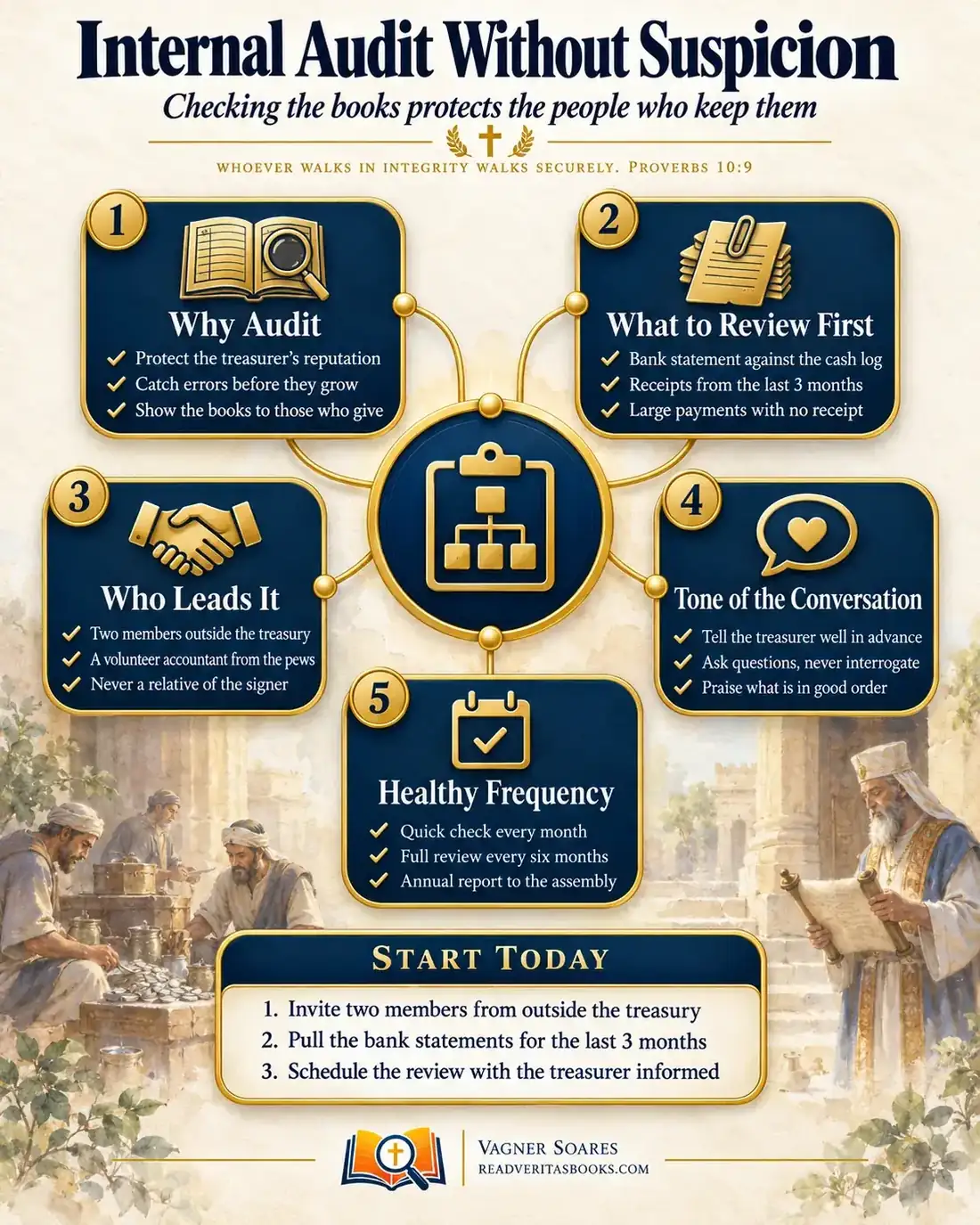
All it takes is someone saying "let's check the books" and the mood in the meeting shifts. The treasurer feels accused, the leaders feel awkward, and the topic gets postponed again. Meanwhile only one person knows the state of the church's money, and any mistake, even an honest one, can become hard to explain.
The answer is not to stop checking but to change how you do it. A church internal audit can be as ordinary as the greeter schedule: set in advance, carried out by independent people and led with questions, not accusations.
Whoever walks in integrity walks securely
Proverbs 10:9
Why audit: checking protects the people who serve
In many churches, the books only get checked once a rumor is already going around. At that point any review feels like a trial, and the treasurer, guilty or not, gets hurt. The approach here is the opposite: the audit starts as a routine, before anyone has doubts.
Think about the honest treasurer. They work alone, often in the evenings, and keep receipts as best they can. If someone ever says "money is missing," all they have is their word. With regular reviews, they have reports signed by other people. An audit is the best defense for someone who does the work well.
There is a practical reason too. A duplicated entry, a forgotten bank fee, a wrong formula in the spreadsheet: caught the next month, they take minutes to fix. Discovered three years later, nobody remembers what happened, and an honest mistake starts to look like theft.
And there is the trust of those who give. Church financial accountability does not mean revealing who gave what, but it does mean showing that someone has looked at the numbers carefully.
Advertisement
Books checked by more than one person: what Scripture shows
Paul's collection in 2 Corinthians 8
In 2 Corinthians 8:18-21, Paul is dealing with the collection the churches were gathering for poor believers in Jerusalem. He does not carry the money alone. He sends Titus and, with him, a brother chosen by the churches themselves. And he explains why: to avoid anyone blaming them over how they handled that gift, "providing for honest things, not only in the sight of the Lord, but also in the sight of men" (2 Corinthians 8:21).
The text does not say Paul was under suspicion, and it offers no accounting method. It shows that even an apostle preferred that the handling of money be visible and shared with others. Being honest before God did not excuse him from being transparent before the church.
The temple chest in 2 Kings 12
In 2 Kings 12:9-15, during the reign of Joash, the priest Jehoiada sets a chest beside the altar to collect money for repairing the temple. When there was much money in it, the king's scribe and the high priest counted it together (2 Kings 12:10): two people with different roles.
The same passage says they did not demand accounts from the men who paid the workmen, "for they dealt faithfully" (2 Kings 12:15). The text does not condemn checking, nor does it turn it into a rule for everything. It shows trust resting on a process. The principle for the church: checking is not the opposite of trusting. Review gives trust a foundation, and proven faithfulness deserves to be recognized.
What to review first: a six-step walkthrough
For the first review, limit the period to the last three months and follow this order:
- Gather in one folder, paper or digital, the bank statements, the cash log or treasury spreadsheet, and every expense receipt for the period.
- Compare each month's closing balance on the statement with the cash log. If they don't match, the difference guides the rest of the review.
- Check income: every offering count sheet should match a bank deposit, with the same amount and a nearby date.
- Check spending: every payment needs an invoice or receipt with date, amount, description and who approved it.
- Set aside the payments above the limit your leadership has set and look at them more slowly. That's where a missing receipt matters most.
- Write every discrepancy on an open-items sheet: date, amount, what's missing and who will resolve it.
The next period starts where this one ended. Don't try to catch up on years at once: the volume is discouraging and nothing gets finished.
Who leads it: the audit committee by church size
Two rules always apply: whoever audits has no part in the treasury's routine and no family tie to the treasurer or to whoever signs off on payments.
When complaints arose over the daily distribution to widows in Acts 6:1-6, the apostles asked the community to choose seven men "of honest report" (Acts 6:3) to take charge of that service. The passage is about distributing food, not auditing, but it shows something useful: where resources and mistrust met, the church chose respected people, and did it in the open.
Small church (up to about 100 people)
Choose two careful, discreet members, nominated at the leadership meeting and recorded in the minutes. They don't need to be accountants. If nobody is free of family ties to the treasury, ask a leader from another church in the same denomination or network for help.
Medium church (about 100 to 500 people)
Form a church audit committee of two or three members with a set term, and replace at least one name each term. A member with an accounting background can guide the group. If your bylaws already provide for an audit or finance oversight body, that body should take on this role.
Large church
The internal committee handles the routines, and leadership may consider a periodic review by an outside, independent professional. Separate duties: whoever records is not whoever pays, and whoever pays is not whoever reconciles the bank. Confirm with an accountant or attorney what local law and your bylaws require.
Advertisement
Tone of the conversation: a notice template and meeting script
The same review can feel like care or like an ambush. "A soft answer turneth away wrath" (Proverbs 15:1): the proverb is about words in general, and it fits a conversation about money, where everyone is sensitive.
Send the notice in writing, several weeks ahead. A template you can adapt:
"Hi [name]. As we agreed at the leadership meeting, the review committee will go over the period from [months] on [date] at [time] in [place]. We'll look at the statements, the cash log and the receipts for the period. If you can, please have everything in one folder by [date]. After this first one, we'll do the full review every six months, always picking up where the previous one stopped. It puts on record the care you take with this work. Any questions, just let me know."
On the day, follow a simple script:
- Open by thanking the treasurer for their service and noting that this is a routine review.
- Turn every doubt into an open question: "Can you help me understand this entry?" rather than "Why is this wrong?"
- Write down the answer before drawing conclusions. If a document is missing, agree on a date to bring it.
- Close by naming what is well organized first and the adjustments second, and read the open-items list aloud.
The treasurer sees the report before leadership does. Nobody likes to find out in a meeting what others thought of their work.
Healthy frequency: the rhythm and what to watch
An audit that only shows up when there's a problem will always feel like an accusation. "Be thou diligent to know the state of thy flocks" (Proverbs 27:23), the wise man tells someone who keeps livestock: regular attention, not occasional.
A three-layer rhythm works for most churches. Every month, a quick check of the balance and the largest expenses. Every six months, the full review with the six-step walkthrough. Once a year, a short report to the members' meeting.
Each choice has a cost. Very frequent reviews tire volunteers and can feel like surveillance; reviews spaced too far apart let errors pile up. Start here and adjust after a year. Watch the committee too: over time, the reviewers grow close to the person reviewed and look less carefully. Rotating one member periodically keeps the review independent.
Example: the first review in a church of 195 members
Take a church of 195 members whose treasurer has held the role for six years. She is devoted, but her books have never been checked and she keeps some receipts in a drawer at home. No one suspects her; even so, when someone at the members' meeting asks what the roof repair cost, she is the only one who can answer.
In February, the pastor brings the matter to the leadership meeting and explains that the aim is to protect the treasurer and the church. The minutes record the creation of the committee and the monthly and six-month rhythm. Two people are nominated: a retired bank employee and a young woman who works in administration. Before confirming them, the pastor checks that neither is related to the treasurer or to the chair of the board, who signs off on payments.
Three weeks ahead, the committee sends the template notice and asks for the January to March documents. The review takes place on a Saturday morning in the church office, with the treasurer present. Three open items come up: a bank fee that was never recorded, an offering entered under the deposit date instead of the service date, and the sound desk repair, above the limit, backed only by a note from the technician. Nothing suggests bad faith.
Each item goes on the sheet with a person responsible and a date. The fee is recorded, leadership decides that offerings will be entered under the service date, and the technician signs a full receipt. The one-page report thanks the treasurer, lists what was checked and corrected, and recommends a digital folder for receipts and two signatures above the limit. She receives it before leadership does, and the annual members' meeting hears a five-minute summary.
When the review finds a discrepancy
Not every discrepancy carries the same weight. Use this rule:
- If it's a recording error (wrong date, forgotten fee, bad sum), fix it, note it on the sheet and move on.
- If a receipt is missing, set a deadline and first ask the supplier for a copy. If that isn't possible, prepare a written statement signed by whoever approved the expense and check with the accountant whether it is enough.
- If an amount is still unexplained after calmly hearing the treasurer out, take it to the pastor and one other leader, in a private meeting, with everything in writing.
- If there are signs of something serious, make no public accusations and don't decide alone. Talk to an accountant or attorney before taking any step.
Mistakes that make a review feel like an accusation
- Holding the first audit right after a rumor without making clear that it is now routine for every period.
- Showing up unannounced or asking for documents in the middle of a service.
- Discussing the results with others before talking to the treasurer.
- Keeping the results among the leaders, with nothing reported back to the church.
Frequently asked questions
Does an internal audit replace an accountant?
No. An internal audit is a review carried out by members, and it complements the bookkeeping. Tax, employment and legal questions should be confirmed with an accountant or attorney.
What is the difference between a church audit committee and a treasurer review?
A treasurer review is the quick, regular check of balances and spending; the audit committee is the group of people outside the treasury who carry out both that check and the fuller review. If your bylaws already name a finance oversight body, it should play this role.
How do you audit church finances if no one knows accounting?
Comparing the bank statement with the cash log and checking that each expense has a receipt is something any careful person can do. If possible, ask an accountant to look over the conclusions once a year.
Can the treasurer refuse to be audited?
The review should be written into the church's policies and recorded in the minutes, so it doesn't depend on any one person's willingness. When it's presented as protection for the treasurer, resistance usually fades.
Signs the routine is working
- The treasurer has the folder ready before the notice even arrives.
- Each review turns up fewer open items than the last.
- Money questions at the members' meeting get answered with numbers, not with "I think."
Checking the books regularly is a concrete way to care for the people who serve and for your church's credibility. See also the complete church administration guide, the complete church finance guide, how to practice financial transparency without exposing donors, how to handle accountability to donors and partners and how to organize minutes and official records.

Vagner Soares is a presbyter with pastoral ordination, a mentor and a digital entrepreneur with more than 10 years of experience in technology, digital marketing and education.
Keep reading
 Church administrationChurch property inventory: know what you own, where it is and who looks after itBuild your church property inventory with a simple spreadsheet, numbered tags, one caretaker per room, the right insurance and a yearly physical count.Read the article
 Church administration · Reference guideThe Complete Church Administration Guide, From Bylaws to Annual ReviewOrganize your church administration in five areas: roles, processes, communication and data, crises and review, with practical steps to start today.Read the article
 Church administrationManaging multiple church locations: what changes when your church has two homesLearn when to open a new church location and how to split leadership, keep one identity, coordinate communication and consolidate your finances.Read the article