
Church property inventory: know what you own, where it is and who looks after it
Build your church property inventory with a simple spreadsheet, numbered tags, one caretaker per room, the right insurance and a yearly physical count.
In this article
- What to inventory: the rule before the list
- Ezra, the Levites and the counting of the temple vessels
- Simple spreadsheet: a template ready to copy
- Caretaker responsible: dividing the care by church size
- Insuring the assets: what to ask and what to watch
- Annual update: the physical count step by step
- An example: the 160-member church and the missing microphone
- First steps for this week
- Signs your inventory is working
- Frequently asked questions
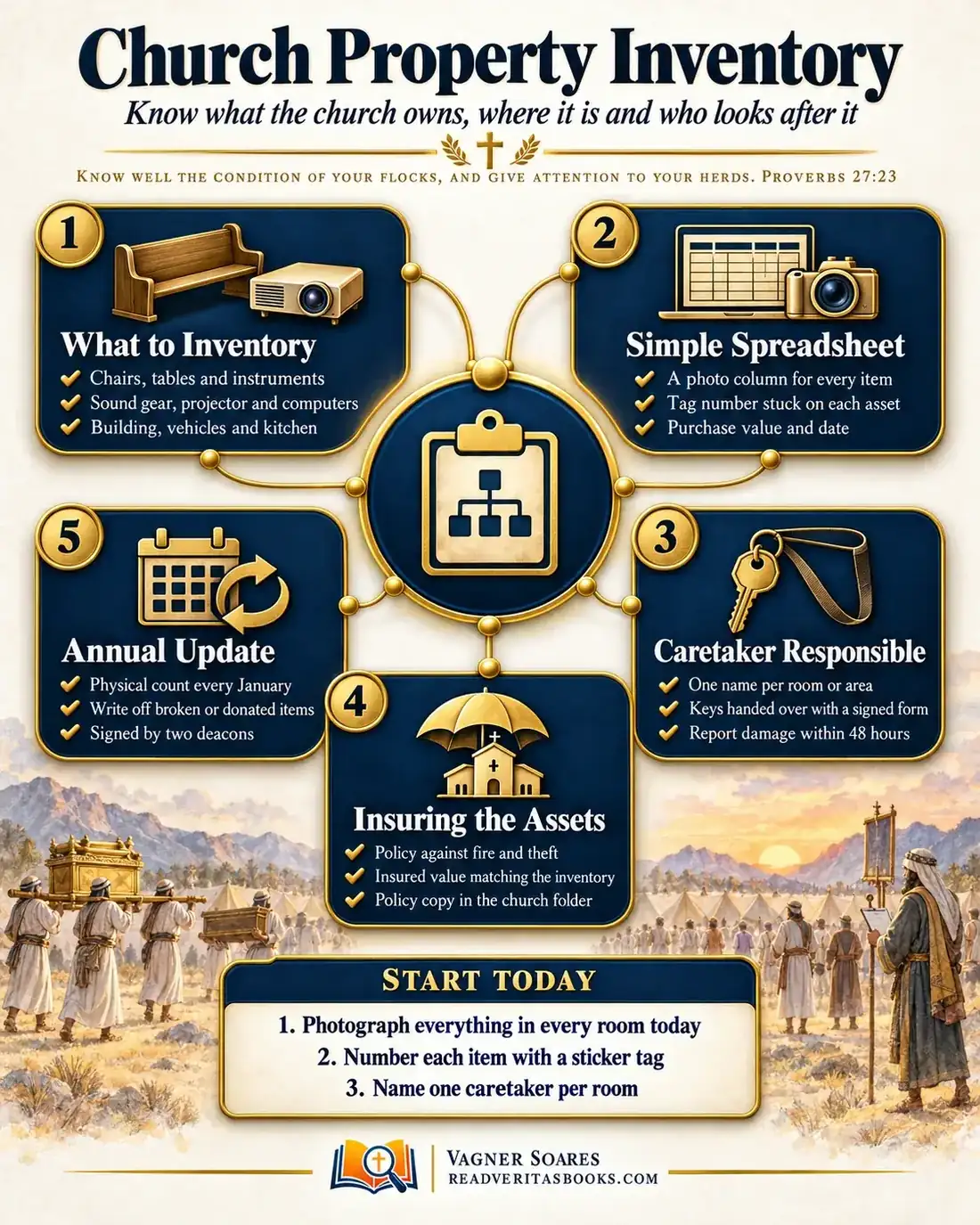
Free mind map
This whole guide on one page
The five steps in this article as an infographic you can print, pin on the notice board or send to your team.
Someone asks where the second wireless microphone went, and nobody can say whether it broke, was lent out or never existed. The new projector sits in a cabinet in a room three ministries share, and the key belongs to someone who stopped attending last year. This rarely comes from bad intentions. It comes from not having a simple record of what the church owns.
A church property inventory fixes that with little money and some method. Below you will find a rule for deciding what goes on the list, a church inventory spreadsheet you can copy, how to divide the care of rooms according to the size of your church, what to ask before buying church property insurance and how to run the yearly count without turning it into an interrogation.
Know well the condition of your flocks, and give attention to your herds.
Proverbs 27:23
What to inventory: the rule before the list
Listing "everything" usually stalls by the third room, and listing only the expensive items misses what goes missing most. So set the rule first. Walk the building room by room, including storage, kitchen, office and the children's area, and ask the same question in front of every object: if this disappeared tomorrow, would we miss it or have to buy it again?
Then decide like this:
- If the item lasts more than a year and would cost money to replace, it goes on the list.
- If it is a consumable (paper cups, paper, cleaning supplies), it stays off.
- If it is cheap but small and easy to lose (a microphone, the projector remote, special cables, an external drive), it goes on anyway.
- If you have many identical items, such as chairs and tables, use one row per group and per room, with quantity and condition.
- If it is electronic, use one row per unit, with brand, model and serial number, since these are the items most often stolen and the most costly to replace.
- If it belongs to someone else and is on loan to the church, record it too and note the owner. When the time comes to return it, nobody will be in doubt.
The building and vehicles are handled differently: note where the documents are kept and who has access to them.
Advertisement
Ezra, the Levites and the counting of the temple vessels
Proverbs 27:23 speaks to someone who keeps sheep: know the condition of your flock, because, as the next verse says, "riches are not for ever" (Proverbs 27:24). The attitude it teaches: whoever looks after goods needs to look at them closely and regularly, not rely on memory.
There is an example even closer to an inventory. When Ezra returned from Babylon to Jerusalem, he carried the silver, the gold and the vessels offered for the house of God. He set apart twelve of the chief priests and weighed out to them everything he entrusted to them (Ezra 8:24-25), asking them to guard it until it was weighed again in Jerusalem. On arrival, several people checked it, and the text records: "By number and by weight of every one: and all the weight was written at that time." (Ezra 8:34)
The passage shows a handover with a count, custody by named people, a check by more than one person and a written record made on the spot. It does not say Ezra distrusted the priests. The care protected the goods and the carriers alike. Something similar appears in 1 Chronicles 9:28, where certain Levites had charge of the ministering vessels, "that they should bring them in and out by tale", and in Numbers 4:32, where the items each Levite family carried were assigned "by name".
Paul follows the same line when handling the gift for Jerusalem: he wanted to avoid blame, "providing for honest things, not only in the sight of the Lord, but also in the sight of men" (2 Corinthians 8:20-21). The principle for the church is plain: counting, naming who looks after what and writing it down is not a lack of trust in fellow believers. It is a way to honor those who gave and to protect those who serve.
Simple spreadsheet: a template ready to copy
You do not need expensive software. A shared spreadsheet with one row per item and fixed columns works for most churches. For when to move beyond it, see spreadsheet, app or management system. To begin, use these columns:
- Tag (a running number: 0001, 0002, 0003).
- Description, with brand and model where there is one.
- Serial number, for electronics.
- Quantity.
- Room or location.
- Room caretaker.
- Condition (good, fair, needs repair).
- Status (in use, on loan, in repair, written off).
- Purchase value and date; with no receipt, a value marked "estimated".
- Photo, with the file named after the tag number.
- Notes (the owner of borrowed items; who has items the church lent out).
On the first tab, write three rules of use:
- There is one official version, in a shared church folder in the cloud, with a backup.
- Only two or three people edit, usually the church office and the treasurer; other leaders have view-only access.
- No row is ever deleted. Anything broken, donated or lost is marked "written off", with the date, the reason and who approved it.
The physical tag matters as much as the spreadsheet. Place the number where it is visible but protected from wear: under the seat, on the side of the device, never over buttons.
Caretaker responsible: dividing the care by church size
An item with no caretaker ends up belonging to no one. The caretaker knows what is in a space and notices when something is missing. It does not have to be the ministry leader; it can be a careful volunteer who uses the space often. Their role is to look after the room and guide others, not to keep people out.
Small church (up to about 100 people)
With a main hall, a children's room, a kitchen and a storeroom, one or two people can answer for the whole building, as long as their names are in the spreadsheet. The weak spot is keys. Make a list of who holds each key, with the date and the signature of the person receiving it.
Medium church
With several ministries sharing spaces, the ideal is one name per room, written in the spreadsheet and, if possible, on a small sign by the door. Before taking on the role, the caretaker walks the room with the spreadsheet and confirms what is actually there. Agree on a single channel, such as a message to the church office, for reporting breakage and losses within two days. When the real problem is competing use of the rooms, a shared calendar for church spaces helps as much as the inventory.
Large church
Here a small property team makes sense, with a coordinator who looks after the spreadsheet and the caretakers of each area. Equipment that moves between events needs a simple check-out and return log: date, item, who took it and who received it back.
Advertisement
Insuring the assets: what to ask and what to watch
Your inventory and your insurance go together. Without a reliable list, it is hard to know how much coverage you need and even harder to prove what was lost.
Some choices involve trade-offs. Insuring at replacement cost usually costs more than insuring at the current value of used items, but it lets you buy an equivalent piece of equipment. A high deductible lowers the premium, yet it can leave smaller items effectively uncovered. And insuring below real value saves money now and sends the bill on the day of the claim.
Take the updated inventory to an insurance agent you trust and ask:
- Does the policy cover fire, theft and electrical damage?
- Is electronic equipment included, or does it need specific coverage?
- Are items taken off site, for retreats and events, still covered?
- What documents will be needed to prove a loss?
- How is the insured value updated after major purchases?
Get the quote in writing, compare at least two options and keep printed and digital copies of the policy with the agent's contact details. For accounting or contract questions, always confirm with a local accountant or attorney.
Annual update: the physical count step by step
An inventory that is never reviewed goes stale quickly. Over the year, items are bought, lent, donated or broken, and the spreadsheet stops matching reality. The count needs a fixed date and a method:
- Put the date on the church calendar a month ahead, ideally in a quiet season such as January.
- Form pairs, preferably with people who do not look after the room they will check.
- Each pair checks tag by tag, notes the condition and lists any items without a tag.
- Anything not found goes on a follow-up list with a deadline to clear it up, without hunting for someone to blame.
- Items that are truly broken, donated or lost are written off, with the date, the reason and who approved it.
- A one-page report sums up the result: items checked, new items, write-offs and open questions.
- Two designated people sign the report (two deacons, if your church has that office), which goes to the leadership and is filed with the previous ones.
That report is one of the foundations of an internal audit without suspicion and should be kept with the minutes and other official church records.
An example: the 160-member church and the missing microphone
Consider a church of 160 members that, while preparing for a conference, discovers it has only one working wireless microphone, although everyone remembers two. At the leadership meeting, instead of looking for someone to blame, the pastor proposes taking an inventory.
The church secretary sets up the spreadsheet with the eleven columns and the three rules on the first tab. Over two Saturdays, she and the treasurer walk the building: first the sound booth, then the main hall, the children's room, the kitchen and the storeroom. They photograph each item, apply tags from 0001 onward and enter everything on the spot, straight into the official spreadsheet.
In the storeroom they find the second microphone in a box, with the cable of its base snapped. It gets tag 0052, condition "needs repair". They also find a keyboard a member lent the church years ago; the owner's name goes in the notes. Three items from an old list cannot be found and go on the follow-up list.
The leadership names three caretakers: one for the sound booth, one for the children's room and one for the hall, kitchen and storeroom together. The keys are collected and handed out again with a signed list. The treasurer takes the spreadsheet to the insurance agent and finds that the insured value was well below what the equipment is worth today; the policy is adjusted.
The following January, two pairs do the count in one morning. The report shows six new items, two write-offs and one open question, is signed by two deacons and is filed with the meeting minutes.
First steps for this week
- Decide with your leadership who will edit the spreadsheet.
- Create the spreadsheet with the template columns and the three rules.
- Photograph and tag the room with the most expensive equipment, even if the rest waits.
- Make a list of who holds each key to the building.
Signs your inventory is working
Your inventory is alive when someone checks the spreadsheet before buying something, to see whether the church already has it. When a ministry asks to borrow the projector and everyone knows where it is. And when the yearly count ends with few open questions, because changes were recorded throughout the year.
Frequently asked questions
Does a small church really need a property inventory?
Yes, and it is usually easier to do. With fewer items, one afternoon and a basic spreadsheet are enough to create a reliable record.
What should I do with church assets that have no receipt?
Record them with a photo and an estimated value, making clear in the spreadsheet that it is an estimate. For the accounting side, check with your church's accountant on how those items should be listed.
Who should be able to edit the church inventory spreadsheet?
It is best to limit editing to two or three people, such as the church office and the treasurer. Other leaders can view it, which keeps things transparent without scrambling the data.
Does church property insurance require an inventory?
Each insurer has its own requirements, so ask your agent before you sign. Even when it is not required, an inventory with photos and receipts helps you set the insured value and prove a loss.
Good church equipment tracking gives your whole leadership team peace of mind and reassures those who give. To go further, see how to put together a church administrative manual and how to run an internal audit without suspicion, which uses the inventory as one of its foundations.

Vagner Soares is a presbyter with pastoral ordination, a mentor and a digital entrepreneur with more than 10 years of experience in technology, digital marketing and education.
Keep reading
 Church administrationManaging multiple church locations: what changes when your church has two homesLearn when to open a new church location and how to split leadership, keep one identity, coordinate communication and consolidate your finances.Read the article
 Church administrationHow to Run an Internal Church Audit Without Creating SuspicionLearn how to run an internal church audit without creating suspicion: what to review first, who leads it, what tone to use and how often to do it.Read the article
 Church administration · Reference guideThe Complete Church Administration Guide, From Bylaws to Annual ReviewOrganize your church administration in five areas: roles, processes, communication and data, crises and review, with practical steps to start today.Read the article