
Why no one reads your church's social media posts (and how to fix it)
Learn the mistakes that make your church's posts invisible and how to fix them with a strong hook, plain language and one clear call to action.

In this article
- An unread announcement has a real cost
- What Scripture says about speaking to be understood
- Common mistakes that make your post invisible
- Opening hook: templates for the first line
- Plain language in five editing steps
- Call to action: what to ask for in each case
- Test and adjust for the size of your church
- Example: the couples' retreat that almost stayed empty
- First steps for this week
- Signs your posts are being read
- Frequently asked questions
Free mind map
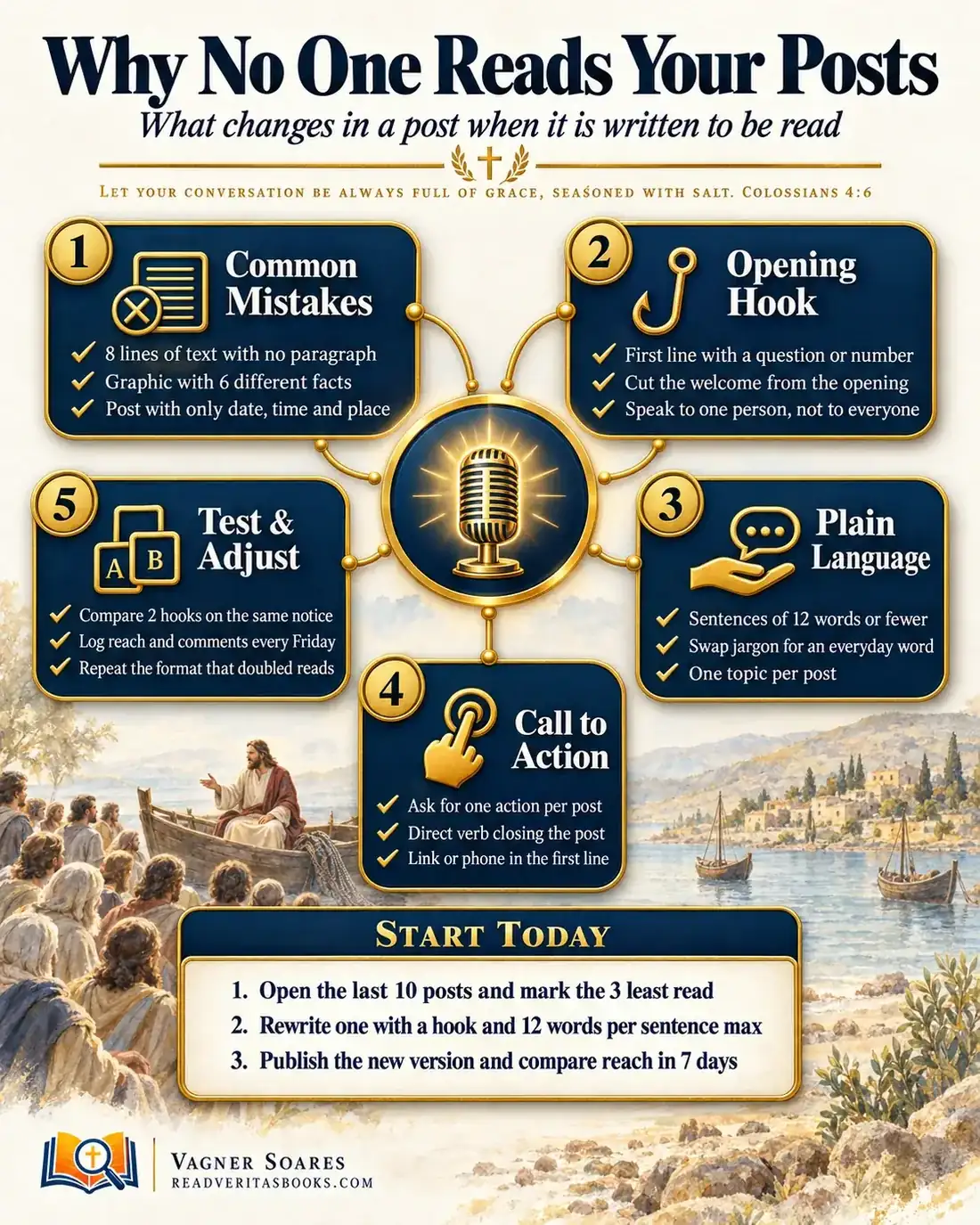
This whole guide on one page
The five steps in this article as an infographic you can print, pin on the notice board or send to your team.
You put care into the announcement, pick the graphic, post it at a good time, and on Sunday half the church says they never heard about the event. The post was there, but nobody read it. It is tempting to blame the algorithm or people's busy lives.
Most of the time, though, the post was written for people who already know the details, not for someone scrolling in a hurry. That can be fixed without an agency and without paid tools. This guide walks you through the mistakes that hide your announcement, how to write the first line, how to simplify the text, how to ask for one clear action and how to test what works with your church.
Let your conversation be always full of grace, seasoned with salt
Colossians 4:6
An unread announcement has a real cost
When a post goes unread, the loss is not a few likes. A new family never finds out there is a children's program. The Saturday work day gets half the volunteers it needed. The pastor repeats the announcement three times from the pulpit and someone still shows up at the wrong time. Church communication online is now part of pastoral care, whether the leadership likes it or not.
There is a hidden cost too: whoever writes the posts gets discouraged, and the church's social media goes quiet. Learning how to write church posts that people actually read protects the member, the visitor and the volunteer who looks after communication.
Advertisement
What Scripture says about speaking to be understood
In 1 Corinthians 14, Paul deals with a concrete problem in the church at Corinth: in their gatherings, some spoke in tongues without interpretation, and the rest of the congregation understood nothing. The apostle does not despise the gift, but he places a standard above it: the building up of those who listen. He uses a military picture: "For if the trumpet give an uncertain sound, who shall prepare himself to the battle?" (1 Corinthians 14:8). And he concludes that he would rather "speak five words with my understanding, that by my voice I might teach others also" (1 Corinthians 14:19).
The passage is not about social media, and it does not say every message must be short. What it does say is that when the church gathers, the message has to be intelligible in order to serve. The principle for church administration is this: an announcement only does its job when the person receiving it understands what to do. "Let all things be done unto edifying" (1 Corinthians 14:26).
In Nehemiah 8, the people who have returned from exile gather to hear the Law. The Levites do more than read: "they read in the book in the law of God distinctly, and gave the sense, and caused them to understand the reading" (Nehemiah 8:8). The result was great joy, "because they had understood the words that were declared unto them" (Nehemiah 8:12). The passage describes the public reading of Scripture, not event promotion, but it shows that helping others understand is part of serving, not a technical detail.
The verse at the top points the same way: it comes right after "Walk in wisdom toward them that are without" (Colossians 4:5). Paul has conversations in mind, not posts, but every word from the church that reaches the neighbor should be shaped for the one who hears it.
Common mistakes that make your post invisible
Almost always one of these three flaws shows up, and often all three at once.
The wall of text
Eight or ten lines in a row, with no paragraph breaks, feel tiring before they start. On a phone they become a gray wall. Break the text into chunks of two or three lines with a blank line between them.
The graphic that tries to say everything
Title, theme, speaker, date, time, address, cost, contact and a verse, all on one image. The result is a graphic nobody can read in a second. Keep only the essentials on the image, such as the name of the gathering and the date, and put the details in the caption. If your church already has a visual style, it helps a lot here; see how to build a simple visual identity for your church.
The announcement that informs but does not invite
"Prayer meeting, Wednesday, 7:30 pm." It is correct and moves no one. It is missing who the gathering is for and what someone gains by coming. One sentence is enough: "If this week has been heavy, Wednesday is a time just to pray together."
A quick test catches most of these mistakes. Look at the post through the eyes of a visitor who has never been inside your church and ask: in five seconds, can I tell what this is, who it is for and what to do? If any answer is no, fix it before it goes live.
Opening hook: templates for the first line
The first line shows up alone before the "more" link. If it says "Blessings, church family!", the reader has no reason to keep going. The greeting can come later; the opening needs to name something the reader lives with or spark curiosity. Write to one specific person, like the mom coming home tired from work, not to "everyone."
Use these templates as a starting point and adapt them to your event.
- A question that touches a need. Instead of "We invite everyone to Family Sunday," write "Do you know where your kids are during the service?"
- A concrete number. Instead of "We need volunteers for rehearsal," write "3 spots left for Saturday's rehearsal."
- An everyday situation. Instead of "Couples group resumes activities," write "Marriage running on empty? Friday is a night just for the two of you."
- A change that affects the reader. Instead of "Important notice," write "Starting this week, Sunday service begins 30 minutes earlier."
A hook is not clickbait. If the first line promises something the post does not deliver, the church loses credibility.
Advertisement
Plain language in five editing steps
Plain language is not dumbed-down language. It means choosing words anyone understands and saying one thing at a time. Ministry acronyms, event names only members recognize and formal phrasing make visitors feel the post is not meant for them. After writing, run the text through this edit:
- Read it out loud. Wherever you stumble or need a breath mid-sentence, cut.
- Split long sentences. As a rule of thumb, aim for 12 words or fewer; longer sentences usually hide two ideas.
- Swap jargon for what actually happens. Instead of "MMF breakout in the fellowship hall," write "Bible study for married couples, Sunday at 9 am."
- Keep one topic per post. If there are three events this week, write three posts or one summary with links, never one post that mixes everything.
- Ask an outsider to read it. A neighbor, a relative or a brand-new member will do. If they need to ask anything, the answer belongs in the text.
Call to action: what to ask for in each case
A post without a call to action ends in a void: people read it, nod and keep scrolling. But asking for everything at once does not work either. When there are too many options, nobody picks one. Use these rules to decide:
- If the event has limited spots, ask people to sign up and put the link or phone number right after the hook, before the "more" cutoff.
- If you need a headcount, ask for a simple reply, such as "Reply YES in the comments" or "Send the church office a message on WhatsApp."
- If the goal is to reach people outside the church, ask for a share: "Tag someone who needs to hear this."
- If it is a change of time or place, ask for nothing but attention; repeat the key fact in the last line.
- If the post would need two actions, split it into two posts on different days.
Either way, end with a short, direct verb: "Sign up today," "RSVP by Thursday," "Bring a friend."
Test and adjust for the size of your church
No one gets it right every time, and what works in one church may not work in another. The goal is not to go viral but to learn how your church reads. Most platforms already show reach, comments and saves for each post; all you need to do is write them down and compare.
Small church (up to about 100 people)
Usually one person handles everything. Use a notebook or a simple spreadsheet with four columns: date, hook, reach and what happened at the event. Every Friday, set aside ten minutes to record the week. At this size, the best measure is often not on the screen at all: ask on Sunday who heard about the event through social media.
Mid-sized church
There is already a small team. Agree on a writing style and test one element at a time: post the same invitation on different days, changing only the first line, and see which one travels further. A simple editorial calendar keeps three ministries from posting on the same day.
Large church
Many ministries want space. Decide who approves the copy, keep a shared spreadsheet of results and hold a monthly review of the formats that stood out.
At any size, watch for the traps. Changing everything at once makes it impossible to know what made the difference. Measuring only likes is misleading: messages, sign-ups and attendance say more about social media engagement for churches. And giving up after one week leaves no time for a pattern to show; keep your changes going for several weeks before drawing conclusions.
Example: the couples' retreat that almost stayed empty
Imagine a church of 185 members planning a couples' retreat with 20 spots. Three weeks out, only four couples have signed up. The volunteer who runs the church's social media has posted a crowded graphic twice, with the caption "Couples Retreat 2026. Info at the church office. Blessings!"
The pastor and the volunteer sit down for half an hour. First they look at the last ten posts and note that the three least seen all open with a greeting and have no link. Then they rewrite the invitation. The graphic keeps only "Couples retreat" and the date. The first line becomes "When was the last time the two of you talked without rushing?" Two short sentences follow about what happens at the retreat, then the sign-up link and the cost. The post ends with "Save your spot by Friday."
On Tuesday they publish that version. On Thursday they post the same invitation with a different first line: "20 spots for couples, and they are going fast." The volunteer logs reach, comments and sign-ups for each day in the spreadsheet. The question drew more comments; the number brought more sign-ups. The following week she uses the same structure and sends the short version to the couples' WhatsApp group. The retreat closes with 17 couples registered, and she saves the template for future events.
First steps for this week
- Open your church's last ten posts and mark the three with the lowest reach. Note what they have in common.
- Rewrite one of them with a hook, short sentences and a single call to action.
- Publish the new version and record reach, comments and replies over seven days.
Signs your posts are being read
You do not need big numbers to know something has changed:
- People comment or message with questions about the event, not about the time that was already in the post.
- On Sunday, fewer people say "I didn't know."
- Members share invitations without anyone asking them to.
- Sign-ups arrive in the days right after a post goes up, not only at the last minute.
- Whoever writes the posts feels the work is bearing fruit and wants to keep going.
Frequently asked questions
Why do our church social media posts get so little reach?
Usually it is a mix of a weak opening, long text and no clear request. Platforms tend to show less of what people ignore, so a post nobody reads reaches fewer people each time. Better writing is the part that is in your hands.
Do we need to post every day?
No. Consistency matters more than volume. A few well-written posts on predictable days work better than many rushed ones.
Who should write the church's posts?
Ideally one person or a small team with an agreed style. Ministry leaders send the information, and the writer adapts it for social media.
Do these tips work for WhatsApp and email too?
Yes. A hook in the first line, short sentences, one topic per message and a clear action work on any channel.
A post written to be read respects the reader's time and draws people closer to your church. To keep going, learn how to use short videos to reach new people, how to handle negative comments on social media and how to run your church WhatsApp without the chaos.

Vagner Soares is a presbyter with pastoral ordination, a mentor and a digital entrepreneur with more than 10 years of experience in technology, digital marketing and education.
Keep reading
 Marketing and communicationChurch WhatsApp without the chaos: how to organize groups and announcementsOrganize your church WhatsApp with groups by purpose, usage rules, messaging hours and pinned announcements so important notices never get buried.Read the article
 Marketing and communicationPartnering with local Christian influencers: is it worth it for the church?Partnering with local Christian influencers: what to evaluate first, shared values, written expectations, risks to consider and how to measure the results.Read the article
 Marketing and communication · Reference guideComplete guide to marketing and communication for churches: from identity to distributionA complete guide to church communication: identity and voice, a content calendar, digital channels, handling image crises and the metrics that matter.Read the article