
Artificial intelligence in everyday church life: practical uses and ethical limits
How to use artificial intelligence in church wisely: simple uses, what not to delegate, human review every time, data privacy and training for your team.

In this article
- What changes when a tool writes for the church
- Delegating without giving up what matters: what the Bible teaches
- Simple practical uses for every size of church
- What not to delegate: a rule for deciding
- Always a human review: the steps before publishing
- Data privacy: a model policy you can copy
- Teaching the team to use it, without fear and without excess
- An example: the church that got the bulletin verse wrong
- Signs your church's use of AI is healthy
- Frequently asked questions
Free mind map
This whole guide on one page
The five steps in this article as an infographic you can print, pin on the notice board or send to your team.
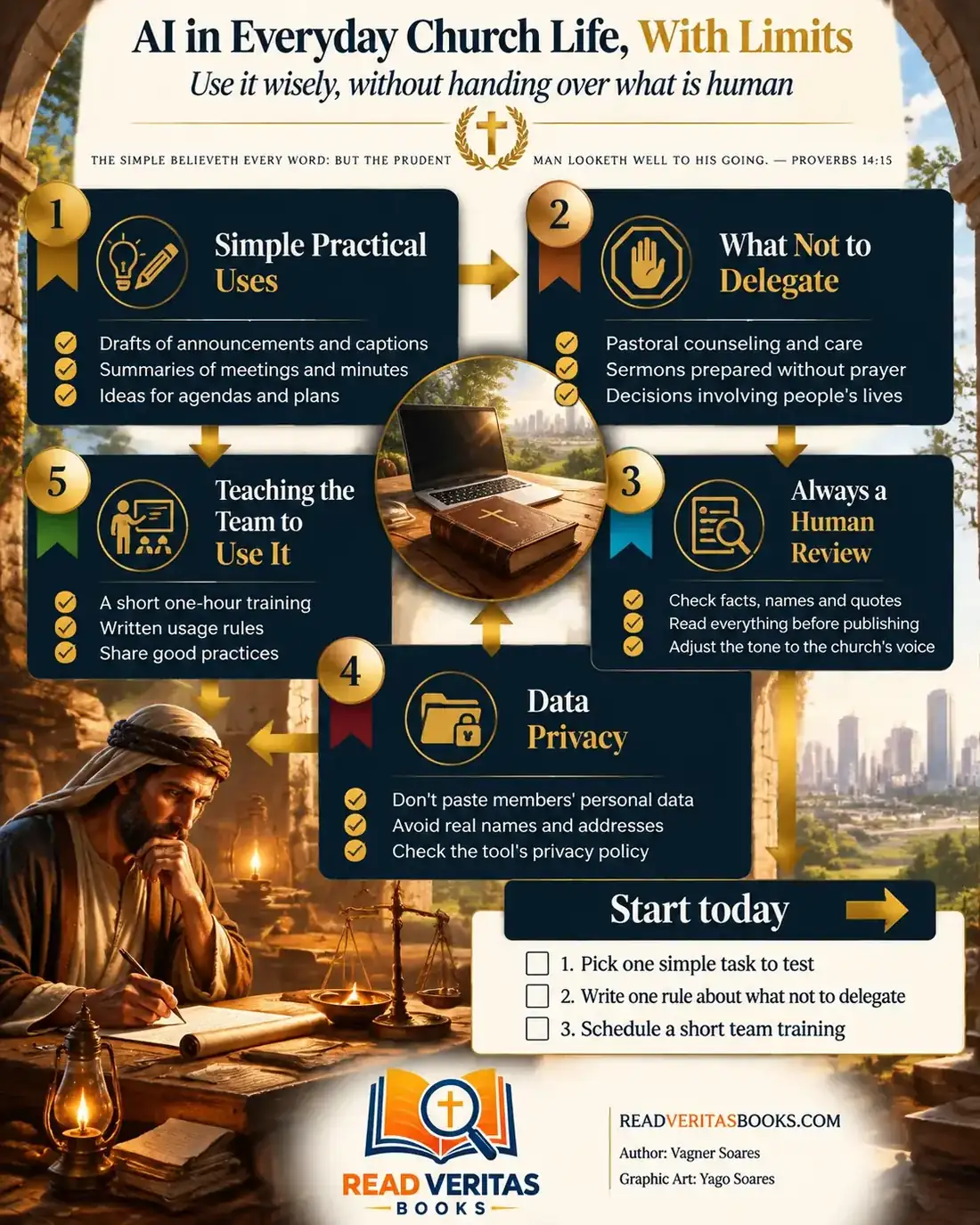
Many church teams already use artificial intelligence without having agreed on anything about it. The secretary asks for help writing the week's announcement, the youth leader generates ideas for a gathering, someone summarizes the meeting minutes in a few minutes. The trouble starts when each person uses the tool their own way, without knowing what is allowed, what is not and who checks the result.
This article is a roadmap for church leaders to decide, calmly and in writing, where AI for churches really helps, what the church does not hand over to a machine, how to review before publishing, how to protect people's data and how to train the team.
The simple believeth every word: but the prudent man looketh well to his going.
Proverbs 14:15
What changes when a tool writes for the church
An AI chat tool does not "know" things the way a person does. It produces the most likely text for the request it received. That is why it writes with the same confidence when it is right and when it invents a name, a date or a Bible reference. The text reads well, and that is exactly what makes it misleading.
In a church, the risk carries extra weight. Whatever is published goes out under the church's name. A wrong time means someone misses the service, an invented verse damages the credibility of whoever teaches, and a prayer list pasted in with names and illnesses takes confidential information out of the church's control.
Banning everything has a cost too: tired volunteers lose hours on repetitive tasks. The sensible path is the one in the proverb that opens this article: do not believe every word, not even the machine's, and agree on the ethical limits of AI before the first problem, not after.
Advertisement
Delegating without giving up what matters: what the Bible teaches
The Bible does not talk about artificial intelligence, and it would be dishonest to make it say so. It does talk about delegating tasks, examining what reaches us and being accountable for what is done in the community's name.
Acts 6: freeing time for what cannot be delegated
In Acts 6:1-4, the church in Jerusalem is growing and a complaint arises: the Greek-speaking widows were being overlooked in the daily distribution. The apostles ask the church to choose seven men "of honest report, full of the Holy Ghost and wisdom" for that service, and they explain why: "But we will give ourselves continually to prayer, and to the ministry of the word."
The passage is about people chosen with care, not machines, and it does not say serving tables was less important. It shows an order of priorities: support work can be shared out so that the essential is not abandoned. The principle for church administration is to accept help with support tasks and to guard prayer, teaching and the care of people with real zeal.
1 Thessalonians 5:21: test before you keep
Paul tells the Thessalonians not to despise prophecies but to weigh them: "Prove all things; hold fast that which is good." The context is discerning words spoken in the congregation, not reviewing administrative texts. Even so, the attitude applies to any content that claims to speak to the church: nothing is accepted just because it arrived finished and sounds good.
2 Corinthians 8:20-21: accountable before God and people
While organizing the collection for the poor believers in Judea, Paul takes care that no one can accuse him of mishandling the funds: "Providing for honest things, not only in the sight of the Lord, but also in the sight of men." The subject there is money, but the principle is accountability. The church answers for what it publishes, and "the tool wrote it" will never be an acceptable answer.
Simple practical uses for every size of church
Low-risk uses help start a piece of work that a person will finish. What changes from church to church is the volume and who takes the task on.
Small church (up to about 100 people)
The pastor and two or three volunteers often do everything. AI can save time on the draft of the weekly announcement, the first version of a welcome message, ideas for a family event or turning scattered notes into readable minutes. One rule is enough: a trusted person reads everything before it goes out.
Medium-sized church
With several ministries, the gain is in consistency. The communications team can adapt the same announcement for the bulletin, the group chat and social media, or ask for an agenda structure for leaders' meetings. Keep the requests that worked well in a shared folder so nobody starts from scratch.
Large church
With administrative staff, the challenge is coherence. Decide which departments may use AI, with which accounts (preferably organizational ones) and who approves what goes public.
Whatever the size, the tool suggests and the person decides.
What not to delegate: a rule for deciding
Use decision questions instead of an endless list of prohibitions. If the answer to any of the first four is yes, the task does not go to the tool as it stands.
- If the task requires presence, listening or praying with someone, it is not delegated. Counseling, visits and replies to people who are grieving or in crisis need a person.
- If the task decides something about someone's life, it is not delegated. Discipline, hiring, dismissal, financial help and choosing leaders call for human judgment.
- If the task speaks to the church on God's behalf, the tool can at most help organize or review. The sermon grows out of prayer, study of the text and knowing the congregation.
- If the task involves personal or confidential data, it goes to the tool only after it has been anonymized.
- If none of this applies, AI can support the task, as long as a human reviews it.
The rule fits in one sentence worth writing into the church's handbook: "We use artificial intelligence to support tasks, never to replace presence, decisions about people or the responsibility of those who teach."
This follows the logic of Acts 6 and also of Jethro's advice to Moses in Exodus 18:22: small matters are shared out, and the great ones stay with the person accountable for them.
Advertisement
Always a human review: the steps before publishing
Everything the tool produces passes through a person before it reaches anyone, because AI errors tend to sit right where the text sounds most certain.
- Read the whole text, from beginning to end. Sentences you would not say out loud do not go out under the church's name.
- Check dates, times, addresses, names and amounts against the calendar or the original source, never from memory.
- Open the Bible at every reference quoted. Make sure the verse exists, says what the text claims and that its context allows that application.
- Adjust the tone to the church's voice, replacing generic phrases with the words your team actually uses.
- Ask whether anyone could feel exposed or hurt. If so, rewrite it or talk to the pastor.
- Record who reviewed it, with a "reviewed by" line in the publishing log.
Data privacy: a model policy you can copy
Many tools store what is typed and may use that content in ways the church does not control. Treat any outside tool as a public place. Proverbs 11:13 contrasts the talebearer with the person who keeps a confidence: "he that is of a faithful spirit concealeth the matter." Prayer requests are a trust, not raw material.
This paragraph can be adapted and added to the church's usage rules:
"No volunteer or staff member may enter into artificial intelligence tools the full names, phone numbers, addresses, documents, health information, family situations, identifiable prayer requests or financial information of members and visitors. When you need help with a text that involves people, use fictitious names or general descriptions and add the real details afterward, outside the tool. Use only the accounts approved by the leadership and, when in doubt, ask the person in charge first."
An anonymized request shows the difference. Instead of pasting the list of people who are ill, ask: "Write a short, warm message inviting the church to pray for members who are receiving medical treatment, without naming any illnesses."
Before adopting a tool, someone in leadership should read its privacy policy and check whether there is an option to keep your content out of training. Data protection rules vary from country to country, so confirm with a local lawyer or accountant and see also how to keep members' data responsibly.
Teaching the team to use it, without fear and without excess
A rule only the pastor knows protects no one. A one-hour session works better, with the people who actually use the tools: the office, communications, the treasurer and ministry leaders.
Start by explaining why: what AI does well, where it goes wrong and what the church has decided not to delegate. In the main part, each participant takes a real text from that week, writes an anonymized request and reviews the result with the six steps. At the end, hand out the one-page rules and say who decides when in doubt.
When using AI in ministry, watch the tensions. A rule that is too rigid pushes people to use the tool in secret; one that is too loose lets everyone invent their own standard. Review the rules once a year or whenever a problem comes up.
An example: the church that got the bulletin verse wrong
Imagine a church of 160 members whose volunteer secretary starts using an AI chat tool to write the weekly bulletin. Within a few weeks, a short devotional goes out with a Bible reference that does not exist, and a member points it out to the pastor. That same week, she pastes the prayer list, with names and diagnoses, into the tool to "tidy it up".
The pastor does not blame the secretary, who acted in good faith. He takes the matter to the church board, which records three decisions in the minutes: the list of permitted uses (announcement drafts, event ideas, organizing notes); the sentence on what is not delegated and the privacy rule, copied into the handbook; and a review of every bulletin by the communications coordinator, who follows the six steps and writes "reviewed by" in the shared folder.
The following month, the pastor leads the one-hour session with the secretary, the coordinator, the treasurer and two ministry leaders. The secretary now drafts the general invitation to prayer with the tool and adds the names by hand, only in the internal version. Three months later, the board reviews the rules and adds one item: devotionals are written by people, and the tool only helps polish the wording.
Signs your church's use of AI is healthy
- The team can say, without asking anyone, what may and may not go into the tool.
- No public text goes out without someone checking dates and references.
- Prayer requests and members' data stay only in the places the church has chosen.
- Time saved on drafts goes into visits, conversations and preparation.
Frequently asked questions
Is it wrong to use ChatGPT in church?
The Bible does not forbid writing tools. With clear rules, human review and care for data, ChatGPT or a similar tool can help with support tasks. What must not happen is for it to replace presence, decisions about people or the preparation of those who teach.
Can I use AI to prepare sermons?
That decision belongs to the leadership and to each preacher. The principle of Acts 6 is that prayer and the ministry of the word are guarded as a priority, not outsourced. If the tool helps you organize ideas or review your text, everything it says must be checked against the Bible itself.
What are the main ethical limits of AI in church?
Do not delegate pastoral care or decisions about people, do not publish anything without human review, do not enter personal data into outside tools and be honest about what was produced. These limits should be written on one page the whole team knows.
Do I need to tell the church that we use artificial intelligence?
There is no single rule, but transparency helps prevent mistrust. A good practice is to make sure a named person signs off on everything that is published. For legal questions about data or contracts, consult a local lawyer.
Used within limits, artificial intelligence in church gives time back for what only people can do. To keep going, see the complete guide to technology for churches, how to handle basic digital security, how to build a simple digital hub without coding and how to organize minutes and official records.

Vagner Soares is a presbyter with pastoral ordination, a mentor and a digital entrepreneur with more than 10 years of experience in technology, digital marketing and education.
Keep reading
 Technology and AIHow to choose a church management system (ChMS) without spending more than you need toChoose a church management system without overspending: what the church really uses, comparing plans, true three-year cost, ease of use and data migration.Read the article
 Technology and AI · Reference guideComplete guide to technology for churches: from communication to artificial intelligenceA complete guide to technology for churches: essential tools, management systems, digital security, artificial intelligence and using it wisely.Read the article
 Technology and AIA simple digital hub without coding: service times, groups and giving in one placeBuild a digital hub for your church without coding: pick the right no-code tool, gather service times, groups and giving, and keep it up to date.Read the article